
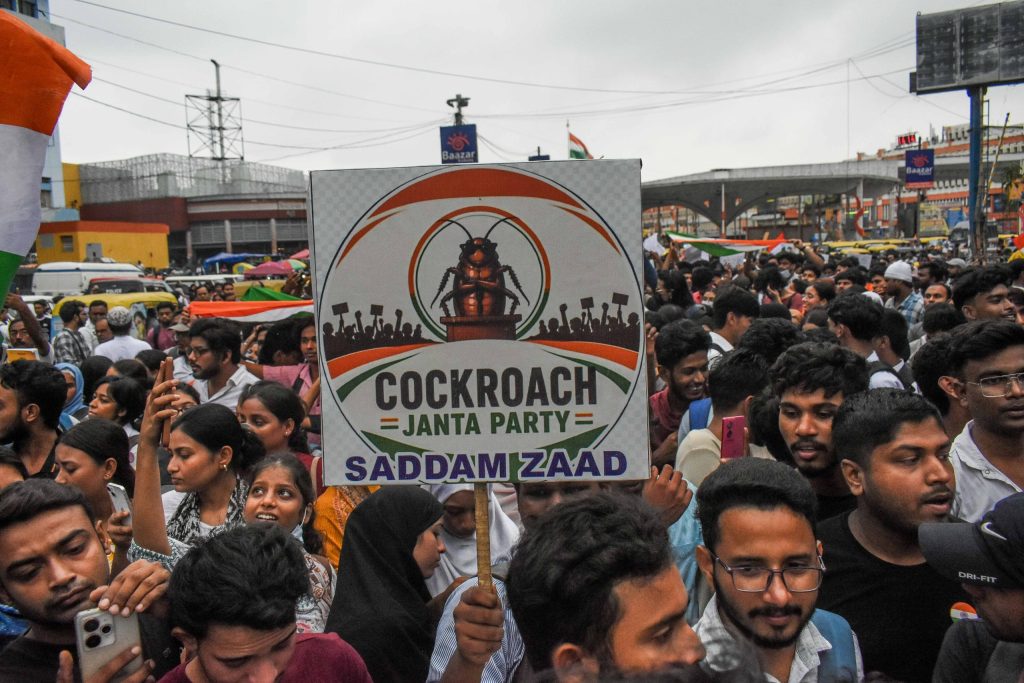
When India’s Chief Justice branded unemployed young people as ‘cockroaches’, Gen Z turned the insult into a rallying call. The corrupt leaking of a national medical college entrance exam gave the resulting Cockroach Janta Party its cause. It called for the education minister’s resignation. Weeks of protest, met with state violence, won that demand, posing what may be the biggest challenge yet to Prime Minister Narendra Modi’s strong-arm rule. Rather than its usual practices of criminalisation, vilification and violence, the government should respect the right to express dissent and engage constructively.
India’s strongman leader, Narendra Modi, has just been forced to do the thing he likes least: making concessions.
It all started on 15 May, when the country’s Chief Justice, Surya Kant, told a courtroom that unemployed young people who protest and speak out on social media are like cockroaches. The remark, revealing the establishment’s contempt for the country’s young people, spectacularly backfired. Within days it had spawned a nationwide movement, the Cockroach Janta Party. Its central protest demand was the resignation of Education Minister Dharmendra Pradhan. On 25 July, Pradhan quit. But that may not be enough to satisfy the demand for change the movement has unleashed.
Birth of a movement
India has more Gen Z people than any other country. Around 407 million Indians, some 30 per cent of the population, are aged between 14 and 29. They face extraordinary competition to access education and struggle to find jobs.
In a volatile atmosphere, Kant’s remark immediately sparked a fire. Although he quickly tried to walk back his words, it was too late. Communications strategist Abhijeet Dipke asked on social media: what if all the cockroaches came together? That question kickstarted a viral movement under a name, the Cockroach Janta Party, that playfully echoes that of the ruling Hindu nationalist party, the Bharatiya Janata Party (BJP). What began as a satirical website, quickly pulled together with the help of AI, became a movement. Within two weeks, it had 22 million Instagram followers.
Supporters of the Cockroach Janta party rally against the Minister of Education in Kolkata, India, 24 July 2026. Photo by Debarchan Chatterjee/NurPhoto via AFP.
The cockroach movement fits into a broader global pattern. Recent years have seen Gen Z mobilise in numbers in many countries where governments are demonstrably out of touch and economies and political systems fail young people. Movements are characterised by collective leadership, mass protests and strategic use of social media to communicate, recruit and organise. India has now joined the wave.
The movement soon found its galvanising cause. India’s education system relies on make-or-break entrance exams, with results deciding the career prospects of millions. In the medical college exam, some 2.2 million students compete for 130,000 places. Families make sacrifices and students spend years preparing. But corruption means questions are often leaked in return for bribes. Two weeks before Kant’s outburst, the national medical college entrance exam paper was leaked and the exam was cancelled. Students despaired. Then they got angry.
Protest prevails
Protesters camped out for weeks in central Delhi, demanding Pradhan’s resignation. Volunteers supplied food, water, medicines and camping equipment. The movement broadened well beyond Gen Z, with people of all ages joining, determined to make the government listen. Sonam Wangchuk, an environmental and education reform activist previously jailed for protesting, further raised the protest’s profile with a weeks-long solidarity hunger strike.
For seven weeks the government tried ignoring the protesters, and when that failed, it turned to violence. After authorities forcibly hospitalised Wangchuk, thousands of protesters marched from the protest site to parliament. Security forces responded with pellet guns and teargas, beat protesters and bystanders with batons and wooden sticks, and detained many. The violence, widely documented on social media, was shocking for a country that prides itself on being the world’s biggest democracy. It was impossible to ignore and sparked protests in other Indian towns and cities. The government was finally forced to hold talks at a neutral venue.
Harshit Singh is a young activist, poet and storyteller who took part in the protests.
It was organised by Gen Z, and most of us in it are, but it’s not only that. I have seen every generation at the protest. People of different castes, gender identities and religions have come together under one umbrella to ask for their rights. At the end of the day, we are all Indians, and every issue this country is going through is our issue.
There is no criterion for joining and no enrolment process. If you think something is wrong, or that your basic rights are not being respected, that is the moment you support the movement, however you can. Come to the protest, talk about it online or in print, and be a voice where you are.
What struck me most is how many people came who didn’t support Abhijeet or disagreed with something a spokesperson had said. Some didn’t even like that we call ourselves cockroaches. They came anyway, because the movement is bigger than any person in it and because after a long time we have a platform where we can speak out loud, with other people standing next to us. That’s why it grew so fast.
What we most need is for people to stop being afraid. Protesting here is almost a taboo, because people expect repercussions and stay away, which makes organising anything difficult.
That fear is not irrational. This government controls the security forces, the Central Bureau of Investigation and the Enforcement Directorate, and it can do whatever it wants with them, as we saw on the streets. The courts will not stop it either, because the judiciary is compromised in the same way the media is.
But if something is wrong, it is fine to ask the government why. They are here to serve us. All we are asking for is to be able to protest peacefully in what is supposed to be the world’s largest democracy.
We need young people in this country to keep showing up and artists to stop being silent, because if the mainstream media will not speak out, art must become the mode of resistance. Support from abroad matters too. When people elsewhere talk about our movement, it creates pressure on the government. And we must hold on to what we know – our rights and our intentions – because diluting the agenda is what the government will try next.
This is an edited extract from our conversation with Harshit. Read the full interview here.
Looking ahead
Pradhan framed his exit as a way of ending the protests and violence rather than an admission of failure. The government promised fast-track courts for exam leakers and a review of the exam and education systems.
In return, the movement called off the protests, having also secured a promise that no protester would face repercussions. But that’s not the way of a government that has long repressed dissent. Modi’s administration has a track record of detaining activists, using force against protests, censoring critical voices and passing restrictive laws. Since the cockroach protests ended, police have detained and harassed hundreds of students and reportedly targeted their families.
Pradhan’s resignation was a remarkable event. The government had never before responded to pressure by sacking an unpopular minister. But the BJP doesn’t appear to have learned much. During a recent by-election campaign, its national president, Nitin Nabin, described protesters as ‘a virus and a cockroach gang devoted to breaking the country’.
Modi may have bought breathing space, but the underlying problems remain. The causes are both economic, with high youth unemployment and evident inequality, and political, with a high-handed government that doesn’t listen to young people or respect their right to dissent. Further protests look likely. One, sparked by similar corruption complaints over a civil service entry exam, has already happened in Jharkhand state.
This isn’t the first time Modi’s government has bent to pressure. In 2021, sustained farmers’ protests won widespread support, forcing it to drop farming law changes. Modi’s support fell in the 2024 general election, forcing him to rely on coalition partners. More recently, his party looked to be on the up again, winning power in West Bengal state for the first time in April following controversial changes to the electoral roll that removed over nine million names, disproportionately Muslim voters and others less likely to support the BJP. But it has just lost the by-election where Nitin Nabin repeated the cockroach slur.
The cockroach movement may present Modi’s biggest challenge to date, because it cuts across class, party and religious divides, which makes it much harder to dismiss. The BJP built its base among Hindus by vilifying Muslims, yet at the Delhi protest, people from both religions prayed side by side. Many young people protested for the first time. The movement’s social media cut-through is also significant. It bypassed a conventional media largely co-opted by the BJP that typically parrots its lines and downplays other viewpoints.
The government should read the room, but there’s every chance it will learn the wrong lesson and go after protest leaders. That will be a recipe for further protests and a repeated cycle of state violence and criminalisation. If India is to live up to its promise as the world’s biggest democracy, it must deepen democratic freedoms, recognise the value of dissent and acknowledge that the young people it branded cockroaches have much to contribute to their country’s future.
-
The government of India must respect the right to protest and release everyone detained for their role in the cockroach movement protests.
-
The government must launch an independent investigation into all instances of security force violence against protesters.
-
The government must consult young people in any economic and education reform processes.
For interviews or more information, please contact research@civicus.org
Cover photo by Debarchan Chatterjee/NurPhoto via AFP
India has recently been added to the CIVICUS Monitor Watchlist, which identifies countries where a severe deterioration in the quality of civic space is taking place.