
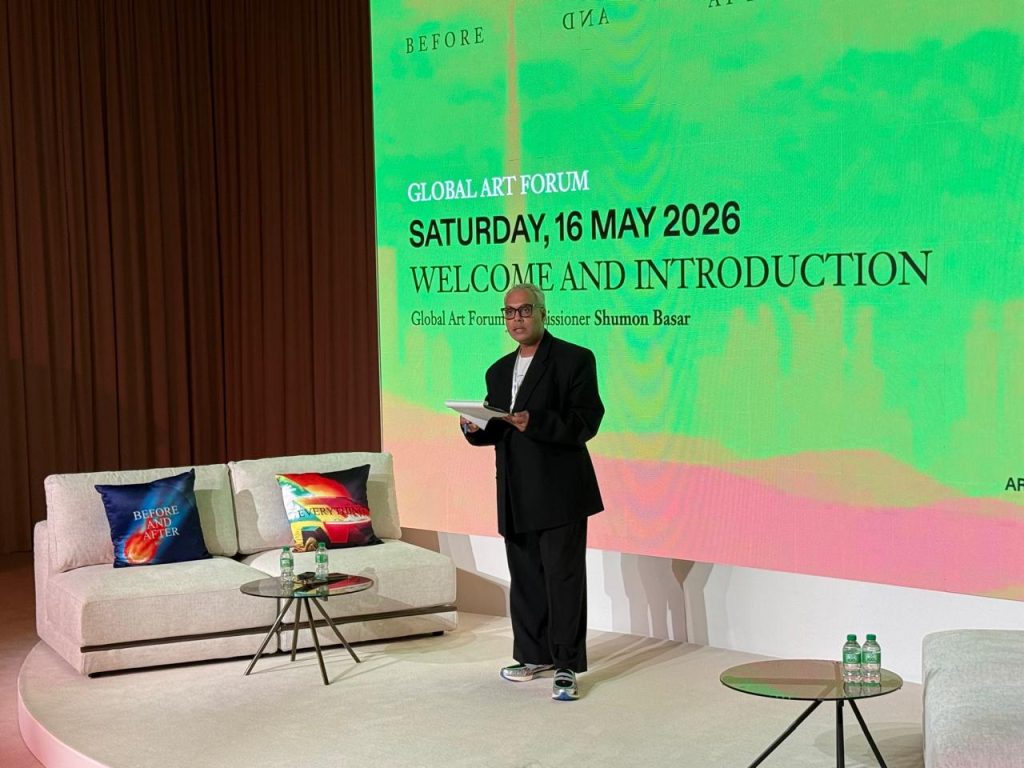
At the 20th Global Art Forum, presented as part of Art Dubai, Shumon Basar joined Antonia Carver, Sunny Rahbar and Sultan Sooud Al Qassemi in a conversation that reflected on two decades of cultural transformation. Their discussion revealed a much larger story: how the UAE built an interconnected ecosystem of institutions, ideas, and people that has reshaped the contemporary global art landscape.
Brendon Bell-Roberts
30 June 2026
Twenty years is a remarkably short time in which to transform a nation’s cultural identity.
Yet that is precisely what the United Arab Emirates has achieved. Today, the country occupies a position few could have imagined at the turn of the millennium. Its biennials shape international curatorial discourse. Its museums attract global audiences. Its art fair ranks among the world’s most influential. Its foundations publish scholarship that is redefining the histories of Arab and Global South art. Its public art programmes are changing how citizens engage with their cities, while a new generation of artists, curators, writers and collectors increasingly sees the UAE not as an emerging cultural destination, but as an established centre of artistic production.

This remarkable transformation formed the backdrop to the opening conversation of the 20th Global Art Forum, presented as part of Art Dubai. Rather than offering another discussion about the future of technology, artificial intelligence or geopolitics, subjects that have frequently defined the Forum over the years, the session looked backwards. Moderated by writer and cultural theorist Shumon Basar, Commissioner of the Global Art Forum, it brought together Antonia Carver, Director of Art Jameel; Sunny Rahbar, co-founder of The Third Line and Bidoun magazine; and Sultan Sooud Al Qassemi, founder of the Sharjah-based Barjeel Art Foundation.
Together they reflected on the people, institutions and moments that quietly transformed the UAE’s cultural landscape long before international headlines proclaimed it an artistic powerhouse.
It was a conversation about memory, but also about infrastructure.
Not roads or skylines, but intellectual infrastructure.
Throughout the discussion, Basar steered the conversation away from anniversary nostalgia. Instead of celebrating Art Dubai’s success, he invited his guests to reflect on the conditions that made it possible. It was an important distinction. Cultural ecosystems do not emerge because a museum opens or an art fair attracts international galleries. They emerge because artists, publishers, curators, collectors, educators and institutions gradually create an environment in which artistic practice can flourish.
The discussion challenged one of the most persistent misconceptions surrounding the Gulf’s cultural rise: the belief that contemporary art arrived alongside spectacular architecture.
Again and again, the speakers reminded the audience that culture came first.
One of the most revealing moments came when the conversation returned to 2003. Although Art Dubai would not be founded until 2007, both Antonia Carver and Sultan Sooud Al Qassemi identified an earlier turning point: Sheikha Hoor Al Qasimi’s appointment to lead the Sharjah Biennial. Under her direction, the Biennial was transformed from a regional exhibition into one of the world’s most intellectually rigorous platforms for contemporary art, championing artists and curatorial practices from across Africa, Asia, Latin America and the Middle East long before the Global South became central to international museum discourse.
That transformation did not end with the Biennial.
Under Hoor Al Qasimi’s leadership, Sharjah Art Foundation evolved into one of the world’s most respected cultural institutions. Exhibitions became only one part of its work. Publishing, artist residencies, film, music, performance, education, conservation and research all became integral to its mission, creating a year-round institution whose influence extends far beyond the Biennial itself. Today, Hoor Al Qasimi stands among the world’s leading curators, having served as Artistic Director of Aichi Triennale 2025 and the 25th Biennale of Sydney (2026), while topping ArtReview‘s Power 100 in 2024.

The significance of Sharjah lies not simply in the exhibitions it presents, but in the model it established. It demonstrated that cultural institutions could generate knowledge rather than merely display objects.
That principle echoed throughout the conversation.
Sultan Sooud Al Qassemi recalled growing up in Sharjah, surrounded by libraries, theatre productions, public performances, and book fairs, reminding the audience that the UAE’s artistic history reaches far beyond the institutions now most familiar to international audiences. Recent archival discoveries revealing exhibitions held in Dubai during the 1960s reinforce this longer history, challenging simplistic narratives that suggest the country’s cultural life began only in the twenty-first century.
History, the discussion suggested, rarely begins where anniversaries choose to start.
Antonia Carver’s reflections offered another perspective on those formative years. Arriving in Dubai in 2001 after working in publishing in London, she encountered a city whose creative energy defied easy categorisation. Writers collaborated with architects. Journalists worked alongside artists. Film, theatre and literature intersected with emerging contemporary art practices in ways that dissolved conventional disciplinary boundaries. Rather than importing existing institutional models, practitioners responded organically to the opportunities around them, creating organisations that reflected the city’s own rapidly evolving identity.
Sunny Rahbar’s recollections added another crucial dimension. As co-founder of both Bidoun magazine and The Third Line, she spoke from the perspective of someone who helped shape Dubai’s independent cultural infrastructure from the ground up. If galleries provided spaces for artists, Bidoun provided a platform for ideas. At a time when narratives about the Middle East were largely being produced elsewhere, the magazine became one of the most influential voices documenting the region’s artists, writers and thinkers on their own terms. Meanwhile, The Third Line demonstrated that a commercial gallery could also function as a cultural institution, nurturing artists through long-term relationships, publications and public programmes rather than simply facilitating sales.

Collectively, these initiatives established something far more significant than the sum of their individual organisations.
They created trust.
They built networks.
They cultivated audiences.
And perhaps most importantly, they demonstrated that culture is never the product of a single institution.
It is the product of an ecosystem.
If Sharjah demonstrated how a biennial could become an intellectual engine, Dubai revealed how an art fair could evolve into something far more ambitious than an annual marketplace.
Art Dubai has undoubtedly become one of the world’s leading commercial fairs, connecting galleries from the Middle East, Africa, South Asia and beyond with international collectors and institutions. Yet to understand its significance solely in terms of sales would be to misunderstand its broader ambition. From its earliest editions, the fair positioned itself as a platform where commerce and culture could coexist, recognising that healthy art markets depend upon robust intellectual, educational and institutional foundations.
The Global Art Forum has been central to that vision. Since its inception, it has resisted becoming a conventional conference attached to an art fair. Instead, it has developed into one of the region’s most respected platforms for interdisciplinary thinking, bringing together artists, architects, economists, scientists, technologists, philosophers and writers to examine the forces shaping contemporary society. Under Shumon Basar’s direction, the Forum has consistently anticipated many of the questions now dominating international cultural discourse, from artificial intelligence and digital economies to climate change, migration and the future of cities.
That commitment to ideas reflects a broader philosophy underpinning Art Dubai itself.
Rather than limiting its activities to a single week each spring, Art Dubai has steadily expanded into a year-round cultural institution. Through Art Dubai Projects, it has commissioned ambitious public artworks, performances and site-specific installations that engage directly with Dubai’s urban environment, encouraging audiences to encounter contemporary art beyond museums and galleries. These projects reflect an understanding that culture becomes meaningful only when it enters everyday public life.
One of the most ambitious manifestations of this philosophy is the Dubai Public Art Strategy. Developed in partnership with Dubai Culture, the initiative seeks to integrate contemporary art into the city’s parks, waterfronts, public squares and neighbourhoods, transforming the urban landscape into an accessible, open-air cultural experience. Rather than treating public sculpture as mere civic decoration, the strategy positions artists as active participants in shaping the city’s identity and experience.

Equally important has been Art Dubai’s sustained investment in education.
Campus Art Dubai has become one of the region’s most influential professional development programmes, nurturing emerging curators, writers and cultural practitioners from across the Middle East, Africa and South Asia. At a time when conversations around capacity building have become increasingly urgent across the Global South, the programme has quietly helped develop a new generation of cultural leaders whose influence extends far beyond the UAE.
Alongside this, the A.R.M. Holding Children’s Programme reflects an equally long-term vision. By introducing thousands of young people across the UAE to contemporary artistic practice through artist-led workshops and sustained creative engagement, the programme invests not simply in future artists but in future audiences, ensuring that cultural participation begins long before adulthood.
These initiatives reinforce an important point made, implicitly and explicitly, throughout the Global Art Forum discussion.
Art ecosystems are not sustained by institutions alone.
They are sustained by people.
Education, mentorship, publishing and public engagement become as essential as exhibitions themselves.
Few people have contributed more to this broader understanding than Antonia Carver. Long before becoming Director of Art Jameel, she played a formative role in shaping Art Dubai during its early years, helping establish initiatives that expanded the fair’s intellectual and educational ambitions. Today, through Art Jameel, she continues to oversee one of the region’s most influential independent arts organisations, whose work spans exhibitions, heritage, publishing, research, commissions and learning programmes across the UAE and Saudi Arabia.
Jameel Arts Centre, which opened on Dubai Creek in 2018, represents another milestone in the UAE’s cultural evolution. More than a contemporary art museum, it functions as a space where exhibitions, libraries, educational programmes, artists’ gardens and research intersect. Like Sharjah Art Foundation, its success lies not simply in presenting art but in creating the conditions through which artistic practice can be studied, debated and shared.

The conversation at the Global Art Forum repeatedly returned to this notion of interconnectedness.
No single institution, however influential, could have achieved what the UAE has accomplished over the past two decades.
Rather, each organisation has developed a distinct role within a much larger ecology.
Art Dubai has become a catalyst for international exchange and public engagement.
Sharjah Art Foundation has established a benchmark for curatorial research and long-term artistic commissioning.
The Third Line demonstrated that commercial galleries can also function as cultural institutions, nurturing artists over decades rather than seasons.
Bidoun helped shape the intellectual discourse surrounding contemporary art from the Middle East and its diasporas, proving that publishing is itself a form of institution building.
Together, these organisations transformed the UAE from a place where contemporary art was presented into one where it is produced, debated, archived and continually reimagined.
The discussion also pointed towards institutions beyond those represented on stage. The Department of Culture and Tourism – Abu Dhabi has, through figures such as Reem Fadda, developed complementary models centred on research, public engagement and international cultural exchange, further strengthening the UAE’s cultural landscape. Rather than competing, Dubai, Sharjah and Abu Dhabi have cultivated distinct yet interconnected identities, each contributing to a national ecosystem whose influence extends far beyond the country’s borders.
By the end of the conversation, one conclusion had become impossible to ignore.
The UAE did not simply build museums.
It built the intellectual, educational and cultural infrastructure that made those museums matter.
That distinction may ultimately be its most significant contribution to contemporary culture.
If Art Dubai demonstrates how a fair can become a year-round cultural institution, the Barjeel Art Foundation illustrates how collecting can become an act of scholarship.

Founded by Sultan Sooud Al Qassemi in Sharjah in 2010, Barjeel has grown into one of the world’s foremost collections of modern and contemporary Arab art. Yet, as Al Qassemi reflected during the Global Art Forum, the Foundation was never conceived simply as a repository for artworks. Its purpose has always been to make Arab art visible, accessible and intellectually legible through exhibitions, publications, research and partnerships with museums and universities around the world. In doing so, Barjeel has helped rewrite the narrative of modern Arab art, challenging its historical marginalisation within dominant art historical canons.
That commitment to scholarship is perhaps one of the defining characteristics of the UAE’s cultural landscape. Throughout the conversation, collecting was repeatedly discussed not as an end in itself, but as a responsibility. Works of art achieve their fullest significance only when they enter public life through exhibitions, catalogues, archives and critical writing. Collections hidden in storage remain private possessions; collections that are researched and shared become part of cultural memory.
For readers across Africa, this observation carries particular resonance.
Many countries possess extraordinary artistic traditions and internationally celebrated artists, yet the infrastructure that sustains those histories often remains fragile. Archives are incomplete, publications are scarce, and important exhibitions disappear with little documentation beyond a handful of photographs. The Global Art Forum therefore offered more than a reflection on the UAE. It presented a compelling case for why cultural ecosystems require long-term investment in knowledge production as much as in artistic production.
The conversation also pointed towards institutions beyond those represented on stage. While Reem Fadda was not a participant in the discussion, her work at the Department of Culture and Tourism – Abu Dhabi exemplifies another essential dimension of the UAE’s cultural ecosystem. Through her curatorial leadership of the Cultural Foundation and Abu Dhabi Culture Summit, Fadda has championed institutions grounded in research, public engagement and international dialogue. Her work, together with Abu Dhabi’s wider investment in museums, heritage and cultural diplomacy, complements the distinct trajectories established by Sharjah and Dubai.
This relationship between the three emirates may ultimately be the UAE’s greatest cultural achievement.
Sharjah established an international benchmark for curatorial research, commissioning and artistic experimentation through the Sharjah Biennial and Sharjah Art Foundation.
Dubai developed an entrepreneurial model in which commercial galleries, independent publishing, public art and an internationally recognised art fair evolved alongside one another. Institutions such as The Third Line, Art Jameel and Art Dubai have each contributed to a city where artistic production, education and cultural exchange reinforce rather than compete with the market.
Abu Dhabi has invested in museums, heritage institutions, education and international partnerships that connect local histories with global audiences, ensuring that culture occupies a central place within national development.

Together, these approaches have produced something rare: a genuinely interconnected cultural ecosystem in which institutions perform complementary rather than competing roles.
Perhaps the most revealing aspect of the Global Art Forum conversation was its insistence that none of this was inevitable.
Again and again, the speakers returned to individuals who recognised absences and chose to respond. Publishers established magazines because critical discourse was lacking. Gallerists created spaces because artists needed representation. Collectors built foundations because histories were being overlooked. Curators established institutions because existing models no longer reflected the realities of the region.
In this sense, the UAE’s cultural landscape has not been built by singular monuments but by collective acts of imagination.
The country’s museums, biennials and art fairs are the visible expressions of decades of less visible work: conversations held around kitchen tables, independent publications produced with limited resources, artists supported before international recognition arrived, archives painstakingly assembled, educational programmes developed for future generations and partnerships sustained across institutions and emirates.
The Global Art Forum itself stands as a powerful symbol of this philosophy. For twenty years, it has demonstrated that ideas are not secondary to exhibitions but fundamental to them. Conversation is not an accessory to culture; it is one of its primary forms of infrastructure.

As cultural centres across Africa, Asia and Latin America continue to expand, the UAE offers an instructive example. Its success has not been built solely on ambitious architecture or significant financial investment, although both have undoubtedly played important roles. Rather, it has emerged through the patient cultivation of relationships between artists, curators, publishers, educators, collectors, governments and independent organisations. The result is a network of institutions that collectively supports artistic production, scholarship, public participation and international exchange.
There remains, of course, much to be done. No cultural ecosystem is ever complete, and the continued vitality of the UAE’s artistic landscape will depend upon its willingness to nurture emerging voices, support independent thinking and remain open to critical reflection. Yet the foundations established over the past two decades suggest a remarkable confidence in culture as a public good rather than simply an economic asset.
Looking back, the opening conversation of the 20th Global Art Forum was never really about anniversaries. It was about recognising that institutions are only one measure of cultural maturity.
The more enduring measure lies in the strength of the conversations they inspire, the knowledge they produce, the communities they sustain and the futures they make possible.
That may be the UAE’s most important achievement.
It did not simply build museums or stage world-class exhibitions.
It built an ecosystem in which ideas, institutions and people continue to shape one another, ensuring that culture is not merely presented to the world, but actively produced within it.
Shumon Basar
Writer, curator and cultural theorist. He is Commissioner of the Global Art Forum, Art Dubai’s flagship platform for interdisciplinary dialogue on art, culture and society.
Antonia Carver
Director of Art Jameel, overseeing the organisation’s arts, heritage, learning and research programmes across the UAE and Saudi Arabia, including Jameel Arts Centre in Dubai and Hayy Jameel in Jeddah.
Sultan Sooud Al Qassemi
Founder of the Barjeel Art Foundation. Emirati collector, writer and researcher dedicated to advancing scholarship and public access to modern and contemporary Arab art.
Reem Fadda
Director of the Cultural Foundation and Abu Dhabi Culture Summit at the Department of Culture and Tourism – Abu Dhabi. An internationally respected curator recognised for her research-led exhibitions and institution building.
Sunny Rahbar
Co-founder of The Third Line and Bidoun magazine, Sunny Rahbar is one of the architects of Dubai’s contemporary art ecosystem, combining gallery practice, publishing and cultural advocacy to champion artists from the Middle East and its diasporas.