
Editor’s note: This story contains references to suicidal thoughts
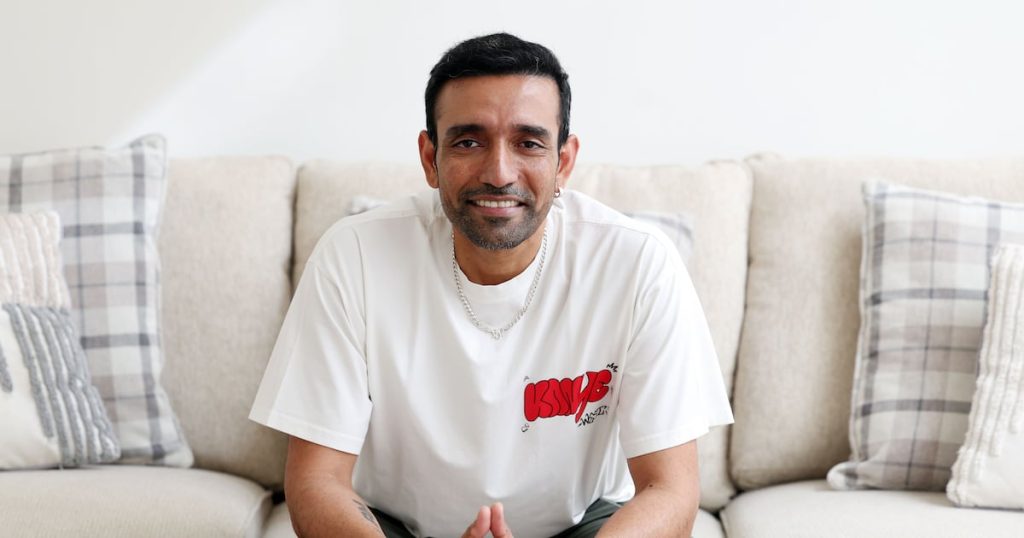
Robin Uthappa draws an interesting parallel between life in the world of cricket, which he has famously been a part of, and today’s corporate world, in which he now coaches.
“Cricket is a complex sport,” he says. “It is an individual sport within a team sport, which is much like corporate life. You exist within the team, you have a role to play and you have to work with other people to achieve what is required for that role. But while you’re doing that, you also have somebody else waiting to take one of your spots if you don’t perform well enough.” He pauses. “There’s an innate sense of insecurity that you operate within and you have one eye looking over your shoulder at all times.”
Earning 59 caps for the Indian national team, Uthappa has a glittering resume. His Indian Premier League career spanned 15 years from 2008 to 2022, during which he amassed 4,952 runs in 205 matches. He has had stints with the Mumbai Indians, Royal Challengers Bengaluru, Pune Warriors India, Kolkata Knight Riders, Rajasthan Royals and Chennai Super Kings.
I meet him in one of the many living spaces in the bright and airy five-bedroom home in Al Barsha, Dubai, that Uthappa shares with his wife, Sheethal Goutham, a former professional tennis player turned hypnotherapist and neurolinguistic programming practitioner, and their two children, Neale, eight, and Trinity, three.
The former cricketer enthusiastically espouses the lessons a lifetime in the sport has taught him; lessons he now shares with professionals via his coaching platform, True. Focusing on high performance, leadership and mental health coaching for men, he calls the platform “close to my heart” saying: “I perceive service as my purpose in life.”
Settling into life in Dubai
Uthappa and his family moved to Dubai from Bengaluru at the start of 2023, spending two years in The Villa, Dubailand before moving to Al Barsha to be closer to the children’s school. He cites the Indian city’s road-choking traffic as “the straw that broke the camel’s back”, when it came to choosing a new place to live.
After years of coming to the UAE both as a player and as a visitor, Uthhapa says Dubai was a no-brainer.
“I didn’t want their core childhood memories to involve being stuck in traffic,” he says. “I came here for the IPL in 2020 and 2021 and we had visited friends here too, meaning we got to experience Dubai and the UAE from more than just a tourist’s point of view. When it came to quality of life for the kids, we were blown away.”
While the Uthappas are still in moving-in mode at the house, some spaces are already set up. The bookshelf, which houses many of the trophies Uthappa has won over the years, doubles as a library for the family, with a biography of Napoleon and the personal development favourite Atomic Habits sitting alongside the bestselling Dog Man children’s book series.
An addition not found in every home, an impressive gold lift that reaches all three floors, takes centre stage.
Goutham and I are clearly on the same child-rearing page, because when I mention that if the lift were in my house, my three children would treat the it like a toy and go up and down in it all day, she admits with a laugh that she had it disconnected for the same reason after it became something of a playground.
The glass ceiling above the entrance living area brings a welcome brightness to the vastness of the room, Two huge living spaces, the majlis area and the family den have been created to be formal and cosy respectively. The latter, with its giant U-shaped sofa on which the children practise their parkour, and a 12-seater dining table are further evidence that this is a welcoming home for family and friends.
Speaking candidly about mental health
Uthappa is a remarkably open person, readily sharing the highs and lows of not only his career, but also his personal journey with his mental health.
In 2009, while playing for the IPL in South Africa, he recounts experiencing suicidal thoughts, which led him to call him family and ask for their help.
“I said: ‘Can you guys come here for a few weeks because I feel like there’s something wrong,’” he says. “I couldn’t put my finger on what it was, but I knew I was not feeling right.”
Back in India, on his mother’s advice, Uthappa visited a therapist, but was advised by a well-meaning family member not to tell anyone.
“In India at the time, in fact in most places for men especially, it was still considered taboo, there was a stigma attached to mental health issues, so I said ‘OK’, because I was just trying to get better,” he says. “But after working with the counsellor for about three months, I felt empowered and thought: ‘Why shouldn’t I tell people about this?’”
When he began feeling better, he stopped seeing his therapist, but quickly found his mental health deteriorating again, falling out of love with the game that had been a lifelong passion. He understatedly calls this period a “topsy-turvy time”. He credits Goutham, who was then a friend and not yet his wife, with helping him see beyond the narrow parameters for recovery he had set for himself.
“I told her I had two options left: I could either end my life, or I could go to another part of the world where I could restart my life in a place nobody knew me,” he says. “Those felt like the most viable options for me at that point in time despite being the second-highest-earning IPL player in the league. No amount of money made me feel better.”
Goutham’s advice was that he give himself six months. She told him: “Play the game not to make a comeback for the Indian team and not to compete with anybody, but just because you love it. After that, if you still want to give it up then do it.”
Uthappa recalls it was then that he started playing the game “from a place of pure joy”. He would go on to win the prestigious Orange Cap in 2014, scoring 660 runs in a single season and leading Shah Rukh Khan’s Kolkata Knight Riders team to the championship.
Life after professional cricket
Playing cricket might be in Uthappa’s rearview mirror, but watching and supporting the sport, providing broadcast commentary for matches and using its guiding principles in the next chapter of his career are not. Along with two friends, he has cofounded Combox, with the aim of creating cricket content in myriad forms, from deep-dive stories, analytics and nostalgia pieces to round-table discussions and documentaries.
His mental health platform remains his true passion, though.
“When I finished playing cricket, coaching or batting coaching felt like something I could very easily do, but it just didn’t feel right,” he says, “I felt like my calling was much larger and the reason I went through what I did was to help people find clarity, and live a life that is purposeful and intentional.”