
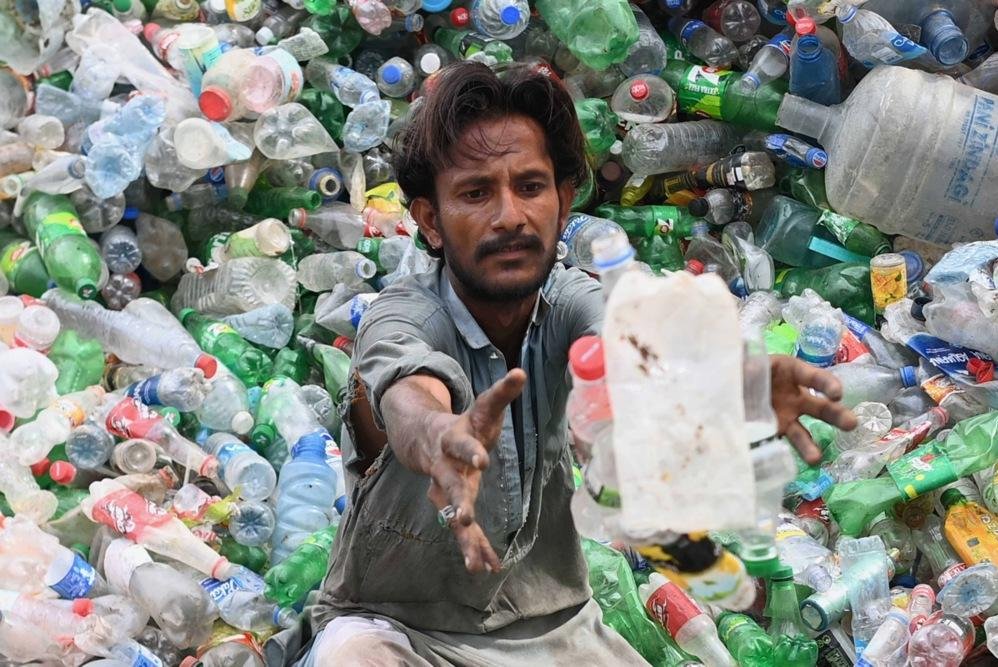
A worker collects used plastic bottles at a waste facility ahead of World Environment Day in Karachi, Pakistan, on June 4. Photo by Shahzahb Akber/EPA
June 25 (UPI) — As global concern over plastic pollution intensifies, a growing share of the problem is tied not to where waste is discarded, but where it begins — with the United States emerging as a major exporter of the raw materials that fuel plastic production in China and beyond.
At the center of that shift is Texas, now a premier hub for petrochemical exports, shipping billions of dollars’ worth of ethane and plastic resins across the Pacific each year. In 2025 alone, U.S. plastics exports to China exceeded $23 billion, underscoring the scale of a trade that is increasingly drawing scrutiny from environmental analysts and policymakers.
The dynamic highlights a widening disconnect in global supply chains. While the United States produces and exports the building blocks of plastic, much of the environmental burden associated with its use — and disposal — is borne elsewhere.
Trans-Pacific plastics pipeline
Fueled by the U.S. shale gas boom, petrochemical producers have expanded rapidly along the Gulf Coast, transforming abundant natural gas liquids into the building blocks of plastics manufacturing.
The industry has become a major economic engine for Texas and the broader U.S. economy, supporting millions of jobs and generating significant export revenue through a growing network of processing plants, pipelines and marine terminals.
“Plastics manufacturing supports 5 million jobs and $1.1 trillion in economic output driven by downstream sectors that rely on plastic materials,” Ross Eisenberg, president of American Plastics Makers, told UPI.
Much of the plastic raw materials exported from Texas are shipped to Asia, particularly China, where they are processed into a wide range of manufactured goods, including packaging, consumer products, textiles and industrial materials.
Many of these finished products are then exported to global markets, including the United States, underscoring the increasingly interconnected nature of the global plastics supply chain.
This circular trade has effectively linked U.S. energy production to Asia’s manufacturing engine and, indirectly, to the world’s growing plastic waste problem.
Environmental advocates contend that expanding petrochemical production is fueling plastic pollution and climate change.
“It’s been clear for years that plastic is largely a product where supply creates demand, not the other way around, so unbridled production is itself the core source of the crisis,” Jane Patton, campaign manager at the Center for International Environmental Law, told UPI.
She cited research showing that continued growth in U.S. petrochemical projects could substantially increase greenhouse gas emissions, undermining climate goals and locking in decades of additional plastic production.
Exporting the problem?
Environmental groups argue that the surge in U.S. petrochemical exports is helping sustain a global plastics economy that remains heavily dependent on single-use materials, even as governments pledge to reduce waste and marine pollution.
Much of the plastic produced from exported U.S. feedstocks is used in short-lived applications, particularly packaging, that quickly enters waste streams. In many parts of Asia, waste management systems struggle to keep pace with rising consumption, increasing the risk that plastic debris will leak into rivers and oceans.
“The environmental costs of plastics extend far beyond the factory gate,” Professor Judith Enck of Bennington College told UPI. “Only about 5% to 6% of plastics are recycled, leaving most to accumulate in landfills, be burned in incinerators or leak into rivers and oceans, where they become a growing source of pollution.”
A landmark study published in Nature found that the world’s 20 most polluting rivers, most of them in Asia, account for roughly two-thirds of global river-borne plastic entering the oceans.
Policy shifts — but not for the environment
Washington has begun tightening oversight of some petrochemical exports to China, particularly ethane shipments, through new federal licensing requirements. But those measures are driven largely by national security and trade considerations, not environmental concerns.
Analysts say the debate underscores a key policy disconnect: As the United States expands its role in global plastics supply chains, the environmental costs associated with production, consumption and disposal remain largely absent from trade and industrial policy. The issue is gaining urgency as governments negotiate a legally binding global plastics treaty and grapple with responsibility for the industry’s growing environmental footprint.
Industry leaders argue the focus should be on waste management rather than curbing production.
“A global plastics agreement should focus on ending plastic pollution, not plastic production,” Eisenberg, of American Plastics Makers, told UPI.
He said he believes the primary driver of plastic pollution is the lack of waste collection and management services for roughly 2.7 billion people around the world.
That gap is becoming more pronounced as countries negotiate the plastics treaty aimed at curbing pollution. While discussions have focused heavily on recycling, waste management and circular economy solutions, many experts argue that insufficient attention is being paid to upstream production.
Global governance challenge
The emerging treaty framework, expected to shape international rules on plastics for decades, faces a fundamental tension: how to reconcile the economic importance of plastics with the environmental imperative to reduce them.
The United States occupies a complex position in those negotiations. As one of the world’s largest producers of petrochemicals, it has significant economic interests at stake. At the same time, it has positioned itself as a leader in ocean conservation and marine protection.
Environmental advocates say efforts to curb plastic pollution will fall short unless they address the rapid growth of plastic production alongside waste management.
“Meaningful progress requires a global plastics treaty that places enforceable limits on production, holds corporations accountable for cleaning up the pollution they create and drives an actual reduction in annual plastic output,” Patton, of the Center for International Environmental Law, told UPI. “Voluntary measures simply won’t be enough.”
Strategic, environmental contradictions
The expanding U.S.-China plastics trade also reflects broader strategic contradictions in the Indo-Pacific.
Even as Washington seeks to reduce economic dependence on China and strengthen supply chain resilience, petrochemical exports continue to bind the two economies in ways that are difficult to unwind. At the same time, environmental concerns are increasingly intersecting with geopolitical competition.
China has begun to position itself as a leader in global ocean governance, promoting concepts such as “ecological civilization” and investing in marine science and conservation initiatives. Yet, it remains one of the world’s largest producers and consumers of plastics.
The United States, meanwhile, faces its own balancing act: promoting environmental leadership while sustaining an export-driven petrochemical sector that underpins domestic economic growth.
Texas industry representatives contend the state’s competitive advantage lies not only in supplying petrochemical feedstocks to global markets, but also in advancing technologies and policies aimed at improving the industry’s environmental performance.
“For Texas, the opportunity is not simply to export more products, but to help supply the materials global manufacturers need while advancing policies and innovations that make the industry safer, more efficient and more sustainable,” Michelle Hargis, of the Texas Chemistry Council, told UPI.
Maintaining that leadership, however, will require a regulatory environment that provides certainty for investors and accountability for operators, industry officials say.
“Predictable and science-based permitting processes are essential for maintaining investment certainty while ensuring facilities comply with environmental and safety standards,” Mary Jane Mudd, executive director of the East Harris County Manufacturers Association, told UPI.
She said public trust ultimately depends on strong regulatory oversight coupled with industry’s commitment to transparency and continuous improvement.
Toward accountability
For policymakers, the challenge is increasingly clear: how to reconcile economic interests with environmental responsibility in a globalized system.
As debate intensifies over who should bear responsibility for plastic pollution, some analysts are calling for greater transparency across global supply chains, including better tracking of where exported plastic feedstocks are used and where the resulting waste ultimately ends up.
Others argue that international efforts must address production practices alongside waste management and recycling.
Industry-backed groups say efforts to curb plastic pollution are already producing results. The Alliance to End Plastic Waste says its recycling and waste recovery projects have prevented more than 240,000 metric tons of unmanaged plastic waste from entering the environment across Asia and other regions.
Critics argue those initiatives address only a fraction of a much larger problem. A study by the University of Texas estimated that proposed petrochemical facilities could generate greenhouse gas emissions equivalent to as many as 131 coal-fired power plants by 2030.
“While the Alliance to End Plastic Waste’s member companies have invested billions of dollars in expanding plastic production, less than 10% of all plastic ever produced has been recycled,” Graham Forbes, of Greenpeace, told UPI.
As concerns over plastic pollution grow, the debate is shifting from waste disposal to accountability throughout the plastics supply chain. Proposed reforms include tougher disclosure requirements, environmental assessments tied to export permits and expanded partnerships with importing countries to strengthen waste management infrastructure.
Implementing such measures, however, remains politically challenging because of the petrochemical industry’s economic importance and its growing contribution to U.S. exports.
For the United States, that scrutiny may mark a turning point. The same energy boom that has transformed the country into a leading petrochemical exporter has also tied it more closely to a global system under increasing environmental pressure.