
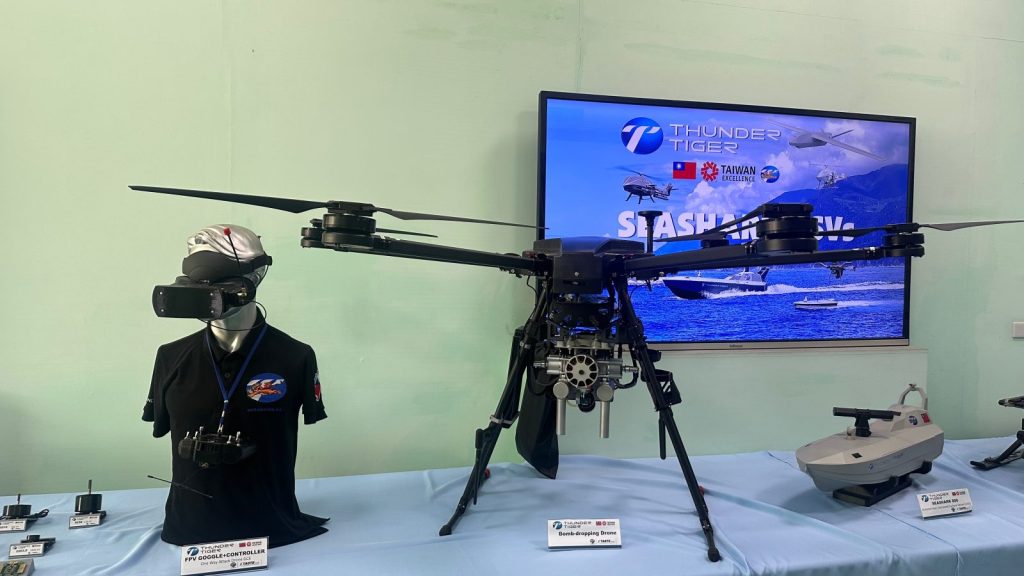
For at least the past two U.S. administrations, cutting China out of the tech supply chain has been a strategic goal in multiple industries. But the drone industry is one that has been years in the making with limited success, with China accounting for over 80% of the global market.
Last September, a Taiwanese drone company became the first Asian firm to obtain clearance for providing drones for U.S. military use, with their China-free supply chain.
I got a close look at how that happened.
Thunder Tiger is based on Taiwan’s western coast, not far from Taichung Airport — once a major U.S. logistics hub during the Vietnam War. The company’s history with the U.S. military goes back four decades, when it supplied remote-controlled model planes used for military training exercises for Americans. Now it’s pitching something far more consequential.
Last month, I joined a group of foreign journalists bused in for a briefing arranged by Taiwan’s foreign ministry. At the event, Thunder Tiger’s general manager, Gene Su, was eager to make his case for the company, based on the world’s most recent wars including in Iran and Ukraine.
“We are seeing $2 million missiles facing $30,000 drones,” Su said, referring to the rough costs of Iranian commercial-grade drones that are countering the U.S.’ Tomahawk cruise missiles. Su said the company’s AI-enabled suicide drone “Overkill,” which was approved by the U.S. Department of Defense last year, along with other American and European suppliers, cost around $3,000 to $5,000 each. Thunder Tiger is also producing $30,000 drones modeled on the U.S. Lucas drones used in Iran.
“That asymmetry is what we’re learning from Ukraine and Iran,” Su said. “We don’t need high-end missiles. We just need low-cost drones.”
For Taiwan, producing “non-China” drones is driven more by an existential threat than just a business opportunity. The country has often been viewed as the next security hot spot. China has repeatedly threatened to use military action to take over Taiwan by force if necessary, as it sees the self-ruled island as a breakaway province.
We don’t need high-end missiles. We just need low-cost drones.Gene Su, Thunder Tiger’s general manager
In a potential conflict with China, Taiwan would be in the position of Ukraine and Iran — fighting a disproportionally larger military power. The adoption of high-precision, low-cost drones that destroy expensive, traditional equipment like tanks and missiles has played an essential role in turning tables and setting a new tone for modern warfare, military experts say.
The Taiwanese government has started to push for producing homegrown drones since 2022, when Russia invaded Ukraine. It aims to produce roughly 180,000 homegrown drones by 2028. At the same time, it is building an alliance that now has more than 260 members — from component makers to finished-drone producers, with mostly Taiwan-based suppliers — all building toward a China-free supply chain.
Thunder Tiger used to source 30% of its components — mainly motors and cameras — from China, but has now transformed its supply chain, Su told Rest of World. Over time, the company has been able to switch to both local and American vendors.
Still, hearing Su’s vision for the drones, I was skeptical. China’s military budget has surged in recent years, growing from one-sixth of the U.S.’ budget to a third. I’ll be thinking of my visit, and the scale of that budget compared to Thunder Tiger’s $3,000 drones, next week when U.S. President Donald Trump meets Chinese President Xi Jinping in Beijing. The U.S. has confirmed Taiwan is likely to be on the agenda.