

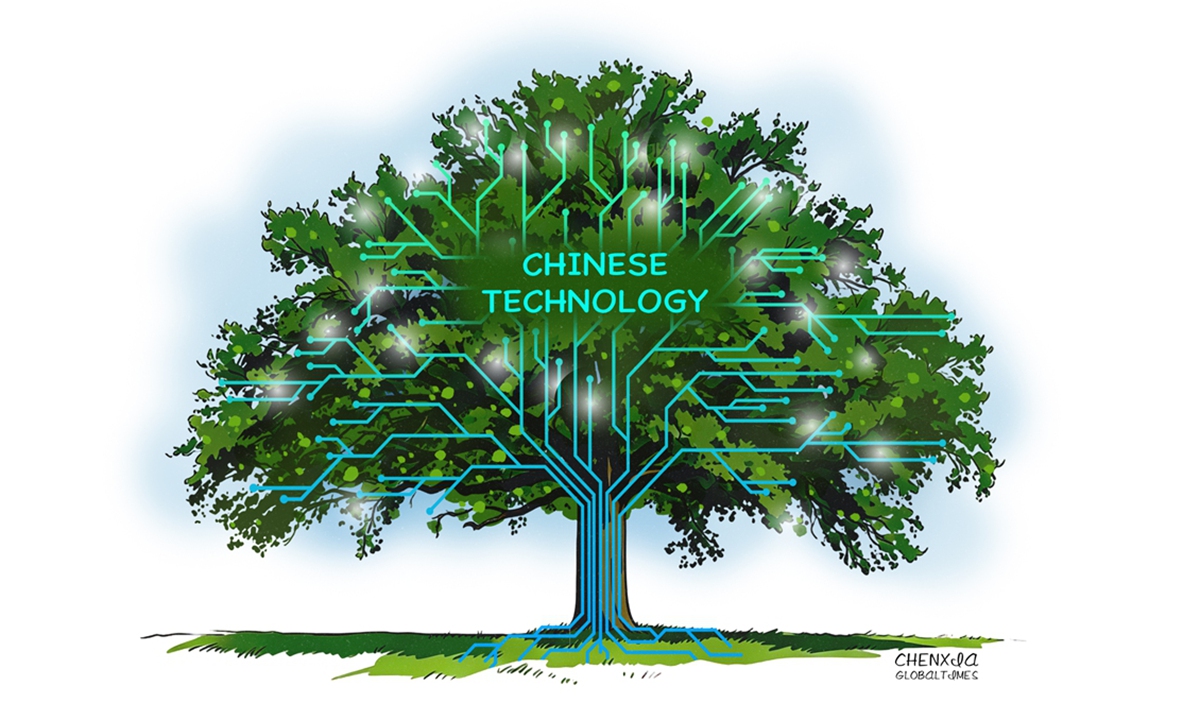
Illustration: Chen Xia/GT
The spread of China’s “next new three” across the world is not about squeezing other countries’ development space, but about making technological innovation more accessible and inclusive. While some countries are still erecting barriers against the “new trio” products, a “next new three” wave is already surging forward, creating a platform for global open cooperation through a commitment to innovation.
Just as China’s “new trio” products are sweeping across global markets and winning over consumers, another wave is already arriving – a “next new three” of artificial intelligence (AI), robotics and innovative medicines. In the 1990s, Chinese workers on assembly lines operated sewing machines to produce shirts that were shipped worldwide. Today, Chinese engineers in laboratories are fine-tuning large language models, robot joints and anti-cancer drugs. From the “old trio” to the “new trio” and now the “next new three,” this decades-long trajectory traces not only the upgrade path of Chinese manufacturing, but also the quiet evolution of China’s role in the global division of labor.
Looking back at the journey of Chinese manufacturing going global, it is a history of evolving models of cooperation. In the past, the “old trio” – represented by garments, furniture and household appliances – built the reputation of Chinese manufacturing for affordable, high-quality products. At that time, China mainly undertook large-scale production and processing within global industrial chains, playing the role of the “world’s factory.” Entering the 21st century, the “new trio” of photovoltaic products, electric vehicles and lithium batteries reshaped the world’s perception of Chinese manufacturing. China was no longer simply selling products, but providing a “toolbox” for the global energy transition. It has become an indispensable link in the new energy industrial chain and a key player in mastering core technologies.
Today, the emergence of the “next new three” following the “new trio” shows that China is accelerating its transition from a global manufacturing hub into a global source of innovation, with “Made in China” and “Created in China” becoming more deeply integrated. China is increasingly providing the world with original technologies, intelligent systems and solutions, while sharing more of the “dividend of intelligence” and “dividend of innovation” with the global community. China’s competitive edge is no longer measured merely by “how much it can produce,” but by its ability to define new products, open up new frontiers, set new standards, integrate global resources and continuously upgrade through innovation.
The spread of China’s “next new three” across the world is by no means a zero-sum game. It is not about squeezing other countries’ development space, but about making technological innovation more accessible and inclusive while fostering local innovation ecosystems. Chinese robots now shuttle 24/7 in hospitals in Thailand, accurately delivering medicines and samples. In Germany and other manufacturing powerhouses, fully automated production lines independently developed by Chinese companies are now in operation. Chinese companies’ AI models are being used by overseas users for content creation, coding and medical image analysis, while China’s AI technologies are also helping small and medium-sized enterprises in Southeast Asia achieve intelligent transformation, boosting local e-commerce and logistics efficiency. In the field of innovative medicines, multiple drugs independently developed by China have entered international markets, bringing new hope to patients around the world.
Similar stories have previously unfolded in the sectors of photovoltaics, electric vehicles, and telecommunications equipment. China’s photovoltaic industry drastically lowered global clean energy costs, while its new energy vehicles transformed green mobility from a high-priced option for the few into a consumer product for the masses. Much like the “new trio” products before, China’s “next new three” are bringing “accessible intelligence” to the world; they ensure that cutting-edge technologies are no longer “limited-edition luxuries,” rather enable more developing nations to gain access to smart, automated, and advanced medical capabilities at an affordable cost. The “next new three” may represent some of the most fiercely competitive arenas globally; while China does not lead in every aspect, experience shows that a philosophy of openness and inclusiveness has fueled a systemic leap in the country’s capacity for indigenous innovation.
While some countries are still erecting barriers against the “new trio” products, a “next new three” wave is surging forward, creating a platform for global open cooperation through a commitment to innovation. China’s open-source AI community is attracting developers worldwide to collaborate: from July 13 to 19, weekly usage of Chinese large models on the OpenRouter platform reached 36.11 trillion tokens – a 30.93 percent increase – securing the top global spot for 12 consecutive weeks. China’s robotics industry chain is opening its supply network to global partners: in the first half of this year, exports of Chinese industrial robots totaled 6.29 billion yuan, reaching 141 countries and regions, with surgical robot exports surging 3.3-fold. Meanwhile, the disclosed potential total value of out-licensing deals for Chinese innovative drugs reached approximately $110 billion, as Chinese innovative drug companies and multinational pharmaceutical firms forged R&D partnerships characterized by deep mutual integration.
The “next new three” products represent not only Chinese offerings but also global opportunities. The history of global industrial competition has repeatedly demonstrated that isolationism inevitably leads to backwardness, whereas openness and innovation are the keys to winning the future. China does not seek to monopolize the race, nor does it intend to push anyone out of the arena. Rather than fretting behind “closed walls,” it is far better to join hands in seizing opportunities and addressing challenges in the era, working together to steer technological innovation – including AI – toward positive, beneficial outcomes for humanity.