
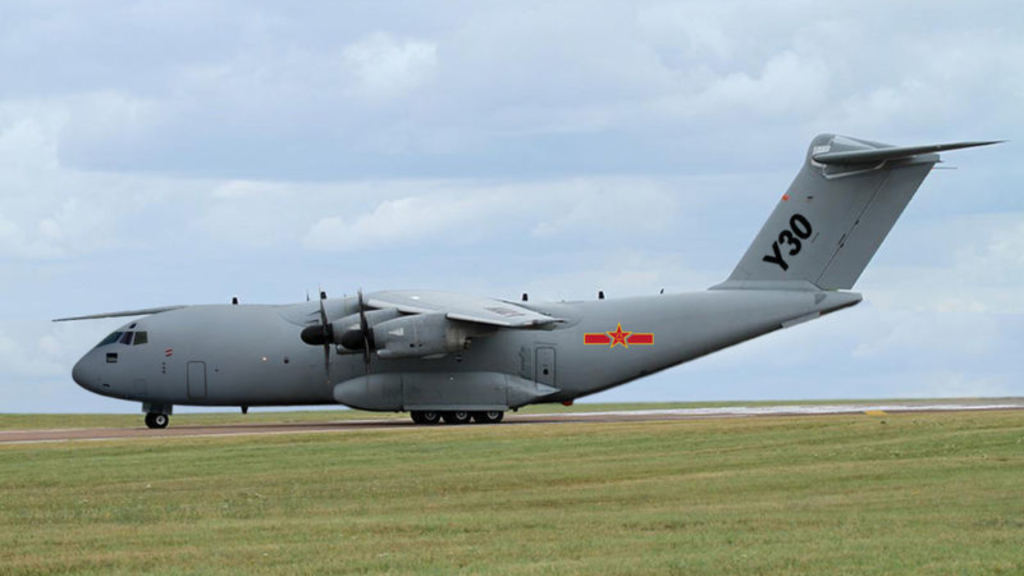
China’s push to modernize its tactical airlift fleet is gaining momentum with the emergence of its new medium-lift transport aircraft, commonly known as the Y-30 or Y-15. The four-engine turboprop completed its maiden test flight in December last year and is being developed by Shaanxi Aircraft Industry Corporation, a subsidiary of Aviation Industry Corporation of China.
Referred to domestically as “Xin Zhong Yun,” the aircraft is positioned as a next-generation platform.
Now, an analysis published by Beihang University in its Aerospace Knowledge magazine claims the aircraft surpasses the C-130J Super Hercules across key metrics, including engine power, payload capacity, structural design, materials, avionics, and flight control software.
C-130J proves reliability in high-risk rescue mission
A recent US rescue operation involving a downed pilot in Iran once again highlighted the enduring role of the C-130 Hercules in high-risk missions. The latest variant, the C-130J Super Hercules, traces its development to the 1990s and represents the most advanced evolution of a platform originally introduced in the 1950s.
While it maintains a slight advantage in operational range compared to China’s emerging Y-30, its real strength lies in maturity. Decades of service have enabled the aircraft to evolve into a versatile platform with numerous specialized mission configurations, from search and rescue to electronic warfare.
However, Chinese analysts are now framing the Y-30 not just as a competitor, but as a platform with significant room for expansion across mission profiles. The aircraft, referred to domestically as “Xin Zhong Yun,” is expected to evolve beyond a simple equivalent to the C-130J Super Hercules, with potential for a wide range of specialized variants.
Powering the aircraft are four indigenous AEP-500 turboprop engines, which reportedly deliver substantially greater output than the Rolls-Royce AE2100D3 engines used on the C-130J. In terms of lift capability, the Y-30 is said to reach a payload of around 30 tonnes – significantly higher than the roughly 20-tonne capacity of its US counterpart, the South China Morning Post reported.
Y-30 brings modern materials and avionics edge to airlift fleet
China’s Y-30 introduces a notable design shift by moving beyond the traditional all-metal airframe of the C-130 Hercules and incorporating extensive composite materials, reducing overall weight while preserving, if not enhancing, structural integrity.
Its avionics suite, developed with 2020s-era technology, is also expected to offer a generational advantage over the C-130J Super Hercules, whose core systems date back to a 1996 upgrade cycle. According to Chinese analysis, once operational, the Y-30 would address a key gap in the People’s Liberation Army Air Force’s tactical airlift capabilities, effectively completing a broader, long-developing military transport ecosystem.
The aircraft is reported to also feature robust short take-off and landing performance, allowing it to operate from unpaved strips in narrow mountain valleys or on remote island outposts. This capability is especially relevant for sustaining China’s military presence along the Himalayan border and across contested areas in the South China Sea.
With a payload capacity of around 30 tonnes and a spacious straight-through cabin layout, the aircraft is expected to transport key assets such as the Type 15 light tank, alongside a range of medium-weight systems including the ZBL-08, PLL-09, PCL-191, and HQ-17. The Y-30 is designed for rapid combat deployment, capable of transporting entire wheeled combined-arms units directly into forward positions. It can also carry a range of naval, air force, and missile-related equipment, enhancing joint operational flexibility.