
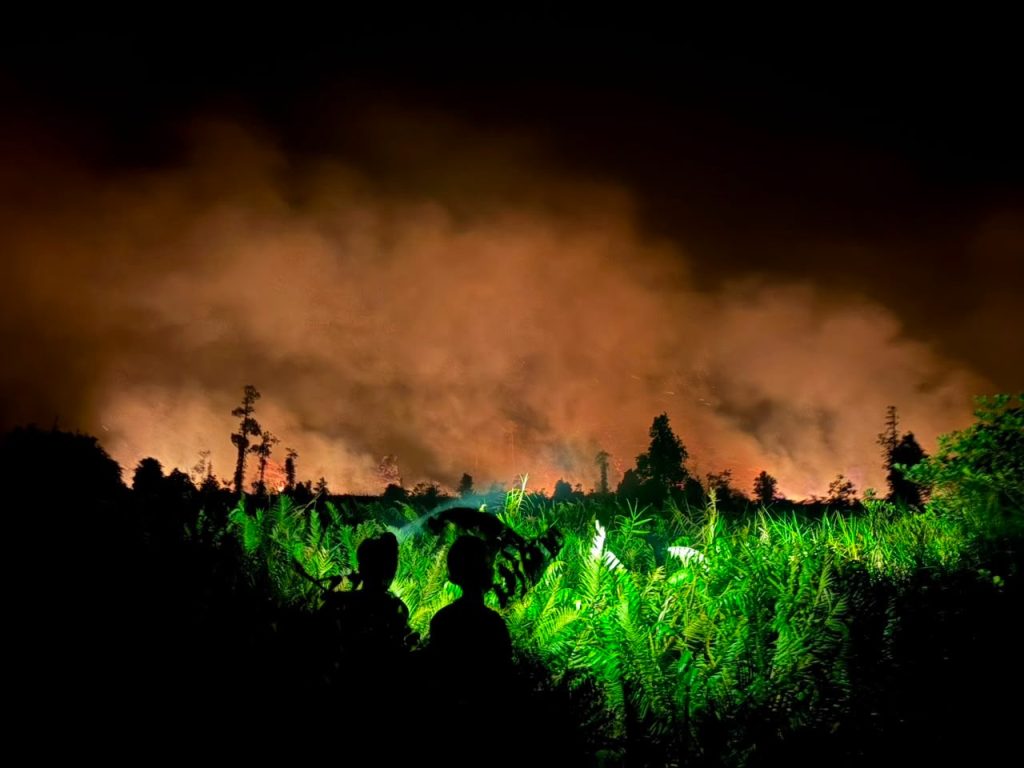

Image courtesy of Yayasan Inisiasi Alam Rehabilitasi Indonesia (YIARI).
Indonesia is experiencing one of its most severe fire seasons of recent years, with the scale of burning raising comparisons with the catastrophic fires of 2019.
On 23 August, forest monitoring platform Nusantara Atlas recorded more than 268,000 hotspots, far more than the 196,000 hotspots recorded at the same time in 2019.
The government has responded with considerable force. The Ministry of Forestry says 12,880 personnel have been deployed across West, Central and South Kalimantan, while another 1,200 military personnel have been sent from Java. President Prabowo Subianto himself visited fire-affected areas in West and Central Kalimantan on Aug. 22 and ordered additional support for firefighting operations.
A swift response is necessary. But putting out fires after they spread is only one part of the solution. The other part is preventing fires from getting out of hand.
Indonesia may be able to mobilise thousands of people, helicopters, water bombers, pumps, soldiers and firefighters once forest and land fires become a crisis. But it has failed to show an equivalent capacity to prevent landscapes from becoming so fire-prone in the first place.
We are now left wondering whether Jakarta has unlearned the lessons of the recurring fires that have affected so many millions of people within and beyond its borders.
That question is becoming harder to ignore as schools close, flights are delayed, people wear masks, and firefighters battle fires for hours on end.
Stronger El Niño
Climate is an important part of the equation.
Intense fires have occurred in the region in all the most recent El Niño years (1997, 2005/06, 2015, 2019, 2023). But this year, El Niño is bringing hotter and drier conditions that increase fire risk and make fires harder to control. Scientists are saying this year’s El Niño could be among the strongest on record.
In fact, a 2026 study in npj Natural Hazards journal found that El Niño increased the modelled risk of major fires in Indonesian Borneo by 2.7 times.
That said, the study also found that major fires remain possible during neutral and La Niña conditions. El Niño, in other words, can amplify the risk, but it is not the only thing that decides whether a landscape burns.
A 2025 study in Environmental Research Letters found that drained peatlands in Sumatra and Kalimantan had up to 13 times the annual mean density of satellite-detected fire hotspots as peatlands without canals. The study’s analysis found that climate, land cover and drainage together explained much of the variation in hotspot density.
In short, El Niño alone does not determine the scale of the fires. The health of wet peatlands is another major factor.
Moreover, humans also ignite fires, making them man-made rather than natural disasters. Indonesian authorities are currently investigating dozens of cases in which people are suspected of deliberately burning land to reduce the cost of clearing it.
This means that stopping Indonesia’s recurring fire crises requires more than helicopters and water bombs. It requires keeping peatlands wet and addressing the economic incentives that make burning attractive.
Lessons unlearned?
Indonesia should have learned its lessons.
After the devastating 2015 fires, President Joko Widodo repeatedly emphasised prevention and ordered the restoration and rewetting of degraded peatlands. He also established a government agency, the Peatland and Mangrove Restoration Agency (Badan Restorasi Gambut dan Mangrove, BRGM), to restore 1.2 million hectares (3 million acres) of degraded peatlands by 2024.
By the time President Prabowo dissolved the agency in December 2024, BRGM had restored approximately 1.6 million hectares of peatland.
The Prabowo administration seems to hold to the idea that rewetting peatlands is key, but its policies do not reflect the same urgency as those of previous governments.
In July, after a meeting chaired by Prabowo on the approaching El Niño, the Meteorology, Climatology and Geophysics Agency (Badan Meteorologi, Klimatologi dan Geofisika, BMKG) said it would carry out weather-modification operations periodically to keep peatlands saturated so they would not burn easily. But this is only a partial solution to a perennial problem.
The question is not whether the government understands the importance of peat restoration as a key measure to prevent fires. It does. The question is whether it is investing enough — and maintaining what it has already built — to make restoration work.
Prabowo’s administration continues the peatland restoration program, but efforts have now been decentralised, with the responsibilities split among several ministries. The government’s budget documents do not provide a single national figure for either firefighting or peat restoration. But ministry-level figures are revealing.
The Forestry Ministry’s dedicated forest-fire-control program was budgeted just Rp145.9 billion in 2026 (only 2.4 per cent of the ministry’s total budget of about Rp6 trillion). Likewise, the Environment Ministry’s dedicated peatland-protection and management program for the same year received as little as Rp15.75 billion (only about 1.13 per cent of its total budget of about Rp1.4 trillion).
These are not complete national totals, but they do illustrate the relative scale of the government’s identifiable annual programs, and it is clear that they are not doing enough.
Monitoring by NGO Pantau Gambut published in July 2026 has found, for example, that 70% of the canal blocks it assessed were damaged, while 52% of intervention sites still had groundwater levels below the safe threshold.
Of all peatlands burned in 2015-2019, only 3% had been restored to forest, Pantau Gambut found, while most had turned into plantations and shrubs, which are easily flammable.
Relearning the lessons
The lesson from another devastating fire season should be more than just having more helicopters, pumps and firefighters. Those are essential when fires are already burning, but the more important question is what Indonesia does between fire seasons to stop the burning before it starts.
Jakarta can continue to mobilise enormous resources after peatlands have dried out and caught fire. Or it can also invest more in keeping those landscapes wet, maintaining canal blocks and changing the incentives that make burning a cheap way to clear land.
Indonesia has known for a decade that prevention is easier than trying to extinguish a fire once it has spread through dry peat. The 2026 fire season is an opportunity to ask whether the country has actually acted on that important lesson.