
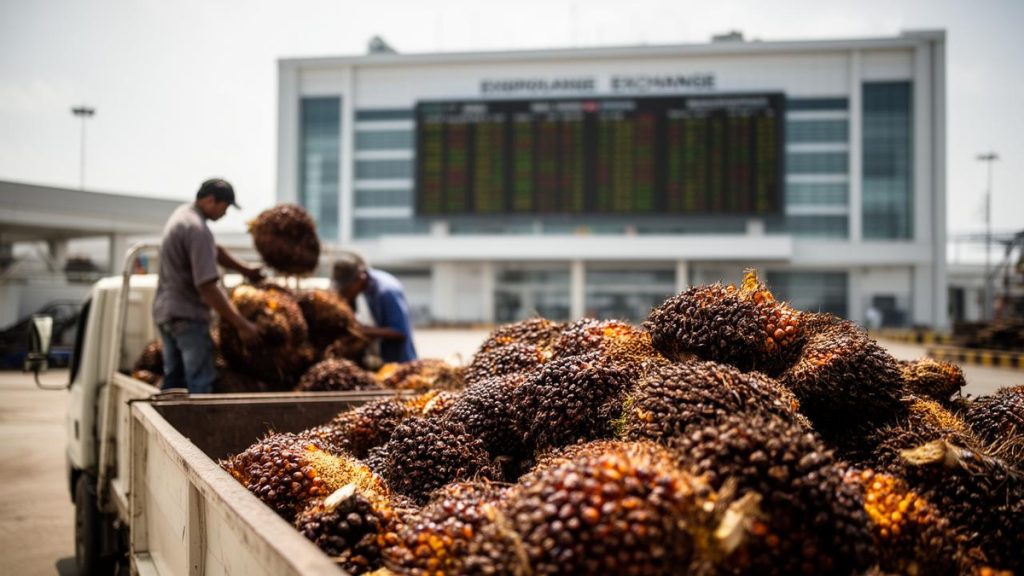
Indonesian President Prabowo Subianto has officially announced the establishment of the Strategic Mineral and Commodity Exchange (BMKS), which will trade palm oil, nickel, tin, coal, coffee, and other major export commodities, with operations targeted to begin on January 1 next year. The initiative aims to establish an independent commodity price benchmark for Indonesia, challenging Malaysia’s long-standing dominance in global palm oil pricing.
In his annual budget address to Indonesia’s parliament, he told lawmakers: “We do not merely aspire to be producers of global commodities. We must become the price-setters of global commodities.” The remark cuts to the heart of Indonesia’s long-standing predicament: as the world’s largest producer and exporter of palm oil, the country has never been able to wield pricing power commensurate with its market share.
According to market data, Indonesia produced 51.66 million tonnes of crude palm oil last year, accounting for more than half of global exports, while Malaysia, the world’s second-largest producer, produced just 20.28 million tonnes over the same period. Yet the pricing and hedging benchmark widely used by international traders remains the crude palm oil futures contract (FCPO) traded on the Bursa Malaysia Derivatives (BMD), which posted an average daily trading volume of 80,399 contracts last year—deep liquidity that continues to attract plantation companies, physical commodity traders, international investors, and speculators.
Siwage Dharma Negara, a senior fellow at Singapore’s ISEAS – Yusof Ishak Institute, analyzes that Prabowo’s plan has two interrelated objectives: first, to leverage Indonesia’s dominant position in palm oil, nickel, and coal exports to influence international market prices and strengthen bargaining power; and second, to enable the government to more effectively monitor export prices, volumes, tax payments, and potential transfer pricing issues.
He cautions, however, that supply dominance does not automatically translate into benchmark status. Malaysia’s FCPO has been in use for years and has gained broad acceptance in the global palm oil trading market.
Liquidity and Trust Are the Biggest Hurdles
This is not Indonesia’s first attempt to challenge the existing market order. In 2023, Indonesia launched an exchange-based physical crude palm oil market operated by the Indonesia Commodity and Derivatives Exchange (ICDX), but trading activity remained limited, and it failed to compete with the FCPO in international hedging and price discovery.
David Ng, a proprietary trader at Malaysia-based financial derivatives and commodity trading firm IcebergX Sdn Bhd, points out that the FCPO’s most attractive feature is its deep liquidity. “If volume is high, you can get in and out in size,” he said. He notes that futures prices and physical commodity prices are closely linked, with physical cargoes typically priced against the FCPO, giving traders a natural incentive to arbitrage the spread between the two.
Both David Ng and Siwage agree that the real challenge for Indonesia is not merely publishing a domestic reference price, but building a market that participants trust enough to actually use. Siwage emphasizes that competitive trading costs, transparent governance, and reliable data are critical. “The government can set rules, but it cannot influence individual prices,” he said. If political forces intervene in price-setting, it would undermine the exchange’s credibility.
David Ng points to another complicating factor: Indonesia’s oil palm plantations are spread across a far larger and more dispersed geographic area than Malaysia’s, making it more difficult to establish a consistent and reliable data collection mechanism.
Revenue Oversight and Transfer Pricing Considerations
Bhima Yudhistira Adhinegara, executive director of the Jakarta-based Centre of Economic and Law Studies, cautions against viewing BMKS purely as Indonesia’s bid for international pricing power. “Prabowo wants to ensure prices are more transparent so the government can audit transaction data and protect income tax revenue,” he said.
He draws a parallel between the initiative and Danantara Sumberdaya Indonesia (DSI), the operational arm of Indonesia’s Danantara sovereign wealth fund. DSI was established in part to oversee exports of crude palm oil, coal, and ferroalloys. Since June 1, exporters have been required to declare transactions through DSI, with further reforms expected to be implemented in January next year.
Bhima is skeptical about whether establishing a domestic Indonesian benchmark price can persuade overseas buyers to abandon existing reference benchmarks such as the FCPO. He notes that large export contracts between Indonesia and buyers in China and India have long established their own pricing arrangements. “Ensuring that contracts adopt an Indonesian domestic price benchmark is extremely difficult,” he said.
Unlikely to Displace FCPO in the Short Term, but Still Strategically Valuable
BMKS will be supervised by Indonesia’s Financial Services Authority (OJK), which has appointed Henry Rialdi as deputy commissioner responsible for exchange regulation and oversight.
Siwage notes that even if BMKS cannot replace the FCPO in international contracts in the short term, mandatory trade reporting could still help Indonesia establish a practically useful physical market price benchmark and give the country greater bargaining leverage in commercial negotiations. He believes Indonesia’s status as the world’s largest palm oil supplier alone is sufficient to generate such influence.
The following table compares key data for the Indonesian and Malaysian palm oil markets:
| Indicator | Indonesia | Malaysia |
|---|---|---|
| Crude palm oil production last year | 51.66 million tonnes | 20.28 million tonnes |
| Share of global exports | Over 50% | Approximately 20% |
| Primary pricing benchmark | Yet to be established | FCPO (average daily volume of 80,399 contracts) |
| Existing exchange | ICDX (launched 2023) | BMD |
Note: Production and export share figures are from last year; FCPO average daily volume data was published by the Securities Commission Malaysia, citing Bursa Malaysia data.
Overall, Indonesia’s move reflects the frustration of resource-rich developing countries over international commodity pricing mechanisms long dominated by a handful of exchanges. However, as the ICDX precedent shows, a government-established trading platform that fails to attract sufficient market participation and liquidity will struggle to dislodge entrenched benchmarks. Whether BMKS can clear this hurdle will depend on whether its trading cost competitiveness, data transparency, and governance credibility can win the trust of the international market.