
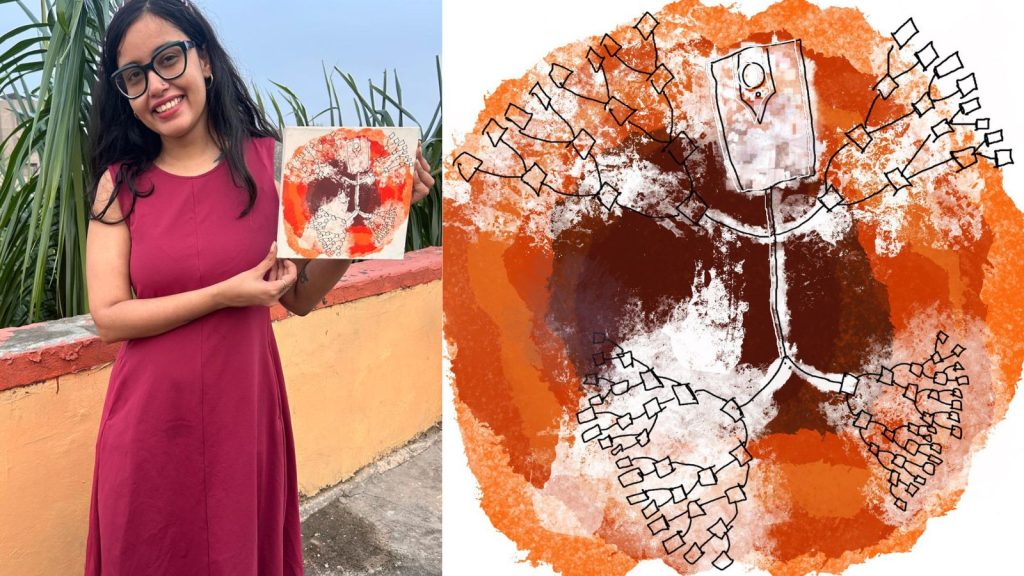
At 16, Delhi-based Anukriti S faced severe harassment after a photo of hers was maliciously circulated by a senior at school. The incident left a deep impact: she was withdrawn, isolated, and reluctant to step outside her house. Over time, Anukriti turned to art and writing to express thoughts she found difficult to speak about. More than a decade later, life has come full circle, with her artwork ‘The Tree That Never Slept’ winning an award.
Anukriti’s artwork was among the top three winners featured in Being Online, a new global digital art gallery created by non-profit global consortium Digital Transformations for Health Lab (DTH‑Lab) in collaboration with the Global Mental Health Action Network (GMHAN).

Launched on August 12, International Youth Day, the gallery showcases 41 artworks by young people under 30 from 21 countries, offering a visual exploration of what it means to grow up, connect, and express oneself in an increasingly digital world.
“I came across the call on LinkedIn for artwork for the Being Online initiative and immediately thought of this piece, which I had made almost three years ago on a particularly difficult day. When I found out I had won, I cried. For 13 years, this incident had made me cry from trauma and shame. This was the first time I cried about it with joy. It felt like a circle had closed,” Anukriti said.
The artist, who said she was systematically failed by institutions meant to protect her, said the opportunity to participate and engage with Being Online felt different. “People want to hear what actually happened from me and with me. We want to talk about what we need to do differently for young people in the future,” Anukriti said.
‘Body disappears, network remains’
Anukriti’s artwork began with one image, a moment meant to stay private, but the phone does not remain singular; it grows branches. “What starts as connection becomes circulation. The image moves, forwarded, saved, duplicated, until it no longer belongs to a person but to a system. The body at the centre disappears, but the network remains,” Anukriti told The Indian Express.
The youngster refers to this image-based abuse and how her work reflected technology-facilitated gendered violence not through intent, but through design. “Harm spreads faster than accountability. The branches represent the constant demand to stay online, to explain, defend, survive; while the violence continues to multiply. Logging off does not ensure safety when memory, screenshots and servers do not forget,” she said.
Story continues below this ad
For this youngster in her late 20s, the story is no longer about one phone. “It is a map of how intimacy becomes infrastructure and how gendered bodies are made endlessly shareable using the internet,” she reflects.
Passionate about using creativity to drive social change, she recalled that she first wrote publicly about her experience in Youth Ki Awaaz in 2018 under an alias. “This call was the first time I saw an opportunity to address the online experiences of young people ever, and I instantly gravitated towards it,” adds Anukriti, who now works at a non‑profit focused on reproductive rights.
Next on the cards is building a survivor support network and pushing for stronger school responses to technology‑facilitated image abuse, recognition in policy, and the creation of a dedicated mental health toolkit, developed with the help of experts.
Digital environments important for health
“Their experiences are essential to informing healthier, safer and more inclusive digital environments. This aligns closely with WHO’s work on the digital determinants of health,” Dr Natasha Azzopardi-Muscat, Director of the Division of Health Systems at the WHO Regional Office for Europe, said. Such initiatives reinforce the importance of listening to young people, she added.
Story continues below this ad
The gallery forms part of DTH-LAB’s work to understand and address the impact of digital environments on young people’s emotional, mental, physical and social well-being. It also reflects the International Youth Day 2026 theme—Different Contexts, Common Aspirations—showing how young people’s experiences vary across countries and communities while sharing many common concerns, hopes and challenges.
Aferdita Bytyqi, Executive Director of DTH-Lab, said that since the Lancet and Financial Times Commission on Governing Health Futures 2030, they have argued that policymakers and technology companies must listen to young people’s lived experiences and recognise digital environments as important settings for health.
“Being Online creates a lasting visual record of those experiences and offers valuable insights that can inform more youth-centred policies and healthier digital environments,” Bytyqi said. The two other winners are Funny Faces by Ada H from the United Kingdom and Captivity by Eyob Tadesse from Ethiopia.
International judging panel
The gallery was selected by an international panel with expertise in health, youth engagement, digital transformations, and the arts. The panel assessed submissions against impact, artistic value, originality, and conceptual strength. The jury also found it important that the winning artworks were grounded in young people’s lived experience and did not reinforce simplistic stereotypes that portray young people’s experiences with digital environments as either entirely positive or negative.
Story continues below this ad
Cassie Redlich, Technical Officer at WHO Regional Office for Europe; Marija Manojlovic, Executive Director of Safe Online, a leading global fund dedicated to the wellbeing, safety and protection of children in the digital world; illustrator Ipsita Divedi; professor Deborah Lupton, University of New South Wales; Zane Muwanguzi, GMHAN; and DTH-Lab Regional Youth Champion alumnus Lorenzo Sablay were among the panel members.