
Thank you for subscribing to my posts. If you’re not yet a paying supporter, please consider becoming one. That’ll allow you to DM me with questions and comments. Your contribution will help cover the cost of the data I use in my posts, which I fund out of my own pocket. Thanks so much for your support and feedback!
There’s two competing theories about why the Yen is falling. The first is that this is a symptom of something much bigger, which is that Japan has run out of fiscal space and is in a debt crisis. That’s getting papered over by the BoJ, which caps yields via government debt purchases. This keeps Japan from going into a full-blown debt crisis, but it puts depreciation pressure on the Yen, as the kind of risk premia markets would like to see are being artificially suppressed. This is basically my view and boils down to this: “why stay in Japan if you’re not getting sufficiently compensated to do that.” The second theory is that fiscal worries can’t possibly be behind the falling Yen because the government has lots of assets. After all, Japan’s official foreign exchange reserves stand at around one trillion Dollars and net debt at 130 percent of GDP is a lot lower than 240 percent gross debt. In this telling, the falling Yen is just a symptom of efforts to reflate the economy, which – as far as the Yen is concerned – have run out of control.
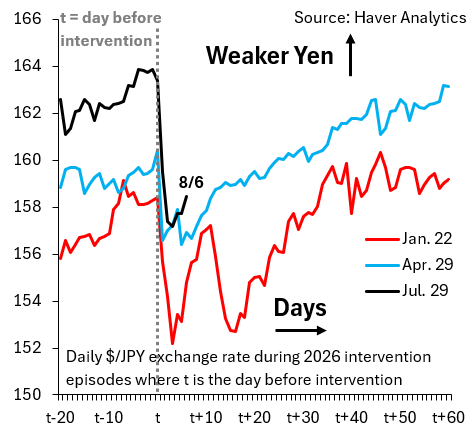
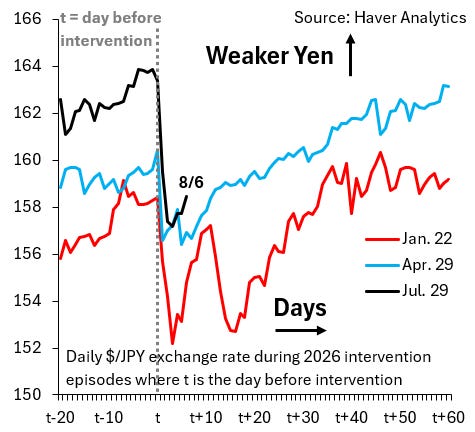
If the second theory were true, there’d be an element of irrationality to the fall in the Yen, so official intervention should help arrest its decline. That’s demonstrably not the case. The chart above, which was in a post two days ago, makes two points. First, the $/JPY exchange rate ratchets up after each of this year’s intervention episodes, so it’s pretty clear that intervention is doing nothing to stop the Yen depreciation trend. Second, $/JPY has already begun to rise again after last week’s intervention, where it’s fair to say that Japan and the US pulled out all the stops. The fact that – even after all this – the Yen is resuming its weakening trend says it all.
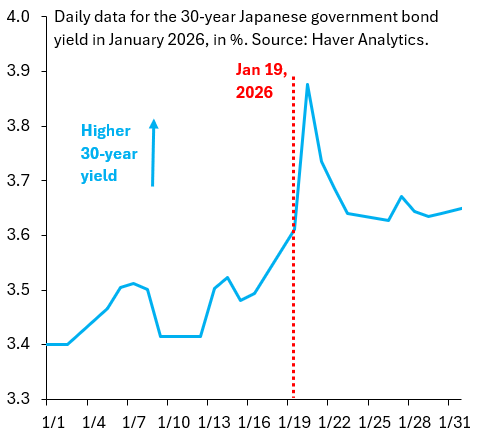
But here’s the thing. You don’t have to take my word for it. We have a great “natural experiment” that sheds light on what’s happening. In the evening of Jan. 19, Prime Minister Takaichi gave a speech in which she said her administration would put an end to “excessive” fiscal austerity. The next day, as the chart above shows, the 30-year government bond yield spiked, a great illustration just how worried markets are about the fiscal situation in Japan. In fact, it was precisely this episode that saw the US wade into Japanese currency markets for the first time this year. As the chart below shows, the NY Fed did its infamous “rate check” on Jan. 23, i.e. in the days immediately after Takaichi’s comment. The US was clearly worried things were about to run out of control in Japan and decided to put a damper on Yen depreciation pressure.
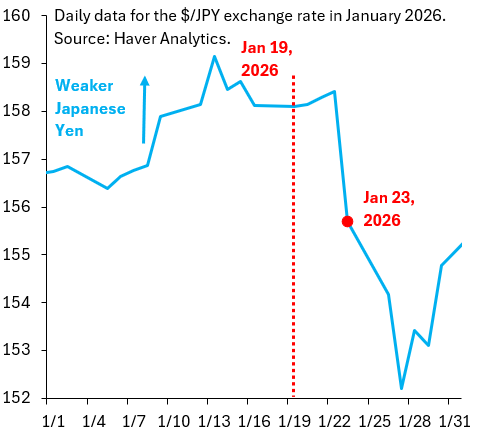
If markets were merely driving the Yen weaker as part of a reflation trade, they’d hardly react the way they did to Takaichi’s comment on ending “excessive” fiscal austerity. This natural experiment shows that Yen depreciation is clearly about debt and yield suppression, which is something intervention can’t possibly hope to fix. Only debt reduction can deliver a stable currency and – fortunately – there is a relatively painless way for Japan to accomplish that.