
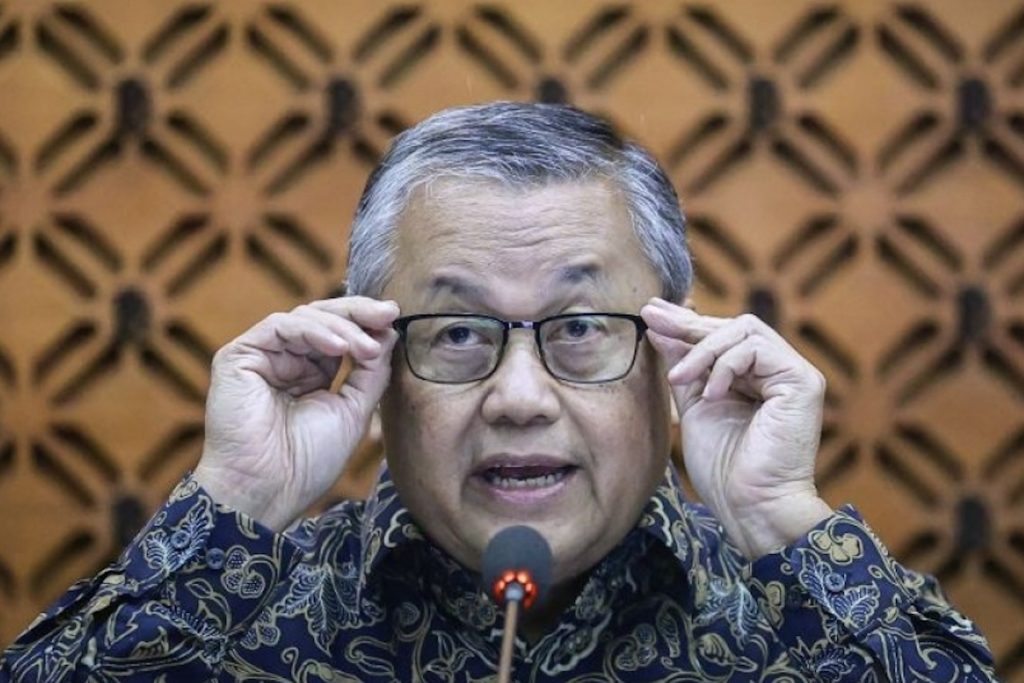
JAKARTA – Bank Indonesia Governor Perry Warjiyo’s abrupt resignation marks a watershed moment for Southeast Asia’s largest economy.
Coming midway through his second five-year term, Warjiyo’s departure — tendered for personal reasons and quickly accepted by President Prabowo Subianto — has rattled local and international financial markets.
For seven years, Warjiyo served as an institutional anchor, guiding the country through the pandemic, global supply chain shocks and aggressive global monetary tightening cycles.
His sudden exit strips away a critical layer of predictability just as Indonesia confronts a punishing convergence of domestic fiscal strain, unrelenting capital flight and intense external vulnerability.
Financial markets operate fundamentally on trust, and sudden central bank leadership transitions invariably provoke rigorous scrutiny. Yet Warjiyo’s resignation transcends standard administrative turnover. It arrives against the backdrop of a plummeting local currency, with the rupiah having depreciated roughly 7% since early 2026 — among Asia’s worst-performing currencies.
Foreign exchange reserves have contracted to $144.9 billion, reflecting heavy, continuous central bank intervention to cushion the currency’s decline. As sovereign bond yields climb and equity markets buckle under domestic policy anxieties, Bank Indonesia finds itself at a dangerous crossroads where monetary defense collides directly with political expediency.
Compounding this monetary fragility is the worsening structural health of the nation’s external balances. The current account deficit has widened to 1.1% of gross domestic product, driven by moderating commodity export windfalls and strong structural demand for imported capital goods.
Foreign direct investment inflows have simultaneously slowed, constrained by persistent regulatory ambiguity and concerns over labor market rigidity.
The timing of Warjiyo’s departure also spotlights the changing legal framework governing monetary policy in Jakarta. Legislative changes enacted through the Financial Sector Strengthening Law expanded Bank Indonesia’s statutory mandate to explicitly include job creation and economic growth alongside price stability.
Independent economists and international rating agencies warned at the time that dual or tertiary mandates dilute monetary orthodoxy. When the line between fiscal stimulus and price stability is intentionally blurred, investors naturally price in a higher risk premium for holding Indonesian sovereign assets.
External pressures, fiscal strain and market psychology
By any measure, the macroeconomic framework underpinning Indonesia is under severe strain, hit by both persistent geopolitical shocks and haphazard fiscal expansion.
Externally, the protracted conflict in the Middle East has triggered severe energy price volatility and logistical bottlenecks. As a net oil importer, Indonesia has absorbed heavy imported inflation, pushing headline inflation to 3.34%.
Rather than passing these global energy shocks fully onto consumers through market-based fuel pricing, the government has tried to shield households, placing an unsustainable burden on public finances and state-owned enterprises like Pertamina and PLN.
Domestically, investor psychology has soured considerably over shifting fiscal discipline. The Prabowo administration has pushed forward with ambitious, costly populist programs, most notably the flagship free school meals program.
With the fiscal deficit hovering near the statutory ceiling of 3% at 2.92%, market confidence has eroded. International rating agencies and institutional investors have watched with alarm as domestic protests over government spending have been met with reactive policy shifts.
Bank Indonesia was forced into aggressive tightening, lifting its policy rate by 100 basis points this year to 5.75% to defend the rupiah, creating acute tension between high borrowing costs and domestic growth objectives.
Furthermore, capital market sentiment has been rattled by shifting portfolio allocations. Global institutional funds have rotated out of Indonesian local-currency government bonds, known as SBNs, and into safer, higher-yielding Western debt instruments.
Foreign holdings of domestic debt have dropped significantly, reducing a traditional cushion that once absorbed domestic fiscal deficits. This structural outflow is squeezing local banking liquidity, driving up domestic lending rates and choking credit growth for small and medium-sized enterprises.
The monetary authority finds itself trapped in a trilemma: defend the currency through elevated interest rates, support growth through liquidity injections, or accommodate fiscal expansion to prevent social friction. It cannot do all three at once.
Market psychology in Jakarta has consequently turned defensive. Corporate treasurers are hedging their foreign exchange exposures well ahead of standard operational cycles, accelerating dollar hoarding.
This hedging compounds the macroeconomic pressure on the rupiah, creating a self-fulfilling loop of currency depreciation and capital flight. Analysts at major international investment banks have revised their terminal policy rate expectations upward, warning that if fiscal expansion remains unchecked, monetary policy will be forced into an overly restrictive stance that risks triggering a slowdown.
Political interference, institutional credibility
The circumstances surrounding Warjiyo’s resignation have amplified long-standing fears about the erosion of central bank independence.
Beyond the statutory expansion of its mandate, institutional concerns were compounded earlier this year by changes to the central bank’s board of governors, including the appointment of figures with close ties to the ruling coalition.
When a long-serving governor exits abruptly under such politically charged conditions, the signal to global capital markets is unambiguous: monetary policy autonomy is sliding toward subordination to executive fiscal priorities.
Global capital markets detest opacity and political capture. Rumors about potential successors — including speculation that cabinet ministers close to the presidential palace could be tapped — reinforce investor fears that Bank Indonesia may increasingly be used to finance or accommodate expansive state budgets through secondary-market debt purchases.
If the firewall between fiscal populism and monetary prudence is permanently breached, Indonesia risks forfeiting the macroeconomic credibility built over decades of post-1998 structural reform. The lessons of the Asian financial crisis show clearly that central bank subordination tends to end in currency crises and prolonged economic stagnation.
The core question is whether institutional safeguards remain robust enough to withstand political pressure. Bank Indonesia’s mandate was built on the premise that separating the printing press from the political budget prevents inflationary spirals.
When political actors try to bypass legislative checks by leaning on central bank liquidity, the long-term cost is paid by the broader public through eroded purchasing power.
The administration faces a crucial choice: reaffirm its commitment to central bank autonomy by appointing an uncompromised technocrat, or proceed down a path of fiscal dominance that will alienate international capital markets.
Civil society, academic economists and financial associations have voiced unprecedented public concern. Open letters and analytical forums across Jakarta emphasize that credible macroeconomic management is a public good that cannot be compromised for short-term political gain.
The erosion of institutional checks leaves the country vulnerable to external contagion. If markets perceive that monetary decisions are driven by political timelines rather than economic data, inflation models and reserve management metrics, the domestic financial system will face structural repricing that no amount of foreign exchange intervention can reverse.
Post-Perry projections
Indonesia’s monetary trajectory now hinges on the caliber and perceived independence of Warjiyo’s permanent successor. With Senior Deputy Governor Destry Damayanti stepping in as interim chief, immediate panic has been averted through a measure of institutional continuity.
However, acting leadership cannot permanently ease structural anxieties. Foreign portfolio outflows will likely stay elevated until a market-friendly nomination is formally announced, leaving the rupiah vulnerable to sharp tests near historical psychological thresholds.
To restore market confidence, the administration must appoint a technocratic heavyweight with unyielding independence, deep international credibility and sophisticated market literacy.
The ideal candidate must have the political capital to push back against fiscal dominance, prioritizing orthodox monetary stability over short-term political convenience, and must signal a clear return to data-driven policymaking — ensuring interest rate decisions reflect core inflation dynamics and external balance realities rather than pressure from the executive branch.
Projections for the rest of the year suggest a bumpy road. Real GDP growth is expected to moderate toward 4.8% as high interest rates dampen domestic consumption and capital formation.
Inflation will likely stay sticky within the upper bound of Bank Indonesia’s target corridor, hovering around 3.2% to 3.5%, driven by imported energy costs and structural supply-chain rigidities. If the selection process yields a governor perceived as a political proxy, capital flight will likely accelerate, bond spreads will widen significantly and the cost of defending the rupiah will rise sharply.
Indonesia stands at a pivotal crossroads. The choice of the next central bank governor will determine whether monetary policy remains a trusted shield for macroeconomic stability or becomes an instrument of political expediency.
Ronny P Sasmita, Ph.D is senior analyst at Indonesia Strategic and Economic Action Institution, a Jakarta-based think tank.