
“People are saying there are supply constraints, but I think in the UAE, and especially in Dubai, the government has made a lot of effort to make sure there are no disruptions in the supply chain,” he said. “They opened Khor Fakkan and Fujairah, so it is then a matter of how developers manage between themselves and their suppliers.”
The disruption did not translate into project delays for DAMAC. Tahaineh said the company initially expected some pressure, but did not feel a major impact across its developments.
“If Khor Fakkan and Fujairah are open, then it is a matter of transportation from Fujairah to Dubai,” he said. “The authorities are always supporting us. Honestly, we did not feel any major impact. Maybe at the beginning we thought it could happen, but we did not feel it, and it did not affect any of our projects.”
Harbour Lights reaches topping out stage
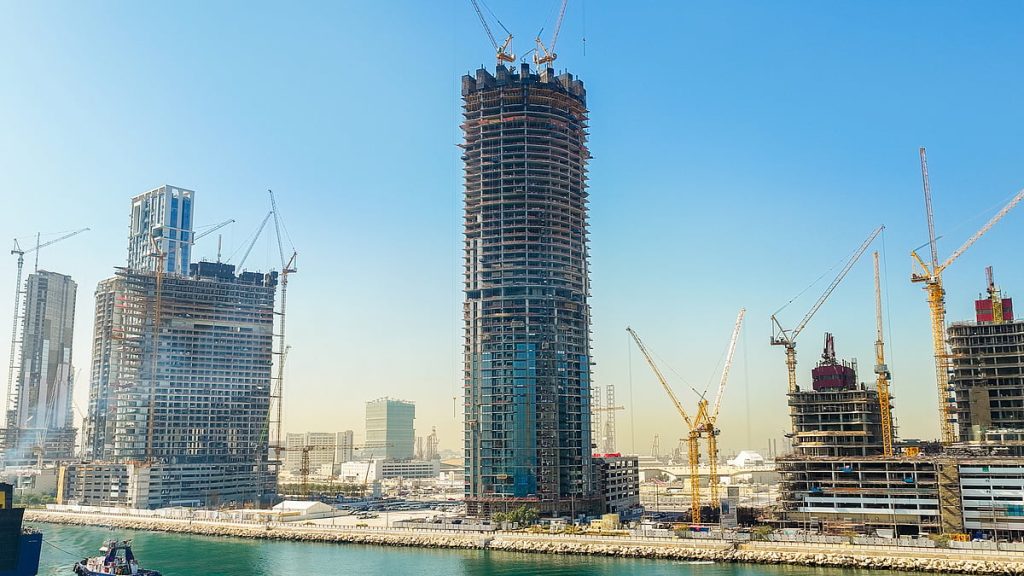
The comments came as DAMAC completed the superstructure of Harbour Lights, a 52-storey waterfront tower in Dubai Maritime City. The project, which the developer says is the tallest tower in Maritime City, has now moved into internal and external finishing works ahead of a planned 2027 handover.
The ceremony marked the final concrete pour on the roof floor slab, with substructure works already complete.
Harbour Lights will have 294 apartments, five podium levels, retail space and amenity floors on level 52. The tower will also feature an infinity pool, a gym, steam and sauna facilities, with views of the Arabian Gulf and Dubai coastline.
Dubai pricing still competitive
Tahaineh said buyer appetite for luxury homes in Dubai remains strong, supported by pricing that still compares favourably with other global cities.
“Dubai’s market is always attractive, and all of us know that,” he said. “If I compare the selling rates for luxury real estate in Dubai with Europe, New York or other developed cities, Dubai is always lower, especially when you compare luxury.”
Dubai developers are also offering a higher level of product quality for the price paid, he added.
“The level of quality and the products that Dubai and Dubai developers are offering are much higher, while prices are lower, in my view,” he said. “I believe the attraction for luxury products will remain strong, and it will become stronger.”
Waterfront demand
Harbour Lights is designed around coastal living, with resort-style amenities and access to key business and leisure destinations, including La Mer Beach, Dubai Creek, Burj Khalifa and Dubai Mall.
Its position in Dubai Maritime City is one of the main selling points, with the tower rising about 200 metres above ground level.
“The units are luxury, and as you can see, the view is in one of the best waterfront destinations in the country, Dubai Maritime City,” Tahaineh explained. “To my understanding, where we are now is currently the tallest building under construction in Dubai Maritime City. We are now around 200 metres above ground level.”
He said luxury mixed-use projects will continue to find buyers in Dubai because demand is still focused on prime locations, quality and views.
“There is a customer for every product, but in my opinion, Dubai is now known for luxury,” he said. “Everyone is looking for luxury products. I believe luxury products will always be attractive to investors, customers and tenants, and the market will remain strong and become stronger.”
Buyers still taking handovers
Tahaineh said Dubai’s real estate market continues to see buying and handover activity, despite concerns raised around supply chains and sentiment.
Nivetha Dayanand is Assistant Business Editor at Gulf News, where she spends her days unpacking money, markets, aviation, and the big shifts shaping life in the Gulf. Before returning to Gulf News, she launched Finance Middle East, complete with a podcast and video series.
Her reporting has taken her from breaking spot news to long-form features and high-profile interviews. Nivetha has interviewed Prince Khaled bin Alwaleed Al Saud, Indian ministers Hardeep Singh Puri and N. Chandrababu Naidu, IMF’s Jihad Azour, and a long list of CEOs, regulators, and founders who are reshaping the region’s economy.
An Erasmus Mundus journalism alum, Nivetha has shared classrooms and newsrooms with journalists from more than 40 countries, which probably explains her weakness for data, context, and a good follow-up question.
When she is away from her keyboard (AFK), you are most likely to find her at the gym with an Eminem playlist, bingeing One Piece, or exploring games on her PS5.