
History lies in collective memory beyond the museums’ glass cases and ink on fraying pages
I have always wondered how memories can be remembered and conveyed unconventionally. It turns out, as an Indonesian, the answer has always been so close.
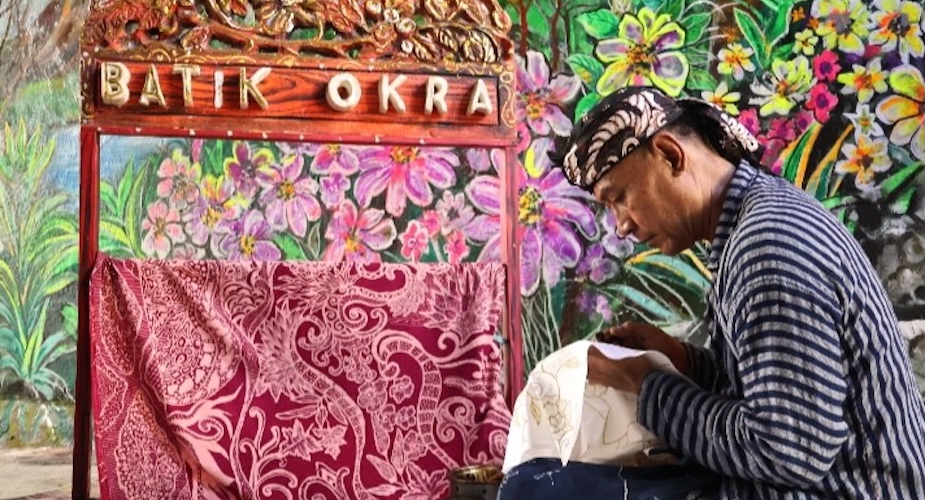
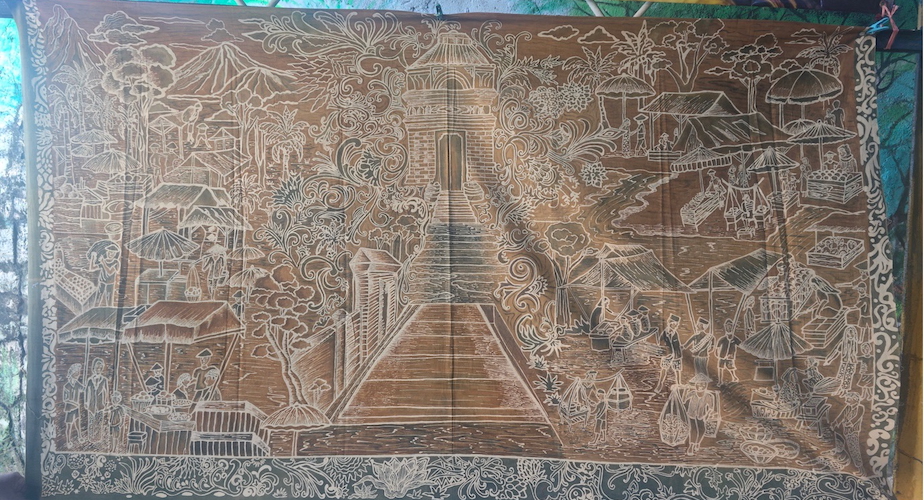
Settling back in Surabaya after my studies, a friend was eager to take me city-walking for old times’ sake to visit a batik workshop she had heard of. It was late in the day when we came across the small workshop in an alley in Kranggan, Bubutan, close to the city centre. Its owner, Ridi Sulaksono, was hanging a large fabric bearing a sketch of the Battle of Surabaya. Beside the cloth were some finished batik pieces, one illustrated an old market and a gapura (traditional Indonesian gate), the other depicted Patih Gajah Mada, legendary leader of the Majapahit Empire, lifting a keris into the air.
Since 2022, Ridi’s workshop, Batik Orang Kranggan or OKRA, has been designing and creating contemporary batik; a more flexible canvas where memories and political meanings are continually rewritten by local creatives. For him, these narrative depictions of Surabaya on fabric become a commemorative medium that preserves collective struggle.
‘This is the Surabaya that was described in the stories of my forefathers, told through the medium I’m learning,’ Ridi explained. ‘My family has always lived here through generations, ever since Kampung Kranggan was a part of the former royal palace, Keraton Surabaya. It was a time we can never go back to. But at least we can imagine how it was and keep remembering.’
The encounter reminded me that batik is a material culture laden with memory and philosophy, etched with symbols; something that colonial forces also appropriated. Contemporary batik positions itself against the lingering visual legacy of ‘colonial batik’: Indo-European batik designs that were introduced by the Indo-European wives of Dutch officers and are nowadays branded as ‘Batik Belanda’ or ‘Batik Kumpeni’. Their designs included symbols of colonial modernity. A well-known example is the floral bouquet batik introduced by Eliza van Zuylen, which mimics the Art Nouveau aesthetic.
Batik OKRA reclaims this visual narrative aspect of batik design as a medium to express Indonesian memory from below as part of a broader decolonial effort.
Decolonising desire
Batik occupies an uneasy space between heritage, commerce, identity and power. Officially recognised by UNESCO in 2009 as an Indonesian intangible cultural heritage, it is often celebrated as a symbol of national identity and craftsmanship. Yet heritage itself can be political, carrying a selective memory that remembers certain histories while silencing others.
As material culture, batik contains traces of political encounter. During the Dutch colonial period, especially throughout the nineteenth and early twentieth centuries, Indo-European communities began adopting and producing batik mostly for daily wear, be it domestic or commercial use. Floral ‘buketan’ motifs inspired by European bouquets became highly popular, alongside visual depictions of fairy tales, soldiers and other symbols associated with the European aesthetic, such as soldiers, guns, steamships and even fairytales. Initially catering to Indo-European families who sought to maintain their distinct style while adapting to the Indies, this style of batik gradually became a desired commodity in the local market, showing that coloniality eventually shaped the market and taste.
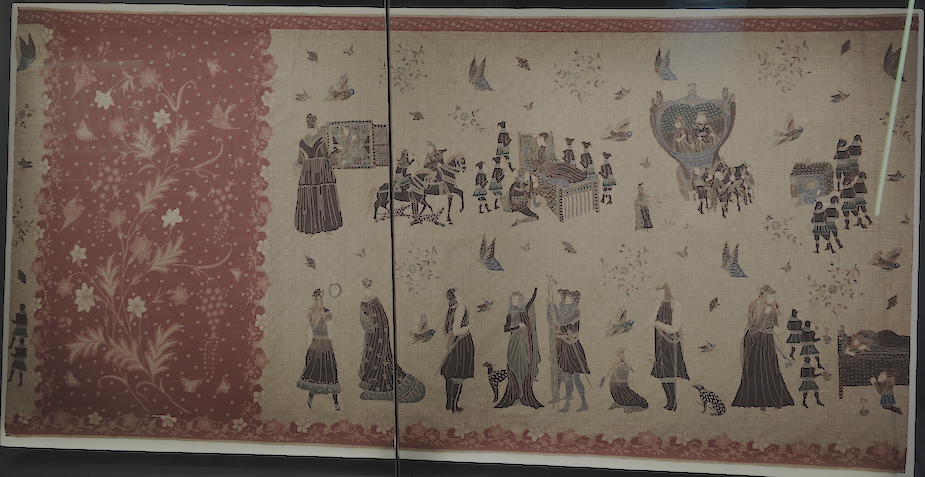
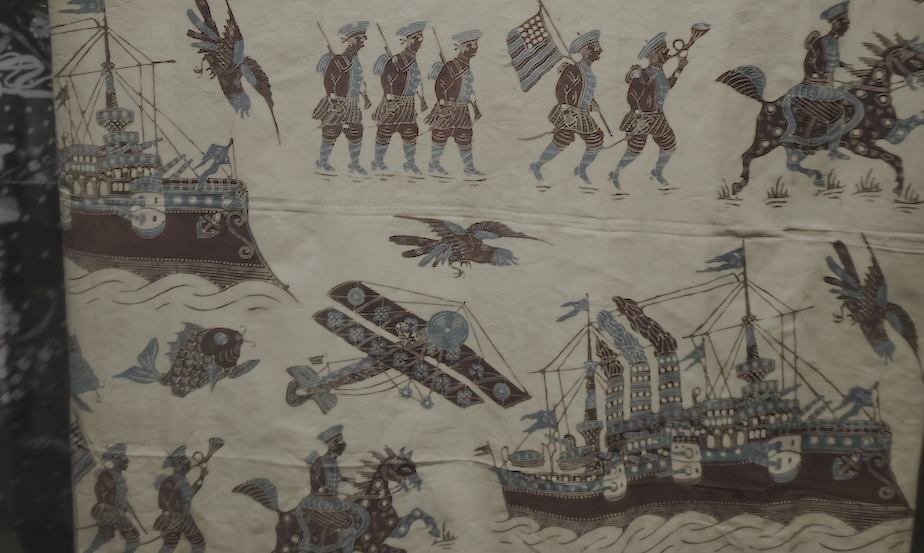
Beneath the beautiful, flowers and orderly soldiers are deeper stories about colonial desire and power that slowly occupied the imagination. Through batik, colonial violence became aestheticised into something soft and intimate.
Colonial elites adopted batik, a deeply local cultural form, while inserting their own symbols and fantasies of authority into it. They attempted to become culturally familiar while maintaining distance and hierarchy. There is an irony embedded within this process; they admired Javanese aesthetics and local refinement, yet also sought to control and redefine them according to colonial standards. By incorporating batik into their lives, colonial elites seem to insert themselves symbolically into systems of legitimacy that were never originally theirs.
The violence of colonialism emerged more subtly through aesthetics, markets, taste and desire. This is the psychological dimension of colonialism, an epistemic violence that reshapes how colonised societies imagine beauty and modernity through the value of the colonisers. Coloniality survives because it teaches people to desire the world through colonial frameworks.
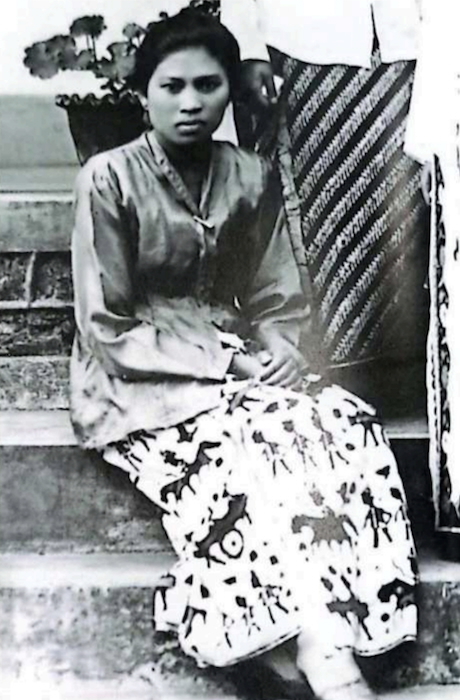
As philosopher and psychiatrist Frantz Fanon described it, this psychology persists long after formal colonialism ends. Colonialism may disappear administratively, but coloniality lingers within imagination, cultural standards, even collective desire; such aesthetics continue to circulate as objects of refinement and prestige, often detached from the violence that originally produced them.
Using one’s weapon against them
Batik was never a passive product of culture. Even within colonial structures, local artisans remained active participants in negotiating meaning and representation. During the construction of The Great Post Road (1808-1811), the stones that originally lined the coastline, along with those assumed to be from candi (Buddhist or Hindu temples), were demolished and used as road material. People in Lasem, on the north coast of Central Java, began using batik as a mnemonic device, incorporating the stones into its pattern. This led to the creation of Batik Kricak, meaning gravel or stone fragments. The gravel is represented by white dots on the base pattern of the batik, which will be fused with other patterns and ornaments. Batik became a complex contact zone where cultural encounters between the coastal communities in Java and colonial oppression produced hybrid forms that were shaped continuously through negotiation. A clandestine method to preserve memory.
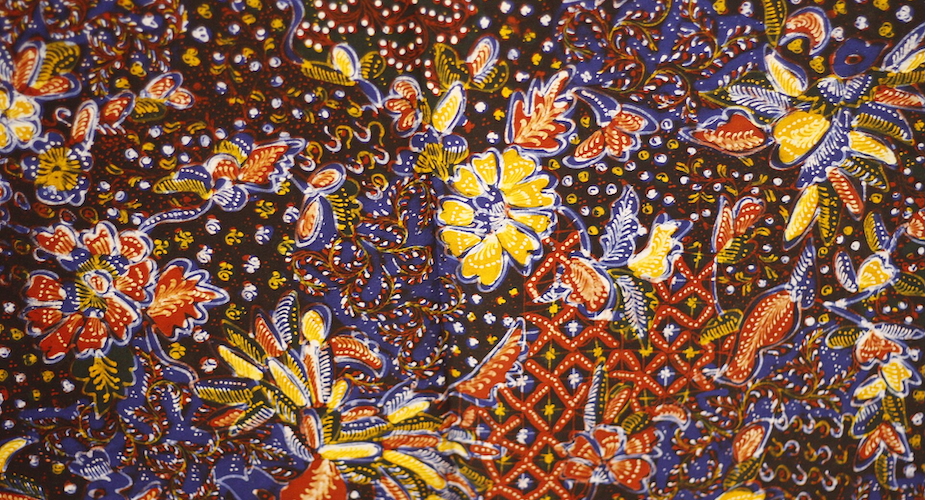
In a similar way, contemporary batik makers like Ridi are also intervening from below. Using visual narrative elements from Indo-European batik, which display marching soldiers and fairy tales, Batik OKRA reclaims its storytelling potential for Indonesian historical memory. If colonial batik once spoke of colonial refinement and order, contemporary batik narrates raw, honest resistance from the colonised.
One of the most striking aspects of Batik OKRA is its scenic imagination of Surabaya before the Dutch arrival when Surabaya was a space of trade, movement, local power and cultural encounter. This becomes important because colonial narratives often frame Indonesian cities as spaces that only became civilised through their intervention. Precolonial urban life is frequently erased and reduced to vague backgrounds before colonial modernity supposedly arrived.
Through these depictions, Surabaya’s identity as an advanced colonial port city or battlefield of resistance is reimagined as a living landscape with its own historical continuity. The cloth quietly insists that history did not begin with colonial empire civilisation.
Batik OKRA also chooses to revisit one of the most charged moments within Indonesian national memory: the Battle of Surabaya of 1945. Illustrating the battle and anti-colonial struggle through images of guns and explosions, the batik transforms into a commemorative medium carrying collective memory into the present.
While colonial batik conveys colonial triumph visually through images of soldiers marching, in this particular work that same visual language is appropriated and redirected toward Indonesian resistance. The medium remains familiar, but the historical gaze shifts entirely, framing it as a subtle act of decolonisation, and reclaims who gets to narrate violence, struggle and memory.
‘I didn’t start as an artist. I was in the Air Force. It was after retirement that I got into batik. Perhaps this is where the true soul lies, jiwanya memang di sini,’ Ridi unfolds a finished batik as we discuss how he translates his understanding of violence into artwork on The Battle of Surabaya piece.
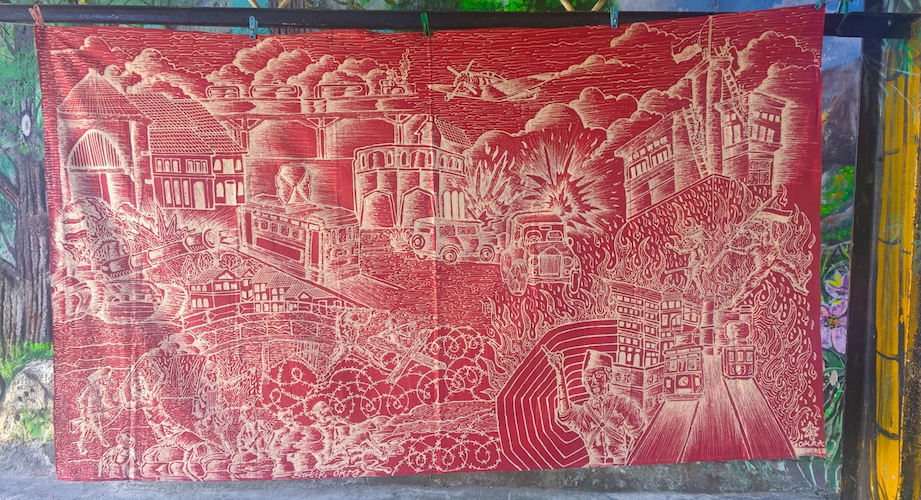
Ridi Sulaksono’s background as a retired military officer also shapes the emotional texture of his works. His depictions of violence differ from the detached romanticism often found in colonial military imagery transformed into decorative prestige. Through Ridi’s batik tool, known as a tjanting, conflict is expressed in direct, explosive emotions. Violence is remembered as something lived, endured and inherited collectively.
This distinction becomes important within contemporary discussions surrounding decolonisation – a concept that does not necessarily mean the outright rejection of all colonial-era cultural products. Rather, it requires critically understanding the structures of power embedded within them. The issue is not simply whether colonial batik is beautiful, but why certain symbols of colonial prestige continue to feel desirable in the present. The depiction of violence, figurative or not, may serve as a wake-up call in the decolonisation process.
Lasting legacy of a dogma
Coloniality survives because its aesthetic has been naturalised. Colonial symbols have over time become detached from their histories of domination and absorbed into everyday standards of beauty. Decolonisation therefore begins through critical awareness; it asks people to question how colonial violence continues to invisibly haunt the taste and historical imagination.
Contemporary batik has the potential to alter this unconscious taste shaped by colonialism. This demonstrates that Indonesian artists can reclaim visual storytelling from colonial frameworks and redirect it toward local histories. This might reflect broader shifts within Indonesian heritage discourse, particularly the growing emphasis on memory from below. Communities themselves participate in reanimating history through everyday cultural practices, oral memory, even tourism.
The batik is also loaded with Ridi Sulaksono’s own heritage in Kranggan, Surabaya. Ridi draws depictions of markets and trade networks of old Kranggan in his batik from his family’s stories, passed through generations; making it a living archive. The cloth carries fragments of memory that official narratives often fail to preserve. It gives room for rasa, sentiments or feelings that allow history to circulate through intimate, ordinary life that is wearable.
It reminds us that resistance sometimes survives loudly through unforeseen ways, where wax lines trace forgotten cities, through the explosions of battle embedded into cloth. And with the appropriate media, appropriate rooms, violence may sometimes be spoken out loud to show the atrocities of oppression. Batik remains deeply political because it is deeply communal, as it takes up a big portion of Indonesian’s life as both a familiar garment and an identity.
Through its reinterpretation of Surabaya’s past, Batik OKRA transforms batik into a living act of remembering by imagining. Who gets to narrate history and memory? Which symbols continue to define beauty and prestige in a postcolonial society? It does not end with Batik OKRA; contemporary Indonesian batik has the potential to demonstrate that we are all active participants in meaning-making, and we have the right to reinterpret taste shaped by coloniality.
Noandha Dhegaska is an independent social researcher and ethnographer exploring themes of coloniality/decoloniality, heritage from below, dark tourism, memory and hauntology.