
The India-Japan defense partnership is entering a new phase. The two countries have deepened maritime cooperation for over a decade through regular naval exercises, defense dialogues, logistics agreements, and shared support for a Free and Open Indo-Pacific. Now the strategic demands of an increasingly contested maritime environment require the partnership to evolve beyond operational cooperation. Recent developments such as the transfer of Japan’s advanced Unified Complex Radio Antenna (UNICORN) mast technology to the Indian Navy, Japan’s relaxation of its arms exports policy, and discussions on co-developing Mogami-class frigates suggest that the future of India-Japan security cooperation also lies in the shipyards.
This shift reflects broader changes in the Indo-Pacific security landscape. China’s expansionist behavior and its increasing presence in the Indian Ocean have prompted like-minded countries to strengthen both deterrence and defense-industrial resilience. For both India and Japan, the challenge is now about building the industrial capacity needed to sustain long-term maritime power. Defense industrial cooperation, particularly in naval shipbuilding, provides a pathway to achieve that objective.
The agreement on Japan’s UNICORN mast system signed in November 2024 marks an important milestone in this regard. UNICORN is designed to integrate multiple communication, radar, and electronic warfare functions into a single mast to significantly improve warships’ operational efficiency while also reducing their radar signature. Importantly, the agreement showcases Japan’s growing confidence in transferring sophisticated defense technology to India as it signals an unprecedented level of strategic trust between the two nations.
The UNICORN agreement serves as proof that India and Japan can move beyond a conventional buyer-seller relationship toward more collaborative defense production. The logical next step here is shipbuilding. India is a trusted strategic partner for Japan with an expanding defense industrial base capable of supporting larger collaborative projects. For India, which seeks to modernize its naval capabilities while advancing the objectives of Aatmanirbhar Bharat (self-reliance), access to Japanese technologies can complement indigenous shipbuilding programs.
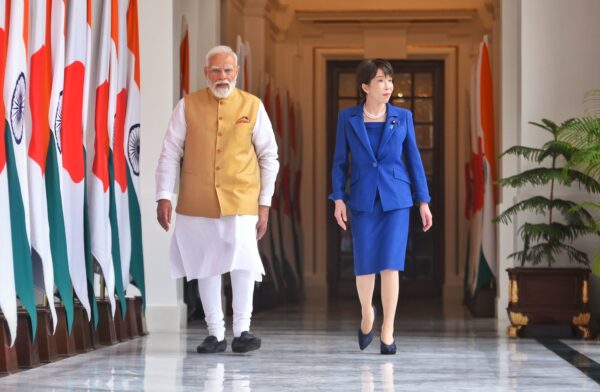
During Japanese Prime Minister Takaichi Sanae’s recent visit to India in July 2026 for the 16th India-Japan annual summit, the growing convergence between defense industrial cooperation and economic security was underscored. The summit emphasized enhancing defense industrial cooperation between the two countries. Both governments recognized that resilient supply chains, trusted technologies, and defense manufacturing are integral to national security.
Shipbuilding sits at the intersection of these priorities. Joint shipbuilding creates long-term industrial linkages that involve advanced manufacturing, electronics, propulsion systems, artificial intelligence, and maintenance ecosystems. Such cooperation also strengthens both military capability and economic resilience. In this context, Japan’s proposal to jointly develop and produce Mogami-class frigates with India deserves serious consideration. The Mogami class represents one of the most advanced multi-mission frigates currently in production, combining stealth features, high levels of automation, anti-submarine warfare capabilities, and modular mission flexibility.
For India, collaboration on such a platform may go well beyond acquiring another class of warship. Indian shipyards have progressed in he design and construction of destroyers, frigates, and offshore patrol vessels. However, Japan’s expertise in automation, integrated ship systems, and advanced maritime electronics could enhance India’s next generation of naval platforms. Moreover, co-development would facilitate technology transfer, strengthen domestic manufacturing, and contribute to the development of a competitive indigenous defense industrial ecosystem. Japan’s advanced design and production expertise could prove to be beneficial for India’s ambition to become a self-sufficient shipbuilding powerhouse.
Despite possessing world-class maritime technologies, Japanese defense companies face the constraints of a relatively small domestic market. Therefore, partnering with India would provide greater production scale, strengthen supply-chain resilience and support long-term sustainability of Japan’s defense industrial base. The presence of Japan’s industrial companies like Suzuki, Mitsubishi and Honda in India shows that Japan’s technology and India’s manufacturing capacity can create a competitive production ecosystem. It would also align with Tokyo’s efforts to build defense industrial partnerships with trusted Indo-Pacific partners, complementing similar initiatives with Australia, the United Kingdom and Italy.
Strategically, India-Japan shipbuilding cooperation would also deepen the regional maritime balance. Both countries occupy a crucial position along the Indo-Pacific’s critical sea lanes and share an interest in preserving freedom of navigation, respect for international law and a rules-based maritime order. Jointly developing naval platforms would improve interoperability across a range of missions, including anti-submarine warfare, humanitarian assistance and disaster relief, and the protection of critical sea lines of communication.
Such cooperation would further reinforce the strategic objectives of the Quad as well. While the framework focuses on non-traditional security issues like critical technologies, resilient supply chains, and maritime domain awareness, stronger bilateral defense industrial partnerships among its members are vital for sustaining long-term regional deterrence. India-Japan collaboration in naval shipbuilding would complement these efforts by creating tangible military capabilities rather than relying on political coordination.
However, strategic convergence alone does not guarantee successful defense industrial cooperation. Both countries will have to navigate challenges ranging from Japan’s evolving defense export regime and domestic political sensitivities to differences in procurement systems and intellectual property arrangements. Therefore, maintaining momentum will require sustained political support and closer engagement between government and defense industries. Nevertheless, the convergence of India’s manufacturing ambitions and Japan’s technological advancements presents a rare opportunity to build a collaborative defense industrial partnership.
A dedicated India-Japan defense industrial framework focused on naval platforms, joint research and development, and workforce collaboration could provide the institutional architecture necessary to translate political intent into industrial outcomes. The coming decade regarding India-Japan security cooperation should focus more on jointly building the capabilities that underpin security in the Indo-Pacific.
If the UNICORN agreement demonstrated what is possible, collaboration on platforms like Mogami-class frigates could establish a new benchmark for defense industrial cooperation between Asia’s leading democracies. At a time when industrial capacity shapes strategic power, building warships together may prove to be an important investment India and Japan can make in the future of the Indo-Pacific.