
Triple Increase in Exports, Domestic Sales, and Production

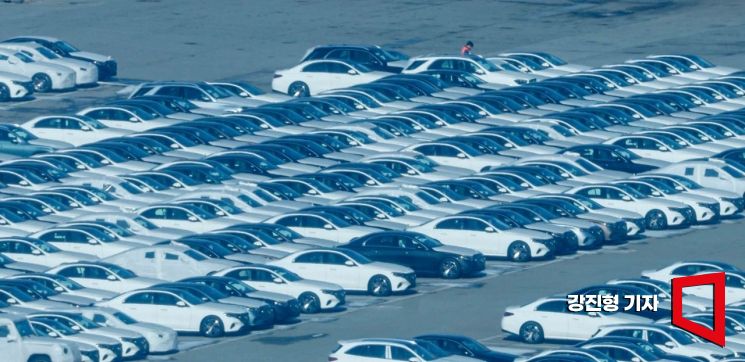
Following President Donald Trump’s signing of a proclamation imposing an unconditional 25% tariff on steel and aluminum products imported into the United States, and his announcement of reviewing tariffs on automobiles and semiconductors, export vehicles are waiting to be loaded at Pyeongtaek Port, Gyeonggi Province, on February 13, 2025. Photo by Jinhyung Kang
Last month, automobile exports, domestic sales, and production all increased simultaneously. In particular, automobile exports set a new all-time high for the month of June.
According to the “June 2026 Automobile Industry Trends” report released by the Ministry of Trade, Industry and Energy on July 15, the value of automobile exports last month reached $6.71 billion, up 5.8% from the same month last year. During the same period, domestic sales rose 9.5% to 160,000 units, and production increased 11.6% to 394,000 units. Notably, export value marked the highest June record to date.
By region, exports to North America grew by 12.3% to $3.605 billion, while exports to the European Union increased by 13.7% to $869 million, leading the results. This was attributed to the expansion of hybrid vehicle exports to the United States and electric vehicle exports to Europe. In contrast, exports to Asia (-13.7%) and the Middle East (-11.4%) declined due to base effects from last year’s robust used car exports and factors such as the ongoing war in the Middle East.
Exports of eco-friendly vehicles also continued to show strong growth. For the first time ever, monthly exports of eco-friendly vehicles exceeded 100,000 units, reaching 102,554 last month, while the export value jumped 31.3% to $2.9 billion. Hybrid vehicle exports increased by 48.7%, and electric vehicle exports rose by 24.4% over the same period.
In the domestic market as well, sales of eco-friendly vehicles drove the growth. In June, 94,222 eco-friendly vehicles were sold, accounting for 59% of total domestic sales. Especially notable was the sharp increase in electric vehicle sales, which surged 92.1% year-on-year to 39,031 units.
Production was influenced by recovering domestic demand and the normalization of component supply. The Ministry explained that the normalization of alternative supply for components, which had previously experienced supply disruptions, resolved issues with finished vehicle production.
However, looking at the first half of the year as a whole, the export value was $35.95 billion, down 1.1% from the same period last year. This is attributed to factors such as a decline in used car exports. On the other hand, production remained steady at 2.111 million units year-on-year, and both domestic and export volumes increased—by 2.5% and 2.1% respectively—demonstrating a stable trend.
Hot Picks Today

30 Beluga Whales Dramatically Rescued After Two Years Trapped in Shuttered Theme Park
The Ministry stated that uncertainties will likely persist in the second half of the year, including wage and collective bargaining negotiations, the global sales expansion by Chinese companies, and the accelerated adoption of artificial intelligence (AI) in manufacturing. It plans to closely communicate with the industry, monitor export and production trends, and continue supporting the transition to next-generation vehicles.
This content was produced with the assistance of AI translation services.
© The Asia Business Daily. All rights reserved. Unauthorized AI training and use prohibited.