
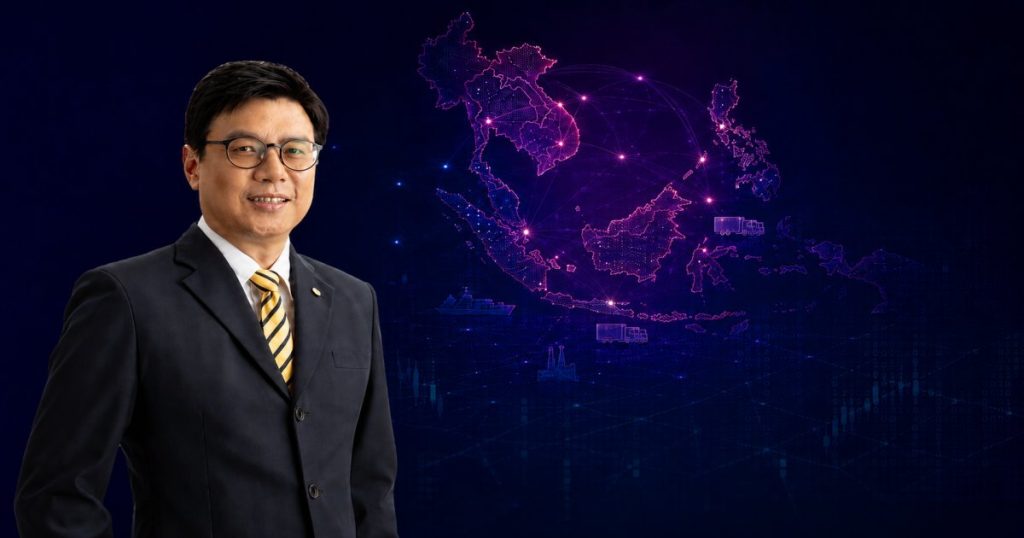
Chong Wee Yeat, Head of Global Banking at Maybank Singapore, is anchoring Maybank’s regional growth strategy in its long-standing presence across Singapore and Malaysia. The bank has operated on both sides of the causeway since 1960, holds the largest banking network in Johor and has the capability in Singapore to open Malaysian ringgit (MYR) accounts for clients. These positions matter because they shape how companies move cash, manage liquidity, seek financing and find local support when they expand between Singapore and Malaysia.
ROAR30 gives that corridor position a measurable growth agenda and represents the next step after Maybank’s M25+ strategy. The group strategy sets a 2030 return on equity (ROE) target of 13% to 14%, placing Singapore’s ambition within a wider push to scale businesses and improve returns. Singapore already contributes about 20% of Maybank group revenue, and Chong said the bank wants “to achieve closer to 30% by 2030,” with the path to that target running through companies that use Singapore as a treasury centre, headquarters base and regional decision-making hub before expanding into Malaysia, Vietnam, Indonesia, the Philippines and other Association of Southeast Asian Nations (ASEAN) markets.
The special economic zone is turning working-level access into banking demand
Maybank’s corridor advantage is built through the operational links it has developed on both sides of the causeway. The Johor-Singapore Special Economic Zone (JS-SEZ) is central to that position because it is designed to deepen investment and operating links between Singapore and Johor, with both governments working on measures to ease approvals, shorten regulatory processes and support companies using the two markets for complementary functions. For banks, those plans matter because companies entering the zone will need financing, treasury services, trade support, foreign exchange (FX), local advice and help moving from investment planning to execution.
Maybank runs dedicated JS-SEZ desks in Singapore and Malaysia, allowing deal teams to monitor client movement, financing needs and investment pipelines from both sides of the causeway. The bank says that its JS-SEZ teams in Singapore and Malaysia coordinate weekly on active deals and client pipelines, including flows moving into Malaysia and those coming from Malaysia into Singapore. That coordination gives Maybank an early view of where companies need financing, treasury services, partner introductions or local advice before an investment becomes a formal banking mandate.
Maybank’s ability in Singapore to open MYR accounts gives the corridor model a practical treasury dimension. For a Singapore-based treasurer managing Malaysian cash, trade settlement or investment flows, that capability can reduce friction in day-to-day liquidity management, especially when combined with extended transaction cut-off times and competitive rates on corridor flows. Chong described the zone’s progress as cumulative rather than sudden, saying its scale is “going to be exponentially greater” as the JS-SEZ continues to develop.
Clearer rules, faster approvals and stronger investor confidence can convert early interest into financing, cash management, trade, FX, payments, advisory and partner-identification demand. Maybank’s advantage lies in being present before those needs become fully formed transactions, especially when clients need help moving from exploration to execution in Johor and Singapore. The opportunity also extends beyond the large investments that dominate public discussion, as Chong noted that smaller and mid-size companies are exploring the zone even though headlines often focus on large data centres and manufacturing commitments.
Mid-size corporates give the strategy its lifecycle logic
The client segment Chong identifies as central to the 20% to 30% revenue ambition is not the large multinational. It is the mid-size company that has outgrown a domestic banking relationship, needs cross-border advice and may not yet receive full attention from global banks. The Malaysia corridor often becomes the first overseas step for Singapore-based mid-size companies, placing them inside Maybank’s core bilateral franchise.
“As the company grows, they will follow a natural corporate path. At some point, they need to expand overseas,” Chong argued. That lifecycle view allows Maybank to build relationships before companies become regional groups, then capture a broader share of trade, payments, lending, treasury and advisory needs as they expand. It also helps the bank position itself earlier in the client journey, before regional mandates are contested by a wider group of banks.
This mid-size focus also explains the shift in Maybank Singapore’s Global Banking portfolio. The business has historically carried significant exposure to real estate lending, but ROAR30 calls for broader participation in non-real estate sectors such as data centres, infrastructure, trade and payments. Chong said the bank is “going to expand beyond” Singapore’s traditional real estate banking base and “grow into other non-real estate sectors”, aligning the franchise with clients building production, logistics, treasury, digital infrastructure and cross-border operating capacity.
New corporate flows are widening the corridor story
Maybank is also seeing foreign corporates use Singapore as a platform for ASEAN entry. Chinese companies expanding into ASEAN as part of supply chain restructuring now represent a more visible source of inbound client flow. Many begin with treasury centres in Singapore before adding manufacturing, distribution and operating assets in Malaysia and other ASEAN markets.
“We see an increase in Chinese companies operating in this region,” Chong noted. “They are increasingly setting up their manufacturing and distribution centres in the region.” Those flows link macro change directly to banking opportunity because tariff uncertainty, China Plus One strategies and the search for resilient supply chains have made ASEAN more important as a production and distribution base. Singapore captures part of that shift through treasury, headquarters functions, professional services and regional decision-making.
Malaysia, particularly Johor, captures another part because it offers land, labour, proximity and industrial capacity that complement Singapore’s strengths. Chong said Maybank is seeing companies from Singapore “moving certain operations into Johor, whether setting up data centres or manufacturing bases.” That places the bank close to the point where expansion strategy turns into capital expenditure, operating set-up and recurring banking flow.
Infrastructure realignment requires a regional banking response
Corporate relocation flows form one side of the ASEAN opportunity, while regional infrastructure creates another. The proposed ASEAN power grid illustrates that second form of demand, as cross-border energy infrastructure would require regional financing, risk management and regulatory coordination. The same banking advantage that supports a company entering Johor can therefore support larger projects that depend on multi-country execution and local market knowledge.
“If this whole power grid takes shape, huge investment will be required,” Chong said, adding that it will require financial institutions “to take a regional mindset and provide a regional-based solution.” This is where Maybank’s network becomes more than geographic coverage. Cross-border energy and infrastructure projects need banks that understand local sponsors, government priorities, currency risks, documentation standards and regulatory conditions across several ASEAN markets.
Singapore is becoming the relationship anchor for ASEAN coverage
Maybank’s operating model for clients moving beyond Malaysia and Singapore rests on a primary-secondary relationship manager structure. When a company based in Singapore enters a new ASEAN market, the Singapore team keeps the primary relationship and remains the client’s main communication point. The in-country team then supports local onboarding, documentation, regulation and market-specific requirements, allowing Maybank to serve a client “going from Singapore to a particular country of investment seamlessly”.
The value of that model lies in the intelligence that local teams can provide. Companies entering Vietnam, Indonesia or the Philippines often need more than financing because they also need to understand local partners, licensing conditions, infrastructure readiness and banking practices. Maybank’s presence across almost all ASEAN markets gives it a ground-level base that can support the Singapore-led relationship.
Chong said having an established presence enables Maybank to provide “on-the-ground intel” to clients making investment decisions. That kind of intelligence helps the bank move beyond product provision into market-entry support. It also strengthens the relationship because the client experiences Maybank as one regional bank rather than a set of disconnected country franchises.
Digital settlement and values-based finance deepen the relationship
Maybank’s regional model cannot rely only on access and coverage. Once the bank wins relationships through corridor depth, it must defend and deepen them through faster settlement, stronger execution, sector understanding and differentiated financing principles. Tokenisation and Islamic finance therefore belong in the same story because both aim to increase the value of the relationship after Maybank has secured the client’s regional trust.
Clients expanding across ASEAN increasingly expect faster settlement, fewer manual processes and a more seamless treasury experience across borders. Maybank Singapore completed the first tokenised deposit transaction across the causeway, which Chong framed as a response to changing client expectations. “The client expectation will change,” he said. “They want to see a more immediate and seamless process and solution.”
The commercial point is not tokenisation for its own sake. Maybank’s tokenisation work, including on-chain FX and near real-time cross-border payment pilots, is relevant because it addresses the same problem as the corridor model: clients want cross-border banking that is quicker, more connected and easier to execute. Islamic finance adds a values-led lending lens to the same relationship strategy, supporting financing decisions through sector understanding and sustainability.
The next test is whether Maybank can institutionalise its corridor playbook
The strategic way forward lies in turning proximity into process. Maybank already benefits from familiarity, regulatory access and local presence, but a regional franchise will depend on how consistently it codifies those advantages across client onboarding, credit assessment, cross-market coordination, product delivery and post-investment support. The next phase under ROAR30 should therefore be judged less by the number of markets covered and more by whether clients receive the same quality of advice, responsiveness and local intelligence when they move from Singapore into Johor, Vietnam, Indonesia or the Philippines.
That is where the corridor becomes more than a source of flow. If Maybank can use the JS-SEZ to refine a repeatable model for early origination, local problem-solving and cross-border execution, Singapore’s role inside the group will depend on whether it can originate, coordinate and retain more regional client relationships. The bank’s advantage will then rest on how consistently it converts long-standing presence into cross-border client execution.