
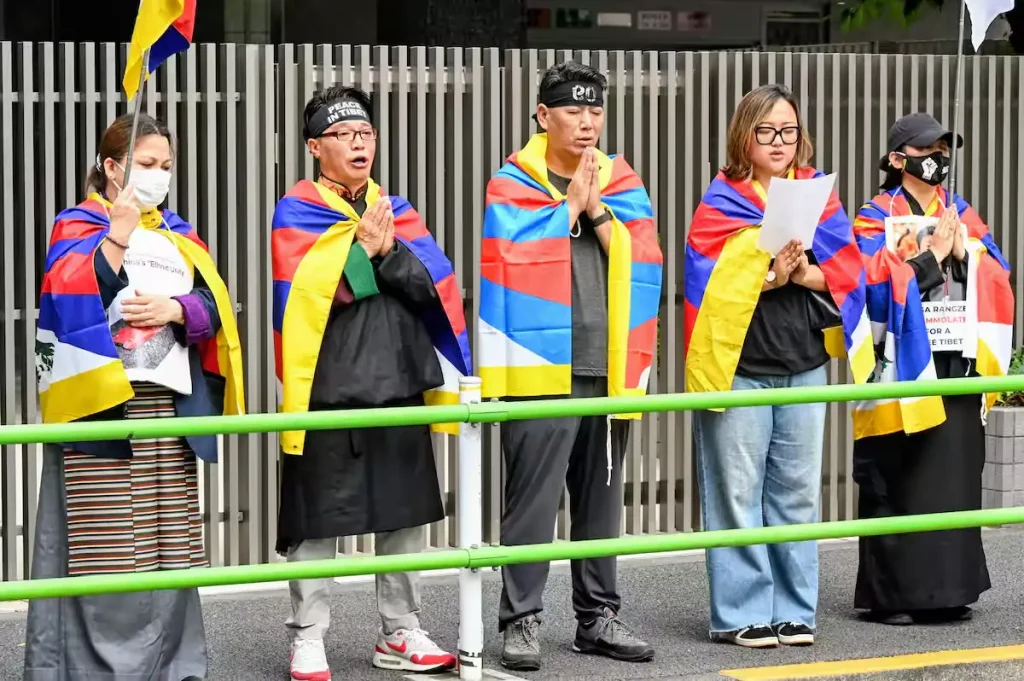
Tibetans living in Japan gathered outside the Chinese Embassy in Tokyo on July 4 to protest China’s Ethnic Unity and Progress Promotion Law, which came into force on July 1. The demonstrators called for unity to protect the Tibetan language and culture.
The protest also honored a Tibetan activist who died after setting himself on fire in the United States in protest against the law. Participants offered prayers in his memory and reaffirmed their opposition to the Chinese government.
The new law stipulates penalties for acts deemed to undermine the “unity of the Chinese nation” and explicitly calls for the comprehensive promotion of Standard Chinese (Mandarin). Critics fear it will further accelerate assimilation policies in regions such as the Tibet Autonomous Region.
The activist who self-immolated was identified as Lobga Rangzen, 42, who reportedly fled to the United States as a refugee about 20 years ago.
On July 2, outside the United Nations headquarters in New York, he wore a traditional Tibetan chuba robe, held the Tibetan flag, recited prayers, and set himself on fire. Footage of the incident spread on social media, and he was later pronounced dead at a hospital.

Erasing Tibet
Speaking at the rally, Kalden Obara, former representative of the Tibetan community in Japan, expressed concern that the new law could lead to further restrictions on “the Tibetan language, culture, religion, and our identity as Tibetans.”
Regarding Lobga’s death, Obara said, “We received the news with profound sorrow. We seek human rights, freedom, and dignity through peace and dialogue—not violence.”
He warned, “If our culture and language disappear, it means the Tibetan nation disappears. That must never happen. China invaded Tibet and is trying to erase the Tibetan nation completely from the world. But we Tibetans will never give up.”
Obara said he believed Lobga’s self-immolation was intended “to draw the attention of the United Nations and the international media to Tibet.”
‘We Will Not Be Defeated’
Since unrest broke out in Lhasa in 2008, around 160 Tibetan monks and other Tibetans have reportedly self-immolated in protest in Tibetan-populated areas of China.
At the same time, Obara noted that Tibetan Buddhism regards suicide as a sin.
“Self-immolation is an extremely grave sin. Taking the life your mother gave you and raised is considered the greatest sin. Even so, Tibetans are willing to bear that sin if it is for Tibet.”
Tsering Dorjee, who organized the rally, said: “For more than 70 years, China has done whatever it wanted. Through this unity law, it is now trying, as a final step, to erase Tibetan culture and identity. But we will not be defeated.”

RELATED:
(Read the article in Japanese.)
Author: Shimpei Okuhara, The Sankei Shimbun