
Stay up to speed with stories written by drivers, for drivers.
Get automotive news, DIY tips, market trends, in-depth car profiles, and more right in your email inbox.
It was less than 25 years between Karl Benz hitting the road and the Wright Brothers taking to the sky, and almost ever since, the two forms of transport have been inextricably linked.
Sustained flight was made possible by the internal combustion engine, which first powered the automobile. Conversely, aviation has given the auto world many innovations, from anti-lock braking to lightweight materials. There have even been numerous ill-fated attempts to get the jet engine to work at ground level.
However, when it comes to the synergy between cars and planes, nothing beats their names, for if a vehicle sounds swift enough to soar, then it will almost certainly sound speedy and exciting on the road—as demonstrated by these nine examples. We’ll start with the unlikeliest pair, one likely only known by private aviation buffs.
Aerostar
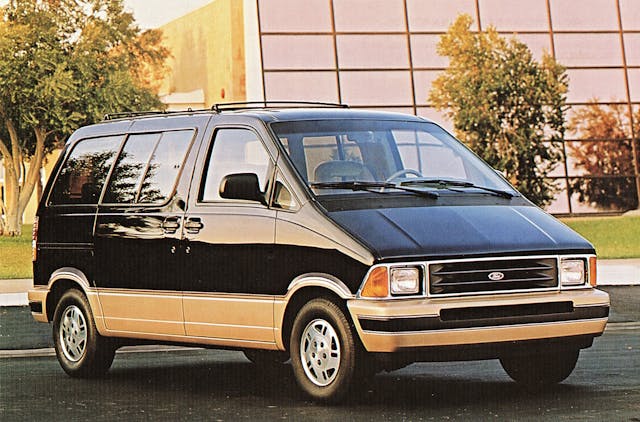
The car: Ford’s first minivan only emerged in 1985 after a gestation period that began in the early ’70s. The “garageable” van had to be able to fit through a standard garage door, but still seat seven in comfort, and offer a huge carrying and towing capacity. The boxy, rear-driven Aerostar was the answer for the next 12 years.
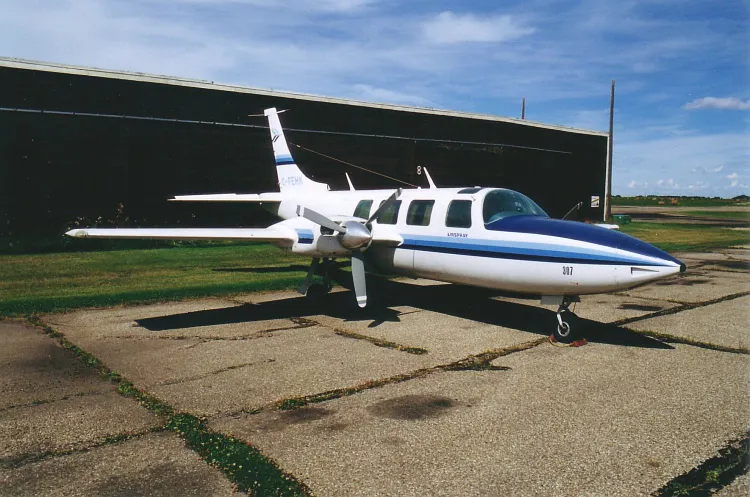
The plane: Whether by coincidence or design, the flying Aerostar ceased production just a year before the Ford hit the road. The twin-engined executive aircraft made its debut in 1967, built by the Ted Smith Aircraft Company and later by Piper, which acquired the rights in 1978. Lycoming provided the engines for the six-passenger plane, which could fly over 1000 miles on a full tank at a height of 25,000 feet.
Concorde

The car: Would you believe that the biggest influence on the design of Chrysler’s Concorde was not the supersonic airliner with which it shares its name, but a Lamborghini? Having just bought the ailing Italian supercar maker, Chrysler reworked one of its existing concept cars to become the Lamborghini Portofino concept. That cab-forward design was then echoed to an extent in the full-size Concorde sedan, which was released in 1992 as a ’93 model. The sedan most noted for its jellybean looks and efficient use of space was replaced in 2005 by a return to rear-wheel-drive form in the Chrysler 300.

The plane: Still the only commercially viable (and that is a bit of a stretch statement) supersonic passenger airliner ever made, Concorde was an Anglo-French venture between the British Aircraft Corporation and Sud Aviation. Initial talks about the project began in 1954, but it wasn’t until 1975 that Concorde was declared airworthy. The cost of development was equivalent to a staggering $2.4 billion in today’s money, and its only major routes were across the Atlantic, where the plane’s supersonic boom wouldn’t disturb anyone. London to New York took less than three hours at twice the speed of sound. Just 20 Concordes were built, operated only by Air France and British Airways, and the sleek delta wing jet’s final flight was in 2003.
Cutlass

The car: Launched as the entry-level Oldsmobile in 1961, the Cutlass would live on, through five generations, until 1999. Over the years, it evolved from a compact to a mid-size, and, in the case of the Cutlass Supreme, a sumptuous and powerful coupe. For a time, it was the best-selling car in America. The sharpest variant of the Cutlass was, of course, the 4-4-2 (which was Cutlass-based but moved between being its own model and a trim), and in its strongest form offered some 370 hp from its 455-cubic-inch V-8.

The plane: Oldsmobile’s naming inspiration came from the Vought F7U Cutlass, a carrier-based jet fighter bomber that was developed shortly after the end of World War II. It was an odd design based on captured German blueprints, which, no doubt, helped speed it into production by 1951. It was not, however, a very stable plane, with pilots reporting no end of handling issues. Four test pilots perished when developing the aircraft, and a further 21 Navy pilots also perished when it was in service. It was withdrawn from service less than ten years after being introduced.
Comet

The car: Mercury looked high above the clouds to name its Meteor and Comet, cashing in on enthusiasm for the Space Race of the 1960s, so it is no coincidence that they share their names with aircraft. The first Comet was essentially a badge-engineered Ford Falcon, but the car’s third iteration moved to the bigger Fairlane platform, and for its final generation (built from 1971-1977), it was based on the Maverick. The highest-flying Comet was the Cyclone GT R-Code, which packed a 427-cubic-inch V-8, and road-going Comets were more reliable than the airborne ones, with one example reported to have been driven over 570,000 miles before its nonagenarian owner, Rachel Veitch, was forced to stop driving by failing eyesight.

The plane: The de Havilland Comet was a true aviation pioneer. It was the first commercial jet airliner, with the design led by the man behind the Mosquito fighter-bomber. The prototype flew in 1949, and paid flights began in 1952. Unfortunately, within a year, three Comets were lost in flight, due to what would later be discovered as metal fatigue in the airframe. With a reputation that would be forever tarnished, only 114 Comets had been built when production was stopped in 1964.
Lightning

The car: Actually, this one’s a truck. Two to be precise, but we know our audience, so we won’t focus on the soon-to-be-defunct F-150 Lightning electric pickup, but instead on the SVT Lightning, which was introduced in 1992. Its 5.8-liter Windsor V-8 knocked out 240 hp thanks to a high-flow intake and heads, as well as fancy hypereutectic pistons. Formula 1 champion Jackie Stewart was even brought in to finesse the handling. When the tenth-generation F-Series arrived in 1997, Ford added a supercharger to its 5.4-liter Triton V-8 to create the flashiest ICE-powered Lightning.

The plane: The BAC Lightning was one of the longest-serving interceptors in the British Royal Air Force. Signing on for duties in 1960, the Lightning remained on active service until 1988. Able to reach double the speed of sound thanks to its unusual, stacked jet engines, it had such an exceptional rate of climb that pilots reportedly compared it to riding a rocket.
Mustang

The car: The original Pony car, still going strong since 1964, was a much bigger hit than Ford ever imagined. Ford predicted it could sell around 100,000 Mustangs a year, but in the very first 12 months, more than 400,000 found homes. Today’s Mustang can’t match those sales numbers (45,333 were sold in 2025), but it absolutely destroys the original car’s performance figures. With a 289 small-block HiPo motor, the first Mustang made 271 hp, while the latest GTD delivers an astonishing 815 horses.

The plane: One of the pivotal fighters of the Second World War, the P-51 Mustang was designed and built for Britain’s Royal Air Force under contract from the British Aircraft Purchasing Commission, joining World War II in 1941 before the U.S.A. entered the fight. Initially powered by an Allison V-1710 engine, the Mustang was soon fitted with the more powerful Rolls-Royce Merlin. More than 15,000 were built, playing a crucial role in the Allies’ victory, with Mustang pilots believed to have downed almost 5000 enemy aircraft.
Spitfire

The car: Michelotti’s design for a new Triumph sports car, based on the Herald, was almost lost. When Triumph was acquired by Leyland, a prototype for the two-seater was found under wraps and fast-tracked for production. The Spitfire would go on to be hugely successful, with more than 300,000 cars sold over 18 years and five iterations. Carrying over the Herald’s chassis (albeit shortened) and mechanicals made it inexpensive, but the styling, complete with clamshell hood, made it far more sporty than the sum of its parts. The Spitfire proved popular in North America, especially in its later 1500 guise, with it making up almost a third of total sales.

The plane: The hero of The Battle of Britain was the Supermarine Spitfire. Although it’s true that the Hurricane flew more missions, the Spitfire’s victory-to-loss ratio far exceeded its stablemate, and its V-12 Rolls-Royce Merlin engine meant it could more readily match its Messerschmitt 109 rival. More than 20,000 Spitfires were built and supplied to the RAF, the Royal Canadian Air Force, the Free French Air Force, and the U.S. Army Air Forces.
Skyhawk

The car: The initial Buick Skyhawk was essentially a rebadged Chevy Monza (as was the Oldsmobile Starfire), utilizing the GM H-body platform. It was, rather generously, compared by some to the Ferrari 365 GTC/4 for its coupe styling when it came out in 1975. 1982 would see the Skyhawk switch to front-wheel-drive on the new J-body, and a three-door hatch, four-door sedan, and station wagon were added to the range.

The plane: The Douglas A-4 Skyhawk first saw the light of day in 1955 when the prototype set a world speed record of 695.163 mph. The carrier-ready light attack aircraft was lightweight and powerful, and played a key role in the Vietnam War. It was also a pioneer of a “buddy” air-to-air refuelling, which negated the requirement for a specialist tanker aircraft.
Viggen

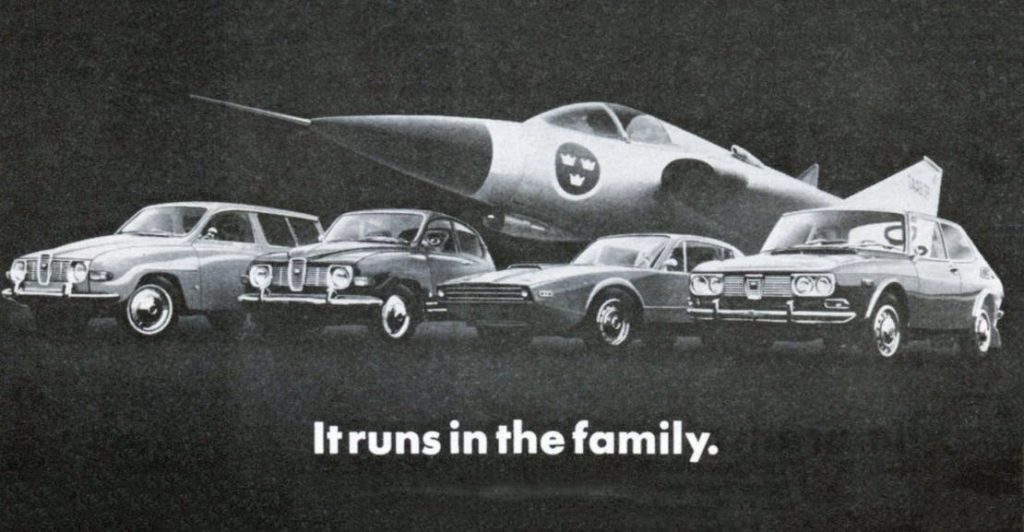
The car: Although by the Saab 9-3 Viggen’s launch date in 1999, Saab’s automotive division was owned by GM and therefore separate from the aviation firm, pitching the most potent 9-3 as a jet fighter for the road was too good a marketing opportunity to be missed. Developed by the company’s Special Vehicle Operation, with help from TWR, the Viggen possessed various aerodynamic accoutrements, special seats, upgraded suspension, and a tweaked version of the 2.3-liter turbo four from the larger 9-5.

The plane: The Saab 37 Viggen broke new ground with its canard wing design, and was also the first combat aircraft to use a central computer and integrated circuits for its electronic systems. In 1970, that made it the most advanced multirole jet fighter in the world. It could operate as a fighter bomber, maritime patrol, reconnaissance, strike fighter, and trainer plane—and travel at Mach 2.1. You’d think that all this would have made it the envy of every air force around the world, but Saab was unable to convince overseas buyers, and only 329 were made.