
Welcome to Foreign Policy’s South Asia Brief.
The highlights this week: Bangladeshi Prime Minister Tarique Rahman makes a significant trip to China, tensions rise as the Taliban say Pakistani strikes in Afghanistan killed civilians, and India sends junior officials to attend the funeral of Iranian Supreme leader Ali Khamenei.
Bangladesh, China Hail ‘New Era’ of Ties
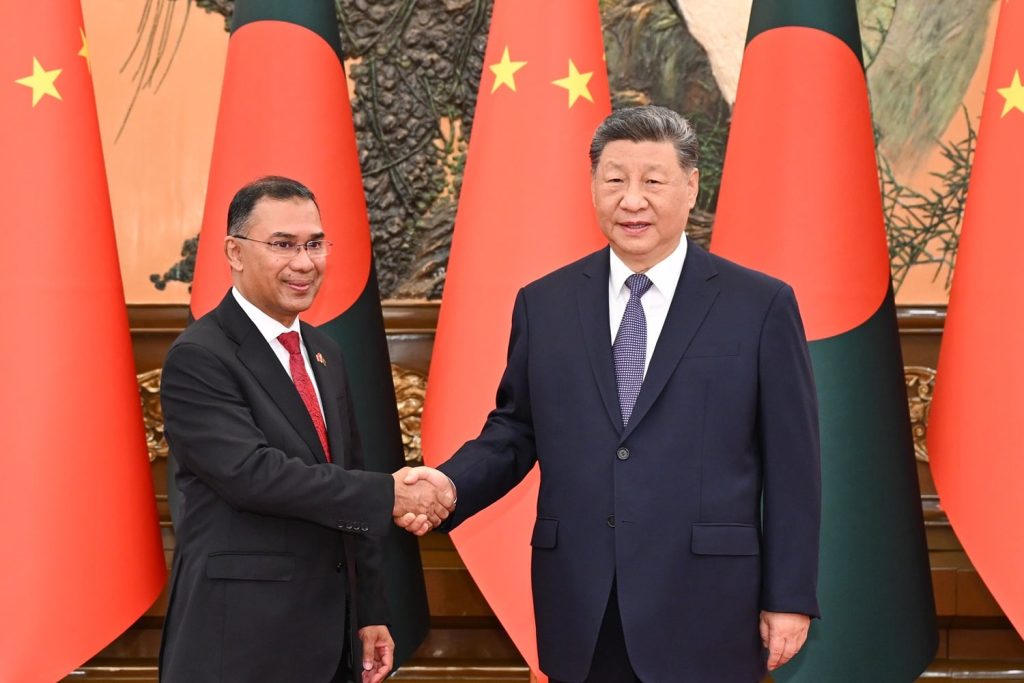
Last week, Bangladeshi Prime Minister Tarique Rahman spent four days in China. The trip, which included an initial stop in Malaysia, was his first abroad since taking office in February.
At first glance, Rahman’s itinerary may not seem like a big deal. China is a top partner and donor of Bangladesh, and bilateral ties have deepened significantly over more than a decade. But the trip was more than just another high-level visit—it has potentially problematic implications for India, China’s rival and a traditional close friend of Bangladesh.
Dhaka and Beijing have called their relationship a strategic partnership since Bangladeshi Prime Minister Sheikh Hasina visited Beijing in July 2024, just before she was ousted amid mass protests. But Rahman’s visit produced a joint statement declaring that the strategic partnership will be elevated to “build a China-Bangladesh community with a shared future in the new era.”
Based on the raft of agreements announced during the visit, this appears to mean that the partnership is branching out into wider areas of cooperation. The countries agreed to partner on connectivity, port modernization projects, and water management. They discussed relocating Chinese factories to Bangladesh to stimulate the latter’s weak private sector.
The two sides announced a 2+2 dialogue between their defense and foreign ministries, an arrangement reserved for especially deep partnerships. One memorandum of understanding even commits Bangladesh schools to teach Mandarin—portending a Chinese soft-power play. Beijing pledged to support Dhaka’s accession to BRICS and the Shanghai Cooperation Organisation.
This is all striking, given expectations that Rahman’s government would seek rapprochement with India. Bangladesh-India ties have sunk since Hasina’s ouster, but some ruling Bangladesh Nationalist Party (BNP) leaders have signaled a desire to get things back on track. A smoother relationship would make it easier to engage on critical issues from trade and connectivity to border security.
However, there are also understandable reasons for Rahman to make this landmark visit to China so early in his term. Bangladesh’s economy—once a regional success story—is sputtering, and it could use Chinese capital in the long term. More broadly, Bangladesh has few deep and multifaceted partnerships; China’s global stature makes it a useful exception.
Finally, among the Bangladeshi public, there is robust pro-China sentiment and strong anti-India sentiment. Rahman’s visit gives a political boost to a young government, while a trip to India at this juncture would have presented considerable political risks.
Rahman’s visit amounts to a strategic disappointment for India, which likely quietly welcomed the election victory of the BNP. New Delhi sees the BNP as a more palatable partner than its ally-turned-rival Jamaat-e-Islami, an Islamist party. India has also signaled a desire to patch up ties with the Rahman government, but the China visit is a reminder of why that won’t be easy.
However, Rahman’s trip does carry some risk for Dhaka. The new government has declared a “Bangladesh first” policy, essentially a form of nonalignment that entails pursuing diplomacy that advances Bangladesh’s interests and avoids deferring to any one country. But if Dhaka appears to be moving too close to Beijing, that undercuts the policy.
Bangladesh’s leaders have actually called for nonalignment since the country’s earliest years, despite Dhaka’s explicit tilt toward New Delhi during the Hasina years. Today, Bangladesh has an opportunity to reassert this policy, if it can balance all its ties.
What We’re Following
Fighting surges on Afghanistan-Pakistan border. The Afghanistan-Pakistan border saw some of its worst violence in months this week, as Pakistan carried out airstrikes across eastern Afghanistan against what it called terrorist targets.
The military operations followed an attack against security forces in Karachi, Pakistan, that that Pakistan insisted was planned and perpetrated from Afghanistan by militants protected by the Taliban regime. The Taliban said civilians were killed in the Pakistani strikes—a claim corroborated by the United Nations, which said at least 28 civilians died.
This year, border fighting between Afghanistan and Pakistan has at times escalated enough to spark fears of outright war. Much has been said about the key dimensions of this crisis, from growing regional instability to the collapsing relationship between the Taliban and its former ally in Islamabad.
But this week’s attacks, especially with their civilian toll, hint at something deeply unsettling for the Afghan people. For nearly five years, despite living under the repressive rule of the Taliban, Afghans have experienced relative peace for the first time in decades. The ongoing fighting threatens to shatter that respite.
Indian officials to attend Khamenei funeral. Indian media report that Syed Ata Hasnain, the governor of the state of Bihar, and Pabitra Margherita, the minister of state for external affairs, will represent India at the funeral of Iranian Supreme Leader Ali Khamenei this weekend. Iran invited Prime Minister Narendra Modi, but his office indicated that he won’t be able to attend.
The decision to send two relatively junior officials to the funeral has raised some eyebrows. But from an Indian foreign-policy perspective, it makes sense: India’s ties with Iran are not very warm, especially since it halted Iranian energy imports under U.S. sanctions pressure.
India has also bolstered partnerships with Saudi Arabia, Iran’s regional competitor, and dramatically scaled up ties with Israel, Iran’s bitter enemy. Still, the optics of India seeming to downplay Khamenei’s funeral aren’t good, given India’s goal of serving as a leader of the global south.
The situation underscores how New Delhi’s policy of strategic autonomy—which aims to balance ties with players across the board—doesn’t always play out according to plan or shield it from awkward diplomatic moments.
Bangladesh measles outbreak slows. Bangladesh has suffered through one of the world’s worst measles outbreaks this year, and on Monday, the country marked a grim milestone: The total number of suspected cases since mid-March rose past 100,000. Dhaka has been hit the hardest, with nearly half of this total identified in the capital.
But this week, the U.N. reported some good news. First, the number of suspected cases is starting to decline, albeit slowly. Second, vaccinations are starting to pick up—a critical development, given that experts have identified delayed and uneven vaccination campaigns since the ouster of Hasina’s government in 2024 as a major driver of the crisis.
According to the U.N., the current campaign has vaccinated 18.4 million children, going above the target of 18 million. Inside certain Rohingya refugee camps, 94 percent of children have been vaccinated.
FP’s Most Read This Week
Under the Radar
Students in Nepal have staged protests against their country’s education system across a few cities in recent days. Their main grievance is what they describe as errors in high school examination results, though demonstrations by medical students have also demanded academic reforms and calls for the education minister to resign.
These are not mass protests, but they still put Nepal’s new leaders in the hot seat. The government won elections in March, six months after demonstrators overthrew the previous government; it pledged to undertake major reforms and expunge corruption. Discontent about education policy will test this commitment.
Additionally, there is a lot at stake: Nepal has major challenges with brain drain and unemployment, making successful education all the more essential for young people.