
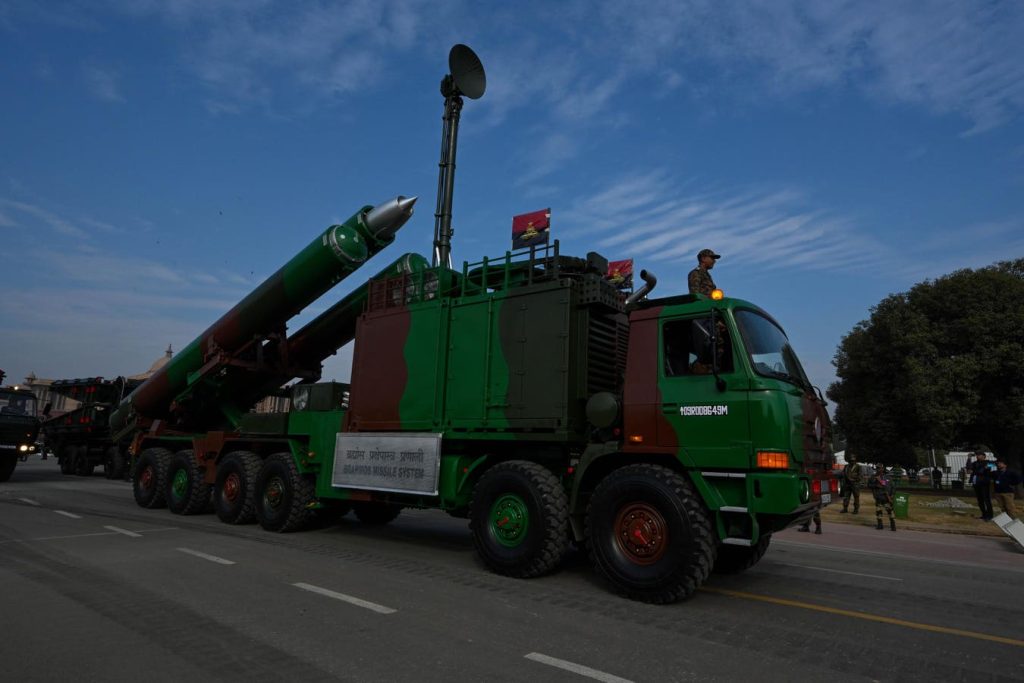

BrahMos missile during the rehearses for the Republic Day Parade 2023 at the Kartavya Path on January 20, 2023 in New Delhi, India. (Photo by Raj K Raj/Hindustan Times via Getty Images)
Hindustan Times via Getty Images
India’s government is reportedly in talks with the United Arab Emirates over a potential sale of its supersonic BrahMos cruise missile, jointly developed with Russia. Such an acquisition would enhance Abu Dhabi’s already considerable and diverse arsenal of standoff weapons.
India is discussing a potential sale of the BrahMos and its homegrown Akashteer air defense system to the UAE, according to a Reuters report published on June 22.
The UAE Air Force executed strikes inside Iran and against Iranian islands in the Persian Gulf throughout the U.S.-Israeli war with Iran that began on February 28 and ended with a fragile ceasefire on April 8. With U.S. and Israeli intelligence support, the UAE targeted Abu Musa and Qeshm islands, the Lavan Island oil refinery, the port city of Bandar Abbas, and the Asaluyeh petrochemical complex, according to a May 29 Wall Street Journal report.
It’s likely that UAEAF fighter jets executing these strikes used standoff munitions to reduce the risk of losing pilots and aircraft to surface-to-air Iranian missiles. For such a small country, the UAE has a sizable and sophisticated air force. The backbone of its fighter fleet is its unique F-16E/F Block 60 “Desert Falcon,” tailor-made for its requirements, supplemented by over 40 advanced Dassault Mirage 2000-9 multirole fighters.
Emirati F-16s carry various bombs and munitions suitable for tactical air-to-ground warfare, such as the Joint Direct Attack Munition, the Paveway bomb, and the GBU-39 small diameter bomb, which has a standoff range of up to 46 miles. Its Mirages carry longer-range air-to-surface missiles more suitable for deep strikes in enemy airspace. These include the Black Shaheen version of the long-range Storm Shadow air-launched cruise missile. As the Stockholm International Peace Research Institute’s extensive arms transfer database notes, this version has a reduced range of under 186 miles in compliance with the Missile Technology Control Regime’s recommended range and payload limitations.
Emirati Mirages and F-16s can both carry the Al Tariq modular kit for the Mk 81, Mk 82, and Mk 83 bombs developed with South Africa’s Denel Dynamics and produced under license. According to the UAE’s Edge Group defense conglomerate, the longer range Al Tariq can accurately engage “stationary, moving and re-locatable targets in a GPS denied environment” up to 75 miles away. The 80 Dassault Rafale F4 fighters Abu Dhabi has on order will also carry these locally manufactured guided munitions.
Not all of the UAE’s long-range missiles and munitions are launched from its fighter jets. And without modifications, it’s unlikely the UAEAF’s F-16s, Mirages, or Rafales will carry any Indian BrahMos missiles Abu Dhabi ultimately acquires. India’s primary standoff cruise missile has versions that can be launched from warships, submarines, aircraft, and mobile land-based launchers. It’s likely the UAE will opt for the latter surface-to-surface variant rather than the air-to-surface one. Consequently, these would enhance Abu Dhabi’s already considerable arsenal of surface-to-surface standoff munitions.
From the United States, the UAE has acquired the M57 Army Tactical Missile System, ATACMS, the M142 High Mobility Artillery Rocket System, HIMARS, and the M31A1 Guided Multiple Launch Rocket System, GLMRS. Abu Dhabi even purchased Scud-B ballistic missiles from North Korea in the late 1980s that can hit targets up to 185 miles away, albeit with limited accuracy. The BrahMos would doubtlessly enhance this surface-to-surface arsenal and uphold the UAE’s policy of widely diversifying its advanced military arsenal.
The Iran war saw ties between the UAE and Israel, which established diplomatic relations under the U.S.-brokered Abraham Accords in 2020, strengthen, with Abu Dhabi thankful for Israel’s deployment of Iron Dome air defense systems and troops on its territory. Israel has developed several air-launched ballistic missiles compatible with fighter jets and used them in combat against targets in Syria, Iran, and the controversial strike targeting Hamas leadership members in Qatar’s capital, Doha. The UAEAF could certainly carry such ALBMs, which are faster than the Black Shabeen, although they may come with similar MTCR-related range limitations, which Israeli ALBMs offered for export, such as the Rampage, are in compliance. Whether exceptions could be made for its Arab ally is anybody’s guess.
“The UAE might well be seeking the kind of long-range joint standoff weapons from the Israelis that Israel used on Doha and Iran,” Ryan Bohl, a senior Middle East and North Africa analyst at the risk intelligence company RANE, told me. “But the procurement would likely be limited, and the UAE would want these weapons for precision strikes on critical targets like key leadership, specific military sites, or military infrastructure related to attacks on the UAE itself.”
Lessons from the Iran war could well influence future Emirati military acquisitions, aside from its enduring diversification policy, which this prospective Indian deal doubtlessly reinforces.