
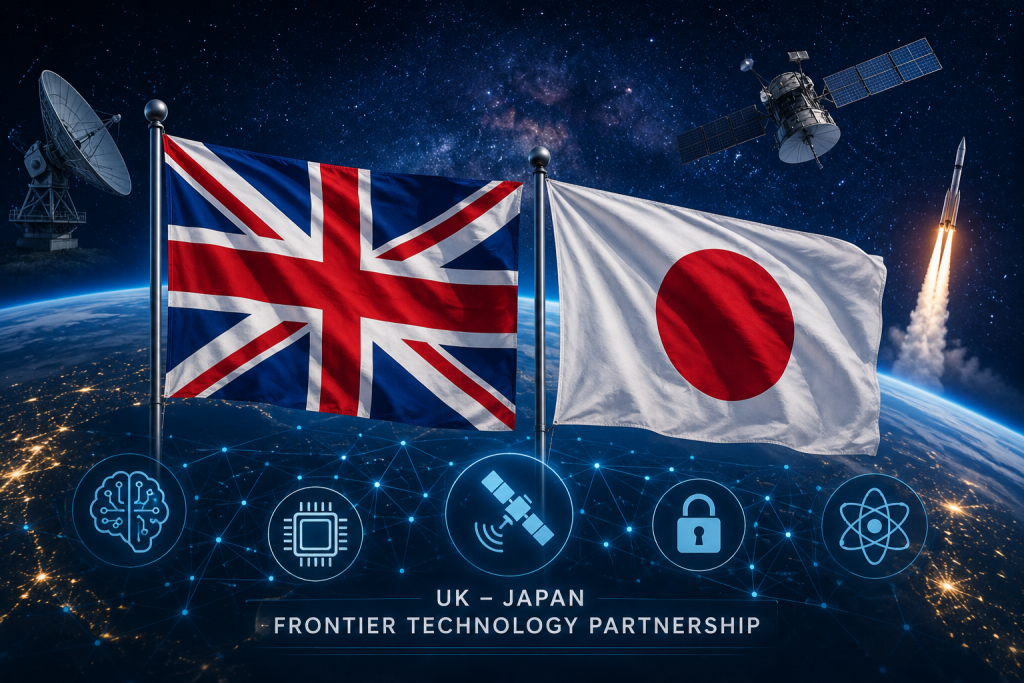
The UK and Japan have unveiled a new “Frontier Technology Partnership” that explicitly ties together cooperation in space, AI, quantum and advanced energy.
A Pact Built Around AI and Science
The partnership was announced by UK Prime Minister Keir Starmer and Japanese Prime Minister Sanae Takaichi. It links Britain’s AI research ecosystem with Japan’s semiconductor and manufacturing strengths. This aims to support next-generation AI models and the infrastructure they rely on. The two governments say they want more resilient, secure supply chains for AI chips and compute. They also want a bigger role in shaping how people design, test, and govern advanced systems.
A central strand is “AI for Science”. London and Tokyo plan joint research programmes that use cutting‑edge AI to accelerate scientific discovery, backed by aligned semiconductor capabilities and high‑performance computing. Both countries will also deepen cooperation between their AI Safety Institutes. They will build common methods for measuring and stress-testing increasingly capable AI systems. These results will feed into international governance efforts, including the Hiroshima AI Process.
Space and “Physical AI” As Shared Testbeds
Space sits alongside AI as a priority domain in the agreement. The partnership calls for closer work on space security, sustainability, and commercial space development. It includes support for industry-led projects and satellite communications technologies. These systems will underpin future AI-driven services in orbit and on the ground.
The two countries also highlight “physical AI” and robotics as strategic tools for complex environments. This includes industrial settings and space-adjacent nuclear sites. Joint work is planned on advanced robotics for decommissioning facilities such as Sellafield in the UK and Fukushima Daiichi in Japan. This is an area where autonomy, sensing, and remote operation directly overlap with space robotics and in-situ servicing technologies.
Building a Broader Frontier Tech Bloc
Beyond AI and space, the framework extends to quantum computing and communications, cybersecurity, 6G‑class connectivity, biotechnology and advanced nuclear and fusion energy. It is a non-binding political agreement. However, it builds on existing bilateral deals in quantum, cybersecurity, and economic security. It is also paired with new industry-led collaborations. These are intended to speed up commercialisation and cross-border investment.