
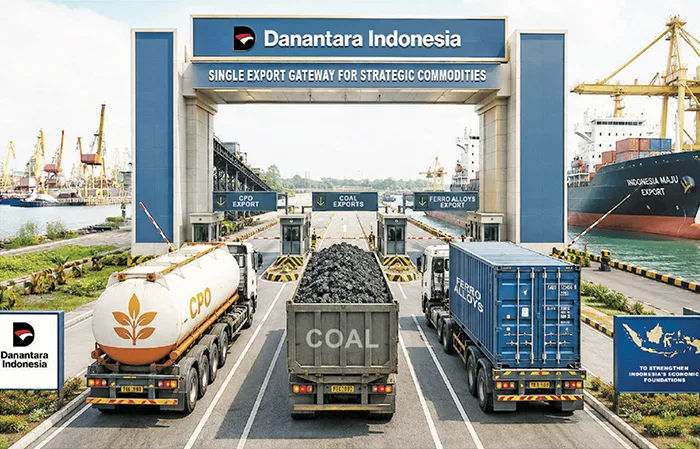
Jakarta, IO – Indonesia stands at a decisive moment in its long effort to transform its natural wealth into national power. For decades, the country has been recognized as one of the world’s most important suppliers of strategic commodities. Its coal, palm oil, processed minerals, and ferro-alloy products are increasingly linked to Asian industry, global manufacturing, biofuels, electric vehicles, batteries, and the wider energy transition.
Yet behind this impressive export profile lies a fundamental national question: how much of the value generated from Indonesia’s natural resources actually returns to Indonesia, strengthens the Rupiah, supports the state budget, deepens domestic financial markets, and contributes to the prosperity of its people?
This question sits at the heart of the Government’s new strategy on export proceeds, known domestically as Devisa Hasil Ekspor, or DHE, and the governance of natural resource exports through PT Danantara Sumberdaya Indonesia, or DSI. The initiative should not be viewed merely as an administrative regulation or a technical adjustment to export reporting. It represents a broader effort to redesign the architecture of Indonesia’s economic sovereignty.
At its core, the policy seeks to ensure that when Indonesian resources leave Indonesian ports, the financial value attached to those exports does not disappear through offshore accounts, intermediary structures, or fragmented trading arrangements. Instead, that value should strengthen the domestic economy that produced those resources in the first place.
The timing could hardly be more significant. The global economy is entering a period of heightened uncertainty. Commodity markets are increasingly shaped by geopolitical tensions, sanctions, climate-related disruptions, supply chain fragmentation, and industrial policy competition among major powers. Emerging market currencies remain vulnerable whenever global capital flows shift toward safe-haven assets. Energy, food, fertilizer, and critical mineral markets can all be disrupted by conflict, export restrictions, and geopolitical shocks.
For Indonesia, foreign exchange resilience is inseparable from development itself. The country requires foreign exchange to import fuel, machinery, technology, pharmaceuticals, defense equipment and industrial inputs. It needs external stability to maintain investor confidence, manage inflation, and protect household purchasing power. It also needs a deeper domestic pool of foreign currency to reduce vulnerability to sudden capital outflows and external shocks. Without stronger foreign exchange resilience, the ambition of Indonesia Emas 2045 becomes significantly harder to finance, sustain, and protect.
This is why the DHE agenda carries strategic importance. Indonesia can no longer remain comfortable with a situation in which natural resources are extracted domestically, infrastructure is provided domestically, labor and environmental burdens are borne domestically, yet a meaningful portion of the resulting financial value circulates outside the national economy.
Export earnings derived from strategic commodities should not be treated solely as private financial flows detached from the broader national interest. These revenues originate from national assets, national permits, national logistics networks, and national ecological space. They therefore carry a responsibility to contribute to national resilience.
The issue of under-invoicing has brought this concern into sharper public focus. Public policy discussions have cited estimates suggesting that cumulative export under-invoicing between 1991 and 2024 may have reached hundreds of billions of US dollars. While these estimates may require refinement, the direction of the problem is difficult to ignore.
Trade misinvoicing weakens the state. It reduces taxable income, understates export values, distorts trade statistics, and creates unfair competition between compliant and non-compliant businesses. It deprives the domestic financial system of foreign exchange liquidity and facilitates the accumulation of offshore capital that contributes little to the economy where the underlying value was created. Under-invoicing is therefore far more than an accounting problem. It is a governance challenge, a taxation issue, a foreign-exchange issue, and ultimately a question of sovereignty.
When a commodity is declared at one price while its true economic value differs materially in the marketplace, the state loses visibility. When exports are routed through affiliated entities in other jurisdictions, the allocation of profits becomes harder to monitor. When invoice structures reduce domestic value capture, the public loses revenues that could otherwise finance roads, schools, hospitals, ports, electricity networks, industrial estates, and the energy transition.
In that sense, reforming export proceeds is not merely about dollars. It is about justice.
Indonesia is not alone in confronting this challenge. Across the world, resource-rich countries have struggled to transform commodity abundance into durable prosperity. Some have become dependent on raw-material exports while failing to build strong fiscal institutions. Others have allowed value to leak through opaque trading structures, transfer-pricing arrangements, weak beneficial ownership transparency, and fragmented oversight systems.
The difference between successful and unsuccessful resource economies rarely lies beneath the ground. More often, it lies within institutions. Natural resources are a gift of geology. Economic resilience is a product of governance.
Against this backdrop, the Government’s decision to involve DSI reflects a broader shift toward strategic economic statecraft. In its initial phase, the framework is expected to focus on coal, palm oil, and ferro-alloy products. These are not ordinary commodities. Coal remains a major source of export revenue and regional energy security. Palm oil supports corporations, smallholders, refiners, logistics providers, workers, and millions of livelihoods. Ferro-alloys represent Indonesia’s growing success in downstream mineral processing and higher-value industrial activity.
The purpose of the new structure should therefore not be misunderstood. The objective is not simply to replace private exporters with a state-controlled entity. The deeper ambition is to create an export-governance system that enables the state to observe, verify, monitor, and optimize the flow of value generated by strategic resources.
If designed effectively, DSI can evolve into a national platform for trade transparency, pricing intelligence, foreign-exchange discipline, and market coordination. It can help ensure that export contracts, shipment volumes, buyer identities, declared values, payment flows, and foreign-exchange repatriation are recorded more accurately and integrated more effectively into national systems.
This is where Indonesia can draw important lessons from countries that have transformed state trading institutions into instruments of economic power. China offers perhaps the most relevant contemporary example. Chinese state trading enterprises such as COFCO, Sinochem, and China Minmetals have long functioned as more than commercial entities. They operate as extensions of national industrial strategy, consolidating demand, securing supply, managing price exposure, and advancing broader economic objectives.
The lesson for Indonesia is not to replicate China’s model mechanically. Indonesia has a different constitutional framework, political system, market structure, private-sector landscape, and international positioning. Yet the strategic lesson remains highly relevant. In a world where major powers increasingly deploy state-backed instruments to shape markets and secure supply chains, a resource-rich nation cannot afford to behave as though classical free-market assumptions still define global competition.
This is precisely where Article 33 of the 1945 Constitution acquires renewed relevance. The constitutional mandate that the earth, water, and natural resources contained therein shall be controlled by the state and utilized for the greatest prosperity of the people provides more than a legal foundation. It offers a strategic framework for economic governance in the twenty-first century.

Today, that mandate should not be interpreted solely through the lens of ownership. It should also be understood through the lens of value governance. Control is not merely about issuing permits or regulating production volumes. It is also about ensuring that the economic value generated by national resources strengthens national prosperity.
In practical terms, this means ensuring that export proceeds reinforce domestic financial markets, support industrial development, improve fiscal resilience, strengthen macroeconomic stability, and contribute to social welfare. This does not mean rejecting markets. On the contrary, Indonesia needs healthy markets, competitive companies, credible investors, efficient logistics systems, and reliable access to global buyers. The objective is to strengthen the relationship between commerce and the national interest.
Private enterprise remains indispensable to productivity growth, innovation, operational excellence, and international market access. Yet the state also carries a responsibility to ensure that transactions involving strategic national resources do not create systemic leakages or undermine broader development objectives. The most effective model is therefore neither one in which the state replaces markets nor one in which markets operate entirely beyond state oversight. It is a model in which the state governs markets intelligently.
For this reason, the institutional design of DSI will be critical. The organization must avoid becoming a traditional bureaucratic gatekeeper that introduces delays, uncertainty, and inefficiency. It must not slow exports, distort pricing mechanisms, weaken competitiveness, or increase transaction costs unnecessarily. Likewise, DSI should not evolve into a narrow monopoly focused on extracting rents rather than improving governance outcomes.
Its legitimacy will ultimately depend not on legal authority alone but on measurable performance. Success should be judged by whether DSI can improve transparency, strengthen data integration, enhance price discovery, reduce trade misreporting, support foreign-exchange repatriation, and reinforce Indonesia’s reputation as a reliable supplier in global markets.
This is why concerns regarding potential monopoly risks deserve serious attention. Oversight is not a secondary consideration. It is central to the credibility of the entire reform. Any institution entrusted with managing strategic exports must operate in conformity with higher standards of accountability than ordinary market participants. Effective oversight should involve close coordination among fiscal authorities, trade regulators, customs agencies, financial supervisors, independent auditors, and other relevant institutions. Indonesia must ensure that efforts to address under-invoicing do not inadvertently create new forms of opacity.
The first guiding principle should therefore be transparency. Exporters, buyers, financial institutions, and the broader public must understand the rules governing the new framework. Reporting requirements should be predictable. Pricing references should be objective. Compliance procedures should be straightforward. Evaluation mechanisms should be measurable.
The second guiding principle should be professionalism. DSI must be staffed by individuals with deep expertise in commodity markets, trade finance, logistics, pricing benchmarks, contract structures, digital monitoring systems, taxation, risk management, and international trade law. Strategic trade management is not routine administration. Coal, palm oil, and ferro-alloy products each operate within distinct market structures, quality specifications, delivery systems, financing arrangements, and buyer relationships. Managing them effectively requires commercial sophistication as much as regulatory authority.
The third guiding principle should be proportionality. The state must intervene firmly where national interests require intervention, yet it should avoid creating unnecessary burdens that weaken competitiveness. Exporters require access to working capital, hedging facilities, foreign currency flexibility, debt-servicing mechanisms, and efficient payment systems. If DHE regulations become excessively rigid, they risk creating liquidity constraints. If export procedures become too cumbersome, they may delay shipments and weaken market confidence.
The fourth guiding principle should be digital integration. Indonesia cannot govern twentyfirst-century trade using twentieth-century systems. Modern export governance requires a real-time data architecture, one capable of linking customs declarations, shipping documentation, export permits, invoices, banking transactions, tax records, beneficial ownership information, benchmark prices, and destinationcountry import data.
Technology can become a powerful ally in this effort. Advanced analytics, artificial intelligence, and anomaly-detection systems can help iden-tify suspicious patterns, including declared export values that differ sig-nificantly from international bench marks, unusual transaction routes, repeated use of offshore intermediar ies, or discrepancies between export declarations and destination market import records. The objective is not to burden legitimate businesses. The objective is to prevent manipulation while making compliance easier.
Stronger digital governance can also protect honest companies. Under invoicing creates unfair competition by allowing some firms to reduce costs through non-compliant practic es while others operate transparently and fulfil their obligations. A more robust governance framework rewards compliance and ensures that market participants compete under the same standards. In this sense, stronger monitoring should not be viewed as anti-business. Properly designed, it is procompetition and profairness.
The fifth guiding principle should be international credibility. Because this policy will be closely watched by embassies, investors, rating agencies, commodity buyers, and trading partners, Indonesia must present it as a governance reform rather than an arbitrary intervention. The objective is not isolation or hostility to ward foreign investors. It is to build a transparent, modern, and account able system that ensures strategic resource exports contribute appropriately to the national economy.
This international explanation is important because many countries are themselves becoming more strategic in resource policy. The United States has used industrial policy to rebuild domestic capacity in semiconductors, clean energy, and critical minerals. The European Union has introduced carbon border measures and strategic raw material frameworks. China deploys state enterprises, development finance, and coordinated procurement to secure supply chains, while India and Gulf countries are expanding their own strategic economic tools.
Viewed in this context, Indonesia’s effort to strengthen resource export governance is hardly unusual. It is part of a broader global shift toward strategic economic policy. What matters is whether Indonesia can execute it effectively. The country should avoid two extremes: naïve liberalism, which assumes that markets will automatically convert natural wealth into national prosperity, and bureaucratic statism, which assumes that state control alone guarantees better outcomes.
Indonesia needs a third path: stra-tegic, transparent, market literate, digitally enabled, and constitutionally grounded. Such an approach recognizes the importance of private-sector dynamism while affirming that national resources require national discipline.
The DHE and DSI agenda should also be closely linked to downstream industrialization. Indonesia has already moved in this direction through mineral processing and industrial development policies. The logic is straightforward: the country should not merely export raw materials but process them domestically, create jobs, build technological capability, expand manufacturing, and capture greater value.
However, downstreaming cannot succeed if the financial flows generated by exports are not governed effectively. Export proceeds can help finance industrial parks, ports, power systems, smelters, refineries, research centers, vocational training institutions, and renewable-energy infrastructure. The dollars earned from commodities today should help build the industries of tomorrow.
This is particularly relevant for en ergy transition. Indonesia possesses vast renewable-energy resources, but unlocking their potential requires financing, technology, transmission networks, storage systems, and long-term planning. If natural resource export proceeds are better captured and circulated domestically, they can help finance a sovereign energy transition, including solar, wind, geothermal, hydropower, biomass, energy storage, green industry, and cleaner manufacturing.
On this topic, the China state trading model offers a useful concep tual lesson. China did not become dominant in solar panels, batteries, and many clean technology supply chains by waiting for private markets to evolve naturally. It combined coordinated demand, state backed capital, supplychain control, and industrial planning to create competitiveness at scale. Indonesia should not reproduce China’s model rigidly, but it should recognize that comparative advantage can be built deliberately through institutions, finance, data, and strategic policy.

The policy also has a fiscal dimen-sion. Better export governance can strengthen state revenue by reducing opportunities for undervaluation, trade misreporting, and aggressive transfer pricing practices. In resource sectors, fiscal leakages often occur through manipulated prices, related party transactions, quality adjustments, shipping arrangements, royalty calculations, or the booking of profits in offshore jurisdictions. A more integrated export-governance framework would make it easier for tax and customs authorities to compare declared values with market realities.
There is also a monetary dimen sion. A stronger DHE framework can deepen foreign currency liquidity within the domestic banking system. This would support trade finance, reduce pressure on the Rupiah, and provide a more stable foundation for macroeconomic management. Indonesia has historically relied on portfolio inflows and external investor sentiment, both of which can reverse rapidly during periods of global uncertainty. Export proceeds, by contrast, are linked directly to real economic activity. If managed effectively, they can become a more durable source of foreign-exchange supply.
The social dimension should not be overlooked. Natural-resource exports support millions of Indonesians. Palm oil sustains smallholders, mill workers, transport operators, traders, and communities across multiple regions. Coal underpins local economies, contractors, ports, and regional revenues. Ferro-alloys and processed minerals support industrial workers, smelters, logistics providers, and energy suppliers. Any reform of export governance must therefore be implemented carefully to avoid unintended consequences. If bottlenecks emerge, they should be addressed quickly. National strategy must be firm, but it must also remain socially responsive.
The environmental dimension is equally important. Stronger export governance can become a platform for advancing sustainability. Palm oil faces growing scrutiny over deforestation, land legality, traceability, and emissions. Coal faces mounting pressure from climate policy. Mineral processing continues to raise questions regarding energy intensity, waste management, water use, and labor standards.
If Indonesia succeeds in building an integrated export-data ecosystem, sustainability indicators should gradually become part of that architecture. Such a framework would allow Indonesia to defend its products more effectively in international markets, while demonstrating that stronger governance supports responsible production. In the years ahead, trade competitiveness will depend not only on price and volume but increasingly on traceability, legality, carbon intensity, and environmental credibility.
For embassies, investors, and international observers, the most important question will be whether Indonesia’s policy strengthens predictability or weakens it. The answer will depend largely on implementation. If the policy is opaque, slow, and highly discretionary, it will create concern. If it is transparent, digital, accountable, and commercially rational, it can strengthen confidence. Investors do not fear governance; they fear uncertainty. Buyers do not fear rules; they fear unpredictability.
The first three months of implementation should therefore be treated as a serious learning phase. The Government should evaluate transaction speed, export continuity, pricing accuracy, buyer feedback, banking readiness, customs integration, DHE placement, tax compliance, and regional economic impacts. Equally important, it should communicate clearly what is working and what requires adjustment. Policymakers must remain willing to refine technical details without abandoning the broader strategic objective.
Indonesia should also consider building a broader national resource-intelligence capability. Strategic export governance requires more than domestic declarations. It requires a sophisticated understanding of global commodity markets, including benchmark prices, freight costs, quality differentials, buyer concentration, trade routes, affiliated-party structures, destination-market import data, and financial flows. Such intelligence would help detect under-invoicing, improve revenue forecasting, strengthen industrial-policy design, and anticipate market disruptions.

Over time, DSI could evolve beyond a narrow export-management channel into a broader strategic-resource platform. It could support national price intelligence, coordinate with downstream industries, help stabilize supply for domestic needs, strengthen export branding, improve traceability, and reinforce foreign-exchange discipline. It could also collaborate with banks to develop trade-finance instruments that reward compliance, work with customs and tax authorities to improve risk profiling, and support ministries in aligning export strategy with industrial-development objectives.
The reform also reflects a deeper philosophical shift. For too long, discussions about resource governance have focused primarily on extraction volumes, export values, and commodity prices. The more important question is broader: how can natural resources strengthen national resilience?
A ton of coal, a shipment of palm oil, or a container of ferro-alloy products should not be viewed solely as a commercial transaction. Each forms part of a larger national value chain. Each carries implications for foreign exchange, taxation, employment, industrialization, diplomacy, and sustainability. The state must therefore govern not only the commodity itself, but also the value generated from it.
If Indonesia succeeds, the benefits could be substantial. The country could reduce export-value leakage, strengthen the Rupiah, improve tax collection, deepen domestic foreign-currency liquidity, enhance trade-data integrity, and create a stronger foundation for industrial policy. It could also strengthen public trust by demonstrating how natural resources are to be managed for national benefit. Citizens would see a clearer connection between resource exports and public welfare. Businesses would operate within a fairer competitive environment. International partners would see a more capable, disciplined, and credible Indonesian state.
If Indonesia fails, however, the risks are equally clear. The policy could become a bottleneck. It could create uncertainty. It could shift opacity from private channels into state-controlled channels. It could invite rent-seeking behavior and weaken competitiveness, if poorly managed. These risks should not be ignored. They should be anticipated and managed. Mature states do not deny risk. They build institutions capable of containing it.
The central test is whether Indonesia can transform a DHE and DSI agenda into a governance reform, rather than merely a control exercise. Control without governance creates friction. Governance supported by intelligent control creates resilience. The objective is not simply to route exports through a state-linked entity. The objective is to ensure that strategic exports are properly recorded, fairly valued, transparently monitored, financially repatriated, and ultimately benefit the nation.
This is why leadership matters. The Government must provide clear direction. Ministries must coordinate rather than compete. DSI must operate professionally. Businesses must comply while providing constructive feedback. Banks must prepare adequate financial instruments. Customs and tax authorities must integrate their data systems. International partners must be engaged through transparent communication. A reform of this scale requires a whole-of-government and whole-of-economy approach.
Indonesia’s grand strategy on DHE and natural-resource exports is therefore far more than a foreign-exchange management policy. It is a test of whether the country can build modern economic statecraft. It asks whether Indonesia can move from resource abundance to resource discipline. It asks whether the state can govern markets without suffocating them. It asks whether natural wealth can be transformed into currency stability, fiscal strength, industrial upgrading, and broad-based prosperity. It asks whether the spirit of Article 33 can be translated into effective Twenty-First-Century institutions.
Read More: Orchestrating A Paradigm Shift: KDMP And The Practice Of Constitutional Economics
As Indonesia moves toward its Centennial in 2045, these questions will become increasingly urgent. No country becomes a high-income economy by exporting commodities through outdated structures while allowing value to leak through weak governance systems. No nation can build lasting economic sovereignty if foreign-exchange flows remain fragmented and strategic resources are governed with incomplete information. Indonesia cannot aspire to become a leading Indo-Pacific economy while remaining merely a supplier of raw value for the industrial strategies of others.
The path forward requires courage, but also discipline. The Government is right to strengthen DHE and reform the governance of natural-resource exports. Yet success will depend on implementation. The reform must be executed with transparency, professionalism, proportionality, digital intelligence, and strong oversight.
DSI must become a trusted national institution, not a feared monopoly. It must help markets become cleaner rather than less efficient. It must support compliant exporters rather than burden them unnecessarily. It must protect the national interest while preserving Indonesia’s reputation as a reliable global supplier.
The ultimate measure of success will not be the creation of a new institution. It will be whether more foreign exchange remains within the domestic economy, whether tax revenues become more accurate, whether under-invoicing becomes more difficult, whether export data becomes more credible, whether the Rupiah becomes more resilient, whether downstream industrialization receives stronger financial support and whether citizens enjoy greater benefits from the resources they collectively own.
Indonesia possesses the resources. It possesses the constitutional mandate. It possesses the market scale, strategic location, downstreaming experience, and the ambition embodied in Indonesia Emas 2045. What it now needs is an export-governance architecture equal to the importance of its natural wealth.
If implemented wisely, the DHE and DSI reforms can become far more than administrative measures. They can become instruments of modern economic statecraft, capable of transforming resource abundance into currency resilience, fiscal strength, industrial upgrading, and long-term prosperity.
In the end, this reform is built on a simple but profound principle: Indonesia’s natural wealth should not merely leave the country as cargo. It should return as strength. It should return as foreign-exchange resilience, fiscal capacity, industrial capability, stronger institutions, better infrastructure, and broader prosperity for the Indonesian people.
That is the essence of resource sovereignty in the twenty-first century. Reforming export proceeds and natural-resource governance should therefore be understood not merely as a technical policy adjustment, but as a long-term national project to secure Indonesia’s economic future.