

There’s a chemical company in Surat quietly supplying chemicals most people have never heard of. Some of those chemicals go into anti-HIV drugs. Others are used in battery electrolytes. Some are semiconductor-grade chemicals used in advanced chip manufacturing.
For most of its listed history, the market largely viewed it as a pharmaceutical intermediates manufacturer. That perception is now changing.
The company is attempting to build a multi-segment specialty chemicals platform spanning pharmaceuticals, semiconductors, battery chemicals, fine chemicals, and CDMO-style custom synthesis. And the market is beginning to recognise that shift.
The stock has re-rated sharply over the last 18 months as revenue growth accelerated, margins expanded, and newer verticals evolved from “future optionality” into visible commercial scale.
The key question is this: Is Acutaas Chemicals building a durable specialty chemicals franchise with multiple long-term growth engines? Or is the market extrapolating too much, too quickly, from a handful of high-growth verticals
Let’s dive in.
Understanding what Acutaas builds
To understand Acutaas Chemicals, you first need to understand why the business is difficult to categorise.
Most chemical companies fit neatly into one bucket:
- Commodity chemicals
- Specialty chemicals
- Pharma intermediates
- Contract manufacturing
Acutaas sits somewhere between all of them.
Story continues below this ad
The company originally built its franchise around advanced pharmaceutical intermediates used in APIs for anti-retroviral therapies, oncology, and high-value specialty therapies.
Over time, management realised that the real competitive advantage was not merely the end market. It was the underlying chemistry capability itself.
That capability is now being extended into multiple adjacent industries, including battery chemicals, semiconductor chemicals, CDMO, custom synthesis, and niche specialty materials.
Business segments
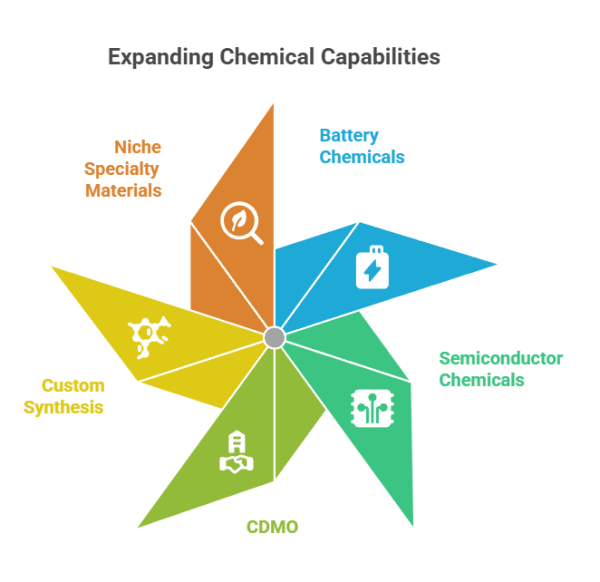 Expanding chemical capabilities
Story continues below this ad
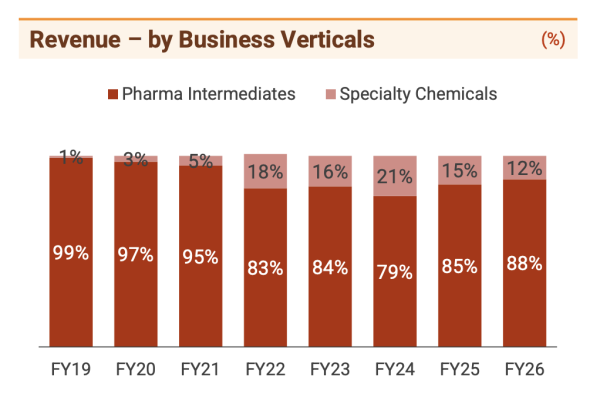
Today, the company broadly reports business under two major verticals:
Pharma (88% of FY26 revenue)
Specialty chemicals (12% of FY26 revenue)
The mix between these segments has fluctuated over time, but specialty chemicals have structurally increased from less than 1% of revenue in FY21 to 13% in FY26.
Key segment-wise revenue mix
 Source: Q4 FY26 Investor Presentation
What makes this structure interesting is that both verticals rely on the same underlying capability: complex chemistry execution.
Financial performance
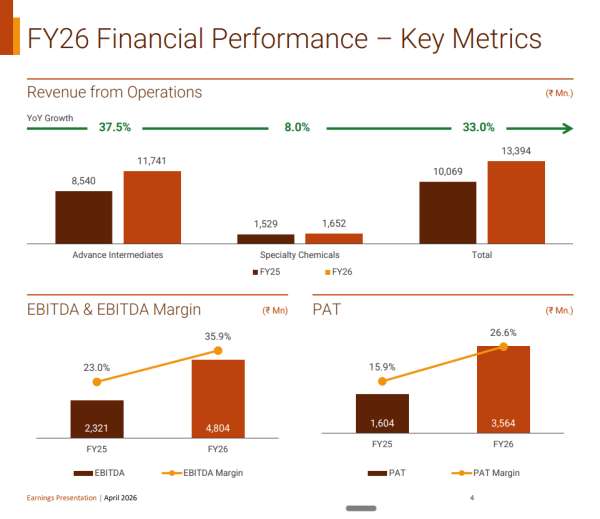 Source: Q4 FY26 Investor Presentation
The pharma business: From intermediates to CDMO
Story continues below this ad
Pharma remains the foundational cash-flow engine for Acutaas Chemicals, contributing 88% of FY26 revenue.
Historically, the company built its franchise around advanced pharmaceutical intermediates used across multiple therapeutic categories. Today, it exports to more than 55 countries and has built long-standing relationships across regulated and semi-regulated markets.
What makes this business structurally attractive is customer stickiness.
Once a pharmaceutical company qualifies a supplier for a critical intermediate, switching becomes operationally and regulatorily difficult.
But the bigger story today is CDMO. Management has guided that the CDMO business alone could potentially reach Rs 1,000 crore in revenue by FY28.
Story continues below this ad
Acutaas already supplies advanced intermediates used in the manufacturing of Darolutamide, the key API behind Bayer and Orion’s blockbuster prostate cancer drug Nubeqa®, whose global sales continue to scale rapidly.
Bayer AG – ‘Nubeqa’ related KPIs
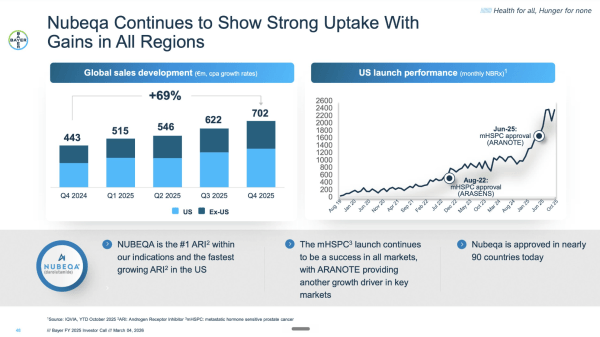 Source: Bayer AG investor presentation
Management has also indicated that two additional CDMO molecules currently under development could each potentially generate over Rs 100 crore in annual revenue once commercialised in FY27.
That matters because CDMO economics are fundamentally different from standard intermediates. Once a supplier becomes qualified within a pharmaceutical product chain, switching becomes difficult due to regulatory and process-related risks. This generally leads to higher margins, longer customer relationships, and better revenue visibility.
As global pharma companies increasingly outsource complex chemistry work, Acutaas appears to be positioning itself directly within that structural trend.
Story continues below this ad
The specialty chemicals business: Battery materials, semiconductors, and fine chemistry
The specialty chemicals segment contributes 12% of FY26 revenue. It is also where much of the market’s excitement increasingly resides, particularly around battery electrolyte additives and semiconductor chemicals.
1. The battery electrolyte additive opportunity
Through its electrolyte additives business, Acutaas is positioning itself within the global EV and energy-storage supply chain. The company is building a large-scale facility at Jagadia, and management recently stated that the entire 2,000 metric tonne capacity each for FEC (Fluoroethylene Carbonate) and VC (Vinylene Carbonate) has already been booked for the next three years.
FEC and VC are high-purity lithium-ion battery electrolyte additives used to improve battery stability and performance. The company is also expanding into additional battery additives, signalling ambitions beyond a single-product opportunity.
Story continues below this ad
As EV adoption accelerates globally, battery supply chains are increasingly looking to diversify beyond China, and Acutaas appears to be positioning itself into that gap.
2. The semiconductor chemical opportunity
The second major optionality within specialty chemicals is semiconductors.
This opportunity is being driven through Baba Fine Chem and the company’s Korean JV via Indichem, focused on semiconductor-grade specialty chemicals where qualification barriers are extremely high.
Management has stated that the research centre for the Korean JV is already operational, samples have started reaching prospective customers, and the commercial plant is expected to be ready by H2 CY2026.
The company is also undertaking Rs 200 crore in capex for this initiative, with management guiding for asset turns of nearly 1x (implying potential revenue of roughly Rs 200 crore) along with high margin potential once commercialisation scales.
The operating leverage
Story continues below this ad
This is where the investment thesis begins translating from narrative into numbers.
Over the last few years, Acutaas’ revenue growth has remained strong, but EBITDA has grown even faster. That divergence matters because it suggests the business is beginning to benefit from operating leverage.
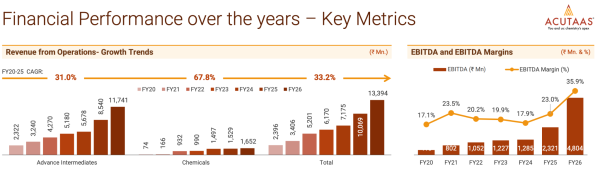 Source: Acutaas Chemicals – Q4FY26 Investor presentation
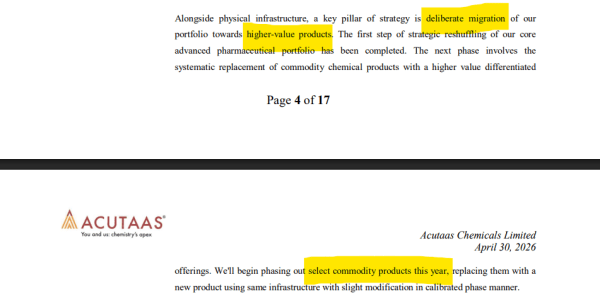
Gross margins have also steadily improved, indicating a gradual shift toward higher-value products and better product mix. This is particularly important in specialty chemicals, where margin expansion often signals improving pricing power and rising contribution from complex chemistry rather than simple volume growth.
Strategy outlook
 Source: Company concall Transcript of Q4 FY26
The setup becomes particularly interesting because multiple growth vectors could begin scaling simultaneously over the next few years.
CDMO molecules are ramping up
Battery electrolyte additives are entering commercialisation
Semiconductor chemical initiatives are moving toward customer qualification and commercial scale
Medium-term revenue potential
Management has guided that the CDMO business could potentially reach Rs 1,000 crore in revenue by FY28, while the semiconductor initiative is targeting nearly Rs 200 crore in potential revenue over the medium term.
The company has also built 2,000 metric tonne capacities each for FEC and VEC in battery electrolyte additives, with management stating that the entire capacity has already been booked by a key customer for the next three years.
Emerging business verticals: Revenue and margins outlook
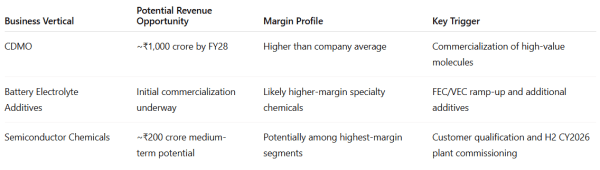 Source: management commentary in FY26
Acutaas is simultaneously scaling CDMO, semiconductors, and battery chemicals together. That makes execution, commercialisation, and capital allocation the key variables to watch over the next few years.
Valuations
At the current EV/EBITDA multiple of 44, the market is clearly no longer valuing Acutaas as a traditional pharma intermediate business.
EV/EBITDA historical chart
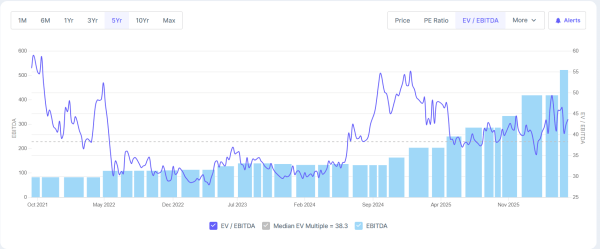 Source: http://www.screener.in
The premium likely reflects four assumptions working in tandem:
- Semiconductor chemicals are becoming a meaningful long-term business vertical
- Battery electrolyte additives are being commercialised successfully
- Pharma intermediates continue to generate stable cash flows
Further operating leverage driving margin expansion as newer capacities scale
Very few Indian chemical companies currently sit at the intersection of semiconductor localisation, battery supply-chain diversification, pharma outsourcing, and specialty chemistry.
Acutaas does.
And markets typically assign premium multiples to businesses exposed to multiple long-duration structural themes simultaneously.
The bigger question is not whether the opportunities are real. They clearly are. The question is whether execution can keep pace with valuation. That is ultimately what this investment thesis comes down to.
Financial data has been sourced primarily from OneSource Specialty Pharma’s Q3 FY26 results, earnings presentations, regulatory filings, and publicly available research as of April 2026.
Rahul Rao has helped conduct financial literacy programmes for over 1,50,000 investors. He also worked at an AIF, focusing on small and mid-cap opportunities.
Disclosure: The writer or his dependents do not hold shares in the securities/stocks/bonds discussed in the article.
The website managers, its employee(s), and contributors/writers/authors of articles have or may have an outstanding buy or sell position or holding in the securities, options on securities or other related investments of issuers and/or companies discussed therein. The content of the articles and the interpretation of data are solely the personal views of the contributors/writers/authors. Investors must make their own investment decisions based on their specific objectives, resources and only after consulting such independent advisors as may be necessary.