
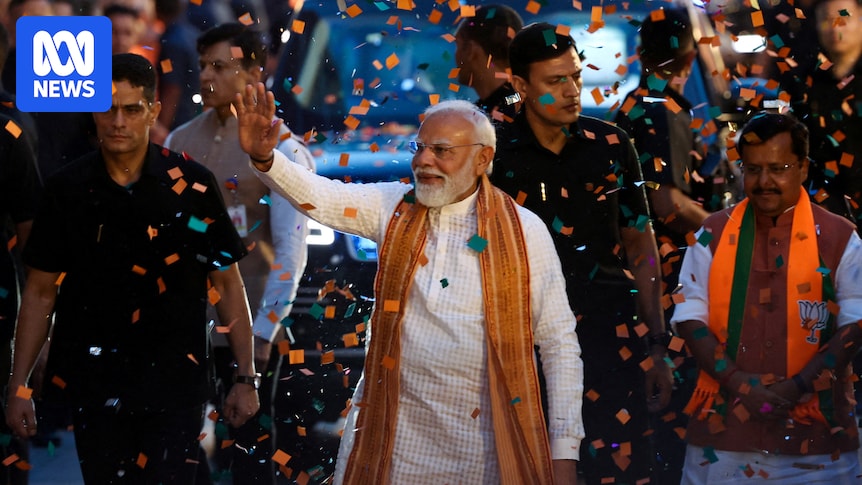
When Narendra Modi won the 2024 general election, becoming the prime minister of India for a third term, it was a diminished win.
Mr Modi is only the second Indian prime minister to retain his leadership for a third consecutive term, but the historic win didn’t come with as much pomp as you would expect.
The votes had significantly dropped from his win four years ago in 2020, and a majority was made possible in 2024 with the backing of his National Democratic Alliance (NDA).
Some analysts thought India would see a change — a resurgent opposition, after winning 232 seats to NDA’s 293.
Two years later, that is not the case.
Narendra Modi and the Bharatiya Janata Party (BJP) came into power in 2014, and since then the influence of the party that is predominantly known for its “Hindutva ideology” has grown in leaps and bounds.
Narendra Modi celebrating becoming India’s prime minister for the first time in 2014. (ASSOCIATED PRESS)
Due to various factors — the “magnetic Modi” pull, a solid ideological identity of BJP, or as some analysts say “illegitimate use” of central powers — a different political map of India is emerging.
In 2014, seven states were under BJP control and now it has 22 states and one union territory.
Political analyst Sandeep Shastri said the growth of BJP in recent elections, both state and national, seems to be a trend.
“The Indian political process and the election system is increasingly emerging as a one-party dominant system now,” he said.
So, how has the BJP, and its leader, Narendra Modi shaped India into a “one-party” nation, and more importantly what does it say about the world’s largest democracy?
Modi’s West Bengal
Last week, the BJP won for the very first time in the state elections held in West Bengal.
What would ordinarily be dismissed as one state election result has been the focus of the political pundits in India, because it shows the might of the BJP is not waning as some suspected after the last general elections.
Instead the party’s influence is flourishing.
Kaleena Roy and her family used to vote for a local party in West Bengal, but said when she voted in the West Bengal elections last month their vote went to the BJP.
Kaleena Roy voted for the BJP in the West Bengal election for the first time. (ABC News: Burhan Bhat)
“We saw the BJP winning in New Delhi last year and observed a change. So, we decided to vote for the BJP in the recently held West Bengal elections,”
she said.
West Bengal is a state in the east of the country and for the past 15 years has been governed by a popular local politician, Mamata Banerjee, from the All India Trinamool Congress Party (TMC).
The TMC is a smaller party that during national elections aligns itself in a coalition with the opposition in India, the Congress party.
The fiery grassroots leader, fondly known as ‘didi’ — which translates to an elder sister — created a political brand for herself as the ‘didi’ of the poor people.
“The people of West Bengal had made it absolutely clear that they were determined to throw Mamata Banerjee out of their state,” Syed Zafar Islam, a national BJP spokesperson said.
“They voted for it. They wanted a change and that is something that is visible,” he said.
PM Narendra Modi while attending the swearing-in ceremony of the new chief minister of West Bengal. (REUTERS: Sahiba Chawdhary)
West Bengal is a key seat that the BJP had been trying to add to its domain for some time now, as it holds the fourth-highest number of India’s parliamentary seats.
It is also home to India’s second-largest Muslim population, according to the 2011 census.
As Ms Banerjee became aware of the crashing defeat coming her way, including losing her seat of Bhabanipur to the BJP candidate, Suvendu Adhikari, she declared she would not resign.
Ms Banerjee has maintained the federal government has “stolen” the election from her.
Her accusations point to the BJP’s electoral reforms, the Special Intensive Revision (SIR), which took place in some states, including West Bengal.
Mr Islam denied these accusations and said: “We are not the party which believes in vindictive approach. We are winning because people across India have realised double engine government is actually working in their favour.”
The contentious electoral reform
Thirteen states and union territories (which are federally administered in India) have undergone the SIR process so far.
It was created to ensure that voter lists are up to date, with no deceased people on the list, but the contentious part is that no “illegal migrants”, as the BJP puts, are on the list.
West Bengal is the only area where the SIR process was followed by an additional layer of special adjudication.
As part of it, nine million voters were removed from the electoral list that consisted of 76 million people.
That is 12 per cent of the voters.
Of these nine million, six million names were struck off as absentees or deceased voters.
Roughly 2.7 million others were also left off the voter list and their fate was left in limbo, even as elections rolled around.
Some had ongoing cases in court, in a bid to prove they had a right to vote.
Shabana, who hails from West Bengal, was one such voter.
She had moved to Delhi with her husband and kids to earn a better income.
A few months before the election, her friends in West Bengal told her that she and her husband were not in the voter list anymore.
“I went to go and get my name added back, but they asked for more and more documents,” she said.
She was born in India and has an Aadhaar card, the official Indian identification card, yet her name was struck off the list.
After multiple trips and at a loss of some income, Shabana was able to eventually vote in the West Bengal election.
“Aadhaar cards are meant to be this one-stop shop and they [the Electoral Commission] are not accepting it,” said Aditya Balasubramanian, a senior lecturer in history at Australian National University.
“It is a very substantial ask for people from poor backgrounds, who don’t necessarily have proper homes, to produce multiple forms of documentation.”
Ms Banerjee’s party alleged the electoral reform was a “BJP tactic” and the voter list revision exercise disenfranchised millions, particularly Muslims to benefit the BJP, an accusation the BJP and the Indian Election Commission have denied.
After 15 years as chief minister of West Bengal, Mamata Banerjee was defeated in last week’s West Bengal election. (REUTERS: Sahiba Chawdhary)
It is a rhetoric that India’s opposition party, Congress, has also been repeating.
“The opposition party [Congress] seems to be thinking it’s all a ploy from the BJP in kind of increasing electoral gains,” Mr Shastri said.
“There is no staying away from the fact that it could have helped the BJP, especially in West Bengal.
“But I would hasten to add that, to explain away the results solely on the SIR factor would be missing the point.”
Mr Shastri said the electoral list revision was one of the factors, but there were other factors too: frustrations with a long-running leader and party, and the BJP running a a campaign using more local leaders.
“They made it a much wider campaign about the working of the government and the implementation of policy, about law and order, about welfarism,” he explained.
The big story of West Bengal is not about grassroots-level mobilisation of the BJP in order to assert dominance, according to Yamini Aiyar, who is a visiting fellow at the Watson School of Public Policy at Brown University and the former president of Indian think tank, Centre for Policy Research.
“It’s about its ability to use national institutions, the election commission as one example, to kind of achieve consolidation from the top down,”
she said.
The attempt to redraw the map
Another controversial measure that the BJP floated recently, the delimitation bill, has added to some analysts saying the Modi government is using its powers to implement rules that could help them in elections.
In April, the government launched a once-in-a generation attempt to redraw the country’s political map.
Modi said it was to reserve seats for women in parliament. Women make up about 14 per cent of India’s lower house MPs. The reform would have raised it to roughly a third, closer to global norms.
It also would have meant the number of MPs in the lower chamber would have increased from 543 to nearly 850.
But the bill failed to pass in parliament.
It was the first time in 12 years a bill proposed by Mr Modi was not passed.
The failure followed a fierce debate, with the federal government accused of using the bill as a “guise” to redraw the map in a way that benefited the BJP.
Such a measure would “constrain the democracy,” Mr Balasubramanian said.
“Delimitation effectively penalises states that have been run well and have low fertility rates … and fertility is typically higher in states in the Hindu belt that are run by the BJP.”
In India, southern states where the BJP is still making progress, fertility rates are lower. Whereas in the north, there is bigger population and one where BJP is popular.
“There is nothing to explain why in the election period you suddenly decide that you want to implement the women’s reservation bill with such great urgency,” Ms Aiyar said.
“When a bill drafted by the BJP for this, exists.”
A bill reserving one-third of the seats for women was passed unanimously by parliament back in 2023, but its implementation has been delayed until at least 2029 due to certain electoral processes, including the lack of a more updated census data.
“There are many options available to undertake the women’s reservation without the need to expand Lok Sabha [the lower house],” she said.
“This has brought in the fear of gerrymandering.
“You really want to expand and give women reservation, then hurry up and do the census,” she said.
The last Indian census was undertaken in 2011. Another was meant to take place in 2019 but didn’t. The government blamed COVID for the delay.
The country’s biggest census ever will now take place this year.
Mr Balasubramanian said India’s political power split is such that most of its central institutions are controlled by the national government.
“That allows a certain kind of strangulation of states that are not BJP run in terms of the allocation of resources in India’s asymmetrically federal structure,” he said.
“There is an assault on democratic ideals … in elections for sure.
“But, unfortunately, it is not something you only see in India.”
A ‘weakened’ opposition
This has been a factor in why no opposition seems to be able to stack up against the BJP.
Even so, analysts say the performance from the Congress party in the post-2024 elections has not been strong enough to gain support from voters.
Delhi-based Mahinder Pal Singh used to be a devoted Congress voter until about 10 years ago.
Mahinder Pal Singh was a Congress voter but switched a decade ago due to tax policies. (ABC News: Burhan Bhat)
“We believed in the Congress party, but they did not do much for us,” he said.
“All Indians are putting faith in the BJP after seeing their results in every state.”
A key reason why the 65-year-old shifted alliance to the BJP, after voting for Congress for most of his life was the tax policies.
“They brought good schemes for the public and equal rules for all states, including the same tax policies for every state,” he said, referring to the Indian government’s one nation, one tax policy introduced in 2017.
Mr Balasubramaniam said: “They are not able to capitalise on moments. Not on the farmers protests, the fact the economic growth goes to 10-15 per cent of the population, the standard of living dropping.”
Mr Shastri said: “Congress, I think, has not recovered from its 2014 defeat. It [became] too used to being a party in governance and not a party in opposition.”
Before the BJP, Congress was India’s longest government in power, for three decades from 1947 to 1977.
In a post-independence India, Congress had a dominance over the country like BJP now.
Ms Aiyar said its core issue is that “Congress has too many factions.
“It was a model that worked for them when [they were] in power.
“You had many states you governed, and multiple leaders could then adjust among each other.”
But now that system doesn’t work.
Add to that the BJP’s ability to sense division in other political foes, as Mr Balasubramaniam explained.
“They are a very systematic and shrewd organisation in terms of thinking of alliances that exist,” he said.
“They have this ability to sense tensions among others and use it.”
All of that combined is why the map of India is turning distinctly orange.
“If you look at Assam, West Bengal, Maharashtra, what you have today, you see that they have actually made inroads in areas that are not traditionally their strong suit,” Mr Balasubramanian added.
The ‘Hindutva ideology’
While there are issues in the system, most analysts believe India’s “largest” democracy is still “thriving.”
“It’s also the world’s most diverse democracy, and I want to emphasise the nature of the current challenges in the democracies going through are embedded in as a sort of response to that,” Ms Aiyar said.
She said as a secular India emerged the BJP looked to find a “one nation” identity.
“One very important element of that has been its capacity to bring together a collective Hindu identity,” she said.
“The BJP often uses the phrase one nation as a kind of precursor to many of its other policy and political initiatives.”
It is what, according to Ms Aiyar, sits at the “heart of their ideology”.
“Over the last 12 years, and frankly even before that, the BJP has very much anchored itself in a capacity to mobilise society and build a social coalition around the idea, around this notion of Hindutva,” she said.
Mr Balasubramaniam said, “There is a lot of work that has been done by organisations like the RSS in helping that ‘Hindutva ideology’.”
The Rashtriya Swayamsevak Sangh (RSS), is India’s largest Hindu nationalist organisation.
It is an organisation that a young Narendra Modi was a part of, and one that has been largely credited for its role in propelling the Indian prime minister to his current fame.
Narendra Modi says the latest election shows India’s democracy is vibrant. (Reuters: Adnan Abidi )
According to Mr Balasubramaniam, it is this solid foundation of identity that keeps the BJP’s social coalition strong.
“There’s hardly ever been any revolts or any major fights between the party that are visible to the public,” he said.
The future of BJP
For a while now the image of Modi and BJP has been intermingled.
You cannot think of one without automatically having a thought about the other.
Despite not having done a single press-conference in his 12 years as the prime minister of the country, he remains the most popular politician in India.
“If you look at all those who voted for the BJP in 2014, around one-fourth of those said that if Modi were not the leader of the party … we would have changed the way we voted,” said Mr Shastri, who has looked closely at the growth of the Modi brand.
Mr Modi is also the most followed politician on social media in the world.
“He is extraordinarily popular,” agreed Mr Balasubramaniam.
But that popularity that has been a key factor in the rise of BJP, is not the same as it used to be.
“There’s been a subtle but quite important shift in the dynamic,” Ms Aiyar said.
“Up until the 2024 election, and actually very physically during the 2024 campaign, the elections were fought on Modi,”
“It was the Prime Minister Modi who was the chief campaigner,” she said.
Indeed, the manifesto for the BJP in the 2024 election was called “Modi ki Guarantee,” meaning it was Modi more than the party he represented that voters were being asked to trust and vote for.
“I think brand Modi has faded a little,” Ms Aiyar added.
Modi will be 78 at the time of the next general election in 2029.
There are no signs yet to suggest if Modi will run the election again, or if BJP will front someone else.
“Give me one politician’s name, any party, anywhere in the world, where the person in power has willingly walked away and handed over the baton to anybody else,” Ms Aiyar said.
Mr Balasubramaniam added that the first thing to say about politics is “it is very hard to predict the future, particularly one years away”.
“Modi hasn’t groomed anyone,” he said.
But Mr Balasubramaniam said there is one thing we can count on: it is highly unlikely that whoever next becomes leader of the BJP will not be linked to RSS.