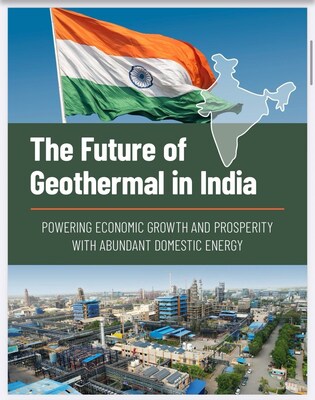
Study identifies geothermal as a scalable solution for India’s rising energy demand
NEW DELHI, May 14, 2026 /PRNewswire/ — Project InnerSpace, in partnership with the Council on Energy, Environment and Water (CEEW), today released The Future of Geothermal in India, finding that India holds significant technical potential for geothermal: 11,000 gigawatts (GW) of industrial heat, more than 1,500 GW of cooling, and 450 GW of electricity—nearly equal to India’s current installed capacity. Even partial deployment could significantly reduce pressure on India’s power system and diversify how industry meets its growing energy demand. The report identifies geothermal as a critical resource for the sectors driving demand—data centres, cities, and industry—while strengthening energy security, enhancing resilience, cutting emissions, and creating hundreds of thousands of jobs. In India, where cooling demand is rising rapidly and industrial energy use remains heavily fuel-based, it offers a practical pathway to deliver reliable energy while easing pressure on the grid.
The Future of Geothermal in India reveals the country’s vast technical potential for geothermal energy, enough to transform how industry, cities, and data centres power their future.
Geothermal energy, the heat naturally occurring in the Earth’s crust, is an abundant, always-available domestic resource. The report outlines a pathway to scale geothermal through pilot projects, policy implementation, and targeted incentives—moving from early-stage development to deployment this decade. Although India began exploring geothermal resources decades ago, deployment remained limited to pilot projects due to high exploration risks, uncertain drilling returns, and the absence of enabling policy frameworks. The report notes that advances in drilling technologies, improved subsurface data, and India’s recent National Policy on Geothermal Energy now make large-scale deployment significantly more viable. Geothermal projects are already underway, including the Tapri Geothermal Cold Storage Project in Himachal Pradesh, a project supported by Project Innerspace’s GeoFund initiative.
The Future of Geothermal in India:
Highlights 1,500+ GW of cooling technical potential (down to 3.5km), with systems that can cut electricity use by 30–40%;
Estimates over 11,000 GW of industrial heat technical potential (down to 3.5km with a cut-off of 100 degrees Celsius);
Highlights 450 GW of technical potential for electricity generation (down to 5km).
Pinpoints leading states for the greatest opportunity for geothermal deployment, including: Gujarat, Uttar Pradesh, West Bengal, Telangana, Maharashtra, and Andhra Pradesh.
Illustrates how geothermal can support India’s data centre growth through cooling applications that reduce demand and 24/7 firm power in key geographies.
“Geothermal is a massive and untapped energy opportunity for India — with industrial heat and cooling as low hanging fruit ready to economically deploy today,” said Jamie Beard, Executive Director of Project InnerSpace. “With rising demand due to economic growth, and the potential for continued energy supply disruptions, there are few energy sources that offer the local and resilient abundance of geothermal energy.”
“Diversity is an essential attribute of every energy system,” said Karthik Ganesan, Fellow and Director — Strategic Partnerships of CEEW. “As India’s energy supply shifts towards clean sources, this diversity will have to be met through newer technologies and geothermal is that ubiquitous source that guarantees energy security, with little environmental footprint and not affected by the vagaries of short-term weather and long-term climatic changes.”
“Industrial heat is challenging to decarbonize using intermittent renewable electricity. Hence, the chemical industry, which uses a lot of industrial heat, is a hard-to-abate sector,” said Mirik Gogri, Head of Corporate Strategy at Aarti Industries. “Geothermal is an excellent source of clean baseload power and heat, with the potential to enable our plants to operate without disruption while also minimizing our carbon footprint. We are thrilled this report identified the industrial zone in Jhagadia as a place where geothermal development is possible, and we look forward to exploring ways to integrate this enormous resource into our operations.”
The report was led by Project InnerSpace, in partnership with CEEW, and with contributions from 12 leading institutions across India and internationally.
About Project InnerSpace
Project InnerSpace is the leading independent non-profit organization dedicated to the global development of geothermal energy. We are a focused research organization, on a mission to remove the major barriers standing in the way of the exponential growth and development of geothermal energy worldwide by 2030. To learn more about Project InnerSpace please visit www.projectinnerspace.org.
About CEEW
The Council on Energy, Environment and Water (CEEW) — a homegrown institution with headquarters in New Delhi—is among the world’s leading climate think tanks. The Council is also often ranked among the world’s best-managed and independent think tanks. It uses data, integrated analysis, and strategic outreach to explain—and change—the use, reuse, and misuse of resources. It prides itself on the independence of its high-quality research and strives to impact sustainable development at scale in India and the Global South. In over 14 years of operation, CEEW has impacted over 400 million lives and engaged with over 20 state governments.