
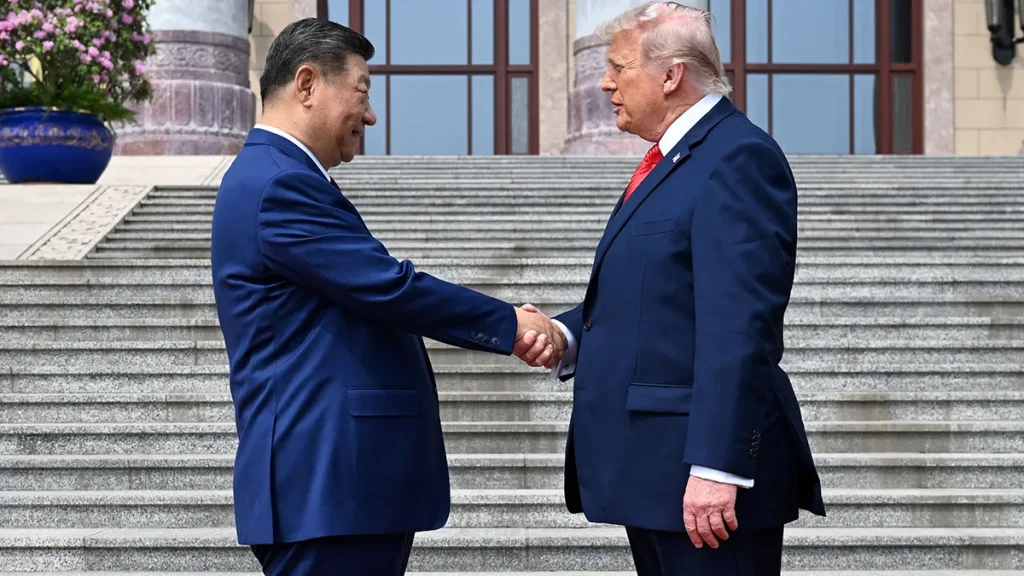
Europe wants Washington and Beijing to talk. A U.S.-China trade war, a Taiwan crisis, or a technology rupture would hit European markets, supply chains, and security planning. But Europe also fears the other scenario: a U.S.-China understanding that lowers tensions between the two powers while leaving Europe to absorb the cost on Ukraine, trade, NATO and industrial policy.
That is the European dilemma. A failed summit would be dangerous. A successful one could still be expensive.
The meeting includes Iran, Taiwan, trade, artificial intelligence, and U.S. arms sales to Taiwan. Trump arrived in Beijing seeking economic openings and a broader reset with Xi, while China entered the summit pressing its own red lines, especially on Taiwan. (AP News)
For Brussels, the concern begins with trade. The European Commission has already warned that U.S. tariffs could block or pressure Chinese exports, which would then be redirected into the European market, causing trade diversion. Commission President Ursula von der Leyen told China’s Premier Li Qiang last year that Europe and China, as two of the world’s largest markets, had a responsibility to defend a fair trading system and ensure equal competition. (Reuters)
That is Brussels’ practical fear: Europe does not only suffer when Washington and Beijing fight. It can also suffer when they cut a narrow deal that pushes excess pressure toward European industries.

Paris reads the summit through a broader question: can Europe remain a strategic actor, or will it remain a market affected by decisions made elsewhere? President Emmanuel Macron has long argued for European strategic autonomy, including reducing dependencies in semiconductors and critical raw materials. His warning has been consistent: Europe must not let Washington, Beijing, or Moscow handle the most important security and economic decisions alone. (elysee.fr)
That does not mean Paris wants confrontation with China. It means France wants Europe in the room, not waiting outside while larger powers trade files across the table.
Berlin’s reading is more industrial. Germany needs China as a market but fears Chinese overcapacity, subsidies, rare earth leverage, and another shock to German exports. The Franco-German reset announced by Macron and Chancellor Friedrich Merz included coordination on China, trade, and economic security, reflecting a shared concern that Europe needs a common China policy, not a collection of national survival plans. (elysee.fr)
For Germany, the Trump-Xi summit could affect cars, machinery, chemicals, batteries, and green technology. If Washington gets relief for American firms while Europe faces redirected exports or tougher Chinese retaliation, Berlin will feel the consequences quickly. Germany can debate strategy for years; its factories notice pressure by the quarter.
Rome brings a different angle. Prime Minister Giorgia Meloni has worked to maintain strong ties with Trump while keeping Italy anchored in European and NATO policy. She has also been clear on Ukraine, saying Italy does not intend to abandon Kyiv, and she recently said she would not support a U.S. troop withdrawal from Italy. (governo.it)

That makes Rome important. Meloni may be better placed than many European leaders to speak to Trump, but Italy still faces the same strategic problem: China cannot be treated only as a commercial partner while Ukraine remains under assault and Beijing stays close to Moscow.
London, outside the European Union but central to NATO and Ukraine policy, will read the summit through security rather than the Brussels process. The United Kingdom’s 2025 Strategic Defense Review said Britain must lead in a stronger NATO and draw lessons from Ukraine, including the importance of industrial strength and technological innovation behind military power. (GOV.UK)
For London, the issue is whether Trump’s China diplomacy strengthens or weakens the Western position toward Russia. If Xi faces pressure to restrain Moscow, Europe benefits. If Ukraine becomes one file inside a wider U.S.-China bargain, London and other European capitals will see danger.
China understands these European divisions. Beijing’s message to Europe is that China and Europe should act as “indispensable poles” in a multipolar world and avoid bloc confrontation. Foreign Minister Wang Yi made that argument at the Munich Security Conference, presenting China as a partner for Europe rather than a threat. (gmfus.org)
That message has an audience in Europe. Many European businesses do not want decoupling from China. Many governments want room between Washington and Beijing. But Ukraine, rare earths, technology and industrial pressure have made old assumptions harder to defend.
Europe’s problem is not that it lacks views. It has too many views and not enough power behind a single line. Brussels worries about trade rules and market pressure. Paris wants strategic autonomy. Berlin watches industrial exposure. Rome manages politics with Trump while supporting Ukraine. London thinks in NATO, sanctions, and security terms.

The Trump-Xi summit exposes the gap between European ambition and European leverage.
If the meeting reduces U.S.-China tensions, Europe benefits. If it reduces pressure around Ukraine, energy routes, technology supply chains, and global trade, Europe benefits again. But if it produces a bilateral understanding that treats Europe as a market, Ukraine as a negotiable file and NATO as an accounting problem, the cost will arrive quickly.
This is the fourth article in an ATN series examining the global stakes of Trump’s China visit. The first looked at Taiwan, Iran, and the broader U.S.-China power contest. The second examined how Japan and South Korea are watching the summit through Taiwan, North Korea, Hormuz, and U.S. alliance credibility. The third looked at how the Middle East and North Africa are reading the summit through Iran, oil, Red Sea security, Suez, and strategic hedging.
For Europe, the question is not whether Trump and Xi should talk. They should. The question is whether Europe can live with what they decide.
Europe does not need the summit to fail. It need not succeed at Europe’s expense.
About the Author: Ahmed Fathi is an internationally syndicated journalist, United Nations correspondent, global affairs analyst, and human rights commentator. He writes about diplomacy, multilateralism, power, public freedoms, and the politics shaping our global future.
Article previously published in American Television News