
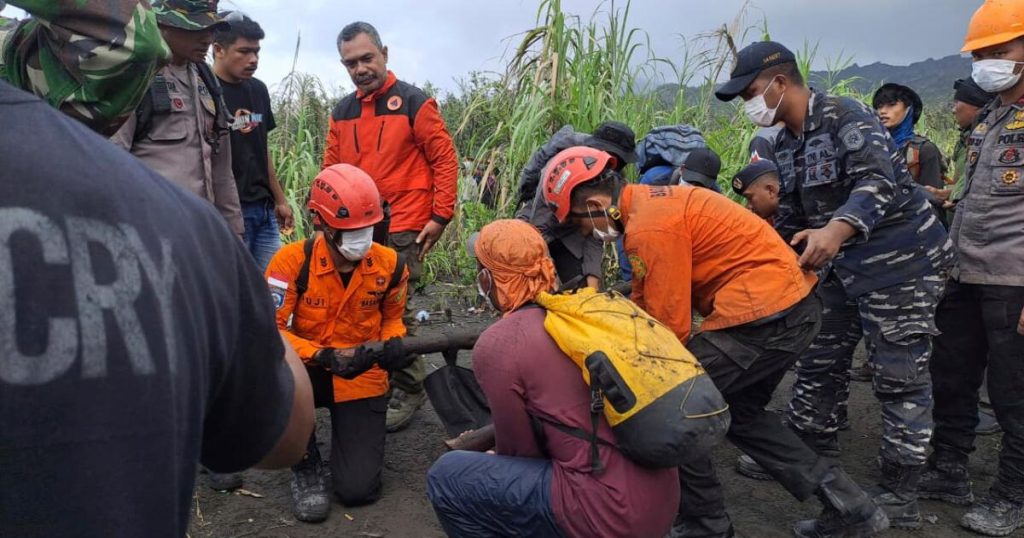
JAKARTA, Indonesia — Rescuers on Indonesia ’s remote island of Halmahera found the bodies of two more hikers Sunday, two days after they were caught in a volcanic eruption on Mt. Dukono, officials said.
The bodies of the Singaporean men, ages 30 and 27, were located a few yards from where another victim, an Indonesian woman, was found dead Saturday, said Abdul Muhari, the National Disaster Management Agency’s spokesperson. All three had been about 165 feet from the rim of the main crater.
The men’s bodies were covered by thick layers of volcanic material, Muhari said, adding that the densely packed material had complicated evacuation efforts and significantly slowed progress.
“The bodies were buried under deep, densely packed volcanic material that is difficult to dig through,” Muhari said. “Rescue teams must proceed cautiously to ensure safety.”
The trio were among 20 hikers who set out to ascend the 4,445-foot volcano in North Maluku province, in defiance of safety restrictions. They became stranded when Dukono erupted early Friday, spewing a thick ash column that rose about 6 miles into the air.
Seventeen people were evacuated hours after the eruption, including seven Singaporean nationals. Ten of those evacuated had suffered minor burns, while two were able to join the rescue operation and provided information to help locate those missing.
Search teams involving nearly 100 personnel faced extreme terrain and continuing volcanic activity, according to Muhari.
Iwan Ramdani, head of the local search and rescue department, said the evacuation efforts on Sunday had been monitored by volcanology officials as the volcano continues to spew ash, hot material and glowing rocks.
“The search operation was repeatedly disrupted by Mt. Dukono’s continued volcanic activity,” Ramdani said. “Teams must be extremely careful during the evacuation process.”
The bodies of the three victims were transported to an emergency response post before being taken to Tobelo Regional Hospital for identification and further handling, Ramdani said.
The National Disaster Management Agency said the search and rescue operation was now closed.
The agency urged residents, tourists and tour operators to comply with safety regulations and avoid restricted areas.
Authorities have banned all activities within a 2½-mile danger zone around the crater, in line with recommendations from Indonesia’s volcanology agency.
Mt. Dukono is among more than 120 active volcanoes in Indonesia, which is prone to seismic upheaval due to its location on the Pacific “Ring of Fire,” an arc of volcanoes and fault lines encircling the Pacific Basin.
Karmini and Tarigan write for the Associated Press.