
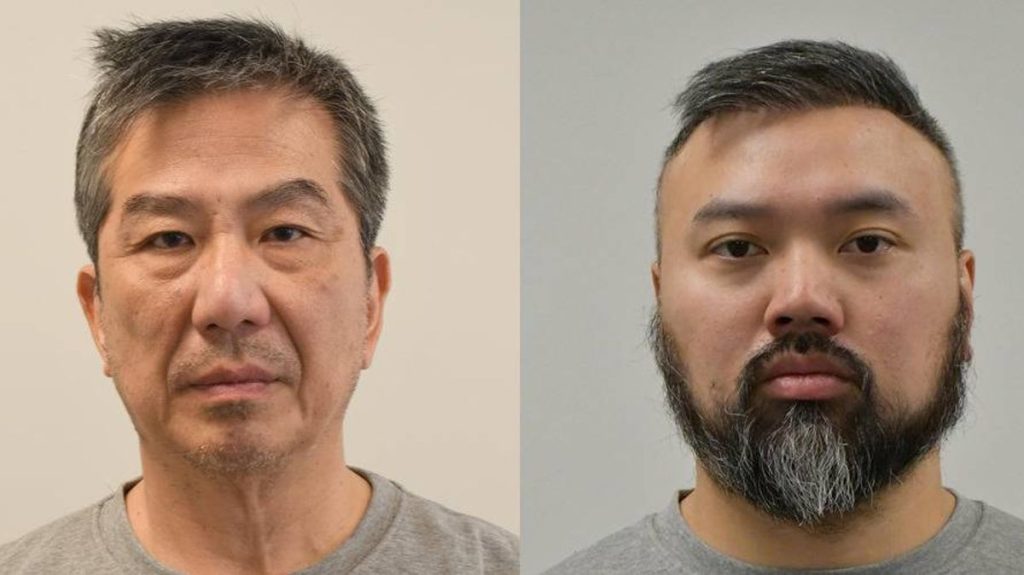
Peter Wai and Bill Yuen were finally caught after trying to force their way in, while a third man was found dead before he could face trial.

Chung Biu Yuen (left), 65, a former Hong Kong police officer currently working at the Hong Kong Economic and Trade Office in London, and Chi Leung Wai, 40, a former UK Border Force officer and special constable with the City of London Police(Image: Copyright remains with handout provider)
A Border Force official and a retired Hong Kong police officer who tried to abduct a woman from her West Yorkshire home have been found guilty of spying for China on British soil.
Peter Wai, 40, and Bill Yuen, 65, both dual Chinese-British nationals, carried out “shadow policing” operations targeting Hong Kong pro-democracy protesters living in the UK. The pair were arrested following a botched attempt to abduct a former Hong Kong resident, Monica Kwong, from her flat in Pontefract, West Yorkshire.
After a two-month trial at the Old Bailey, both men were convicted of assisting a foreign intelligence service under the National Security Act. Chinese ambassador Zheng Zeguang was subsequently summoned by the Foreign Office in response to the verdicts.
Security minister Dan Jarvis said the move was intended to “make it clear activity like this was, and will always be, unacceptable on UK soil”.
Wai was additionally convicted on Thursday, May 7 of misconduct in a public office after using the Home Office computer system to search for individuals of interest to Hong Kong authorities.
The court heard that Wai had served with UK Border Force and was a City of London Police special constable, having previously served in the Royal Navy. He had gathered intelligence under the direction of former Hong Kong superintendent Yuen, who held a senior management position at the Hong Kong Economic Trade Office (HKETO) in London, widely regarded as an extension of the Hong Kong government in the UK.
Those targeted included Hong Kong dissidents, with “special attention” directed towards British politicians, among them senior Conservative MP Sir Iain Duncan Smith. The accused referred to their targets as “cockroaches” while gathering intelligence on which vehicles they drove, their addresses and their social media profiles.
High-profile activist Nathan Law, who has a HK$1 million bounty on his head (£95,680), was photographed departing the Oxford Union during one surveillance mission.
Personal assistant Ms Kwong had departed Hong Kong with her young son in 2023 amid allegations of involvement in a £16 million fraud, which she refuted. Wai had searched the Home Office computer system for details about Ms Kwong and pro-democracy activists.
Sign up for YorkshireLive Premium here
After locating Ms Kwong, the accused assembled a team to gain entry to her home using “underhand means, deception and then force to achieve their ends”, jurors were informed. The group conducted surveillance before attempting to “trick” their way into her home, including by pretending to be electricians who had arrived to repair a fuse, the court had been told.
Among those present was Matthew Trickett, 37, an immigration enforcement officer and former Royal Marine, who was filmed repeatedly knocking on Ms Kwong’s door. He subsequently poured bottled water onto the floor to create a fake flood as part of an unsuccessful ploy to get Ms Kwong out of the flat, the trial had been told.
Having been alerted to what was going on, police were bugging their activities and were waiting inside the flat when the team eventually broke in. When Wai was arrested, officers discovered his warrant card identifying him as a special police constable, alongside a second fraudulent card bearing the rank of superintendent.
Of the 11 individuals detained, only Trickett, who had been employed as a Home Office immigration officer, was charged alongside Wai and Yuen under the National Security Act. However, just a week later, he was discovered dead in woodland near Maidenhead, Berkshire.
Wai, from Staines-upon-Thames, Surrey, and Yuen, from Hackney, east London, had pleaded not guilty to all charges brought against them.
While giving evidence, Wai, known among associates as Fatboy, informed jurors that he worked as an instructor in the traditional Chinese martial art of lion dancing and had previously served in the Royal Navy.
Get all the latest and breaking news in Yorkshire by signing up to our newsletter here.
Yuen told the jury how he came to be officer manager at HKETO following his retirement from the Hong Kong police after 18 years of service. Providing building security formed part of his role – though passing intelligence to Chinese authorities in Hong Kong did not, he insisted.
He had engaged Wai’s private security firm to provide protection for HKETO and visiting dignitaries who were targeted by protesters, Yuen stated.
The jury, which deliberated for 23 hours and 38 minutes, was discharged after failing to reach a verdict on the foreign interference charges against the defendants.
Mrs Justice Cheema-Grubb remanded both defendants into custody to await sentencing at a later date, after the prosecution confirmed the Crown would not pursue a retrial.
Bethan David, head of the counter terrorism division at the Crown Prosecution Service (CPS), said: “These convictions send a clear message that transnational repression, foreign interference, unauthorised surveillance, and attempts to operate outside the law will not be tolerated on British soil.
“This conduct was deliberate, co-ordinated and carried out with full knowledge of who it would benefit, as demonstrated by extensive digital and financial material presented during the trial.
“The CPS will not hesitate to prosecute cases where evidence shows illegal attempts to interfere, intimidate, or operate covertly in the United Kingdom. We will continue to work closely with our law enforcement partners to make sure that those who abuse positions of trust or act on behalf of foreign interests are held properly to account.”
Commander Helen Flanagan, head of Counter Terrorism Policing London, said: “The activity by Wai and Yuen was both sinister and chilling. Our investigation found they were spying for the Hong Kong authorities, targeting UK-based pro-democracy campaigners.
“It is completely unacceptable for anyone to carry out this kind of activity on behalf of a foreign state here in the UK. I hope this outcome provides reassurance to those living in the UK who may be concerned about being targeted by any foreign state, that we will do everything we can to help keep them safe.”
Polly Truscott, Amnesty International UK’s foreign policy director, said the case laid bare the Hong Kong government’s “chilling” determination to spy on activists in the UK.
She said: “Students, activists, and those seeking asylum here must have their personal security and privacy protected and be able to exercise their rights to freedom of expression, opinion and peaceful protest without fear of foreign interference and intimidation.”