
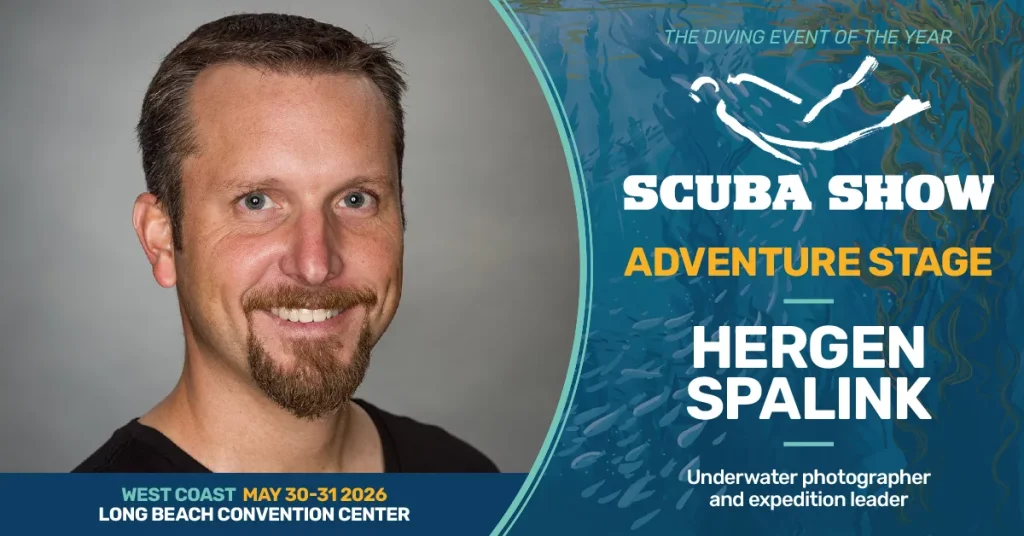
Hergen Spalink is a professional underwater photographer, Nauticam Ambassador, and the co-founder of Subculture Travel. A true global explorer, Hergen has captured images across all seven continents, but his deepest expertise lies in the waters of Southeast Asia, and he’ll be providing an insight into the diving hotspots of Indonesia at the Long Beach Scuba Show on 30-31 May.
Having spent over a decade living in Indonesia as a professional guide and shooter, he possesses an intimate knowledge of the region’s complex ecosystems and heritage. Today, he leverages his 20 years of field experience to lead specialized expeditions with his wife and fellow shooter Kerri Bingham helping divers master the art of underwater storytelling.
Exploring Indonesia
Join Hergen for an immersive visual odyssey across the Indonesian Archipelago. Drawing from two decades of diving – including 11 years living and working in-country full-time – Hergen shares a stunning collection of underwater and topside imagery that captures the soul of the region.
From the critters of Bali to the legendary reefs of Raja Ampat, North Sulawesi and Komodo to the hidden gems of Triton Bay and the Banda Sea, this session goes beyond the typical dive travelogue.
Attendees will gain a deep understanding of Indonesia’s premier destinations, enriched by the historical and cultural narratives that make this archipelago the global epicenter of marine biodiversity.

Long Beach Scuba Show
The Long Beach Scuba Show, this year sponsored by Divers Alert Network, is celebrating its 39th anniversary in 2026 (30-31 May), and it represents the first show under the banner of new owners Rork Media Limited, which also runs the GO Diving Shows in the UK and Australia, and publishes the global-multi-edition Scuba Diver magazine, as well as being behind the Scuba Diver Magazine YouTube Channel, and long-established website Divernet.
Fans of the long-running event will be delighted to hear that Rork Media plan to retain everything that made the Scuba Show such a staple on the West Coast diving circuit, and enhance it with new and improved elements, including a Main Stage with a huge video wall right in the exhibition hall itself, a new layout designed to stimulate exploration around the hundreds of booths, and additional interactive attractions including a VR dive on a deep-water shipwreck in the Baltic Sea.
The three seminar rooms have been organised into themes, to make it easier to find speakers/topics of interest, so prepare to dive into Adventure, Inspiration, and UW Imaging.
Whether you’re an experienced diver, a new enthusiast, or just curious about the underwater world, the Scuba Show brings together everything you love about diving under one roof.
Greg Holt from Scuba Radio will be entertaining the crowds on mornings before and as the show opens, offering plenty of fun and games, and the chance to win some amazing prizes.
Explore hundreds of exhibitors showcasing the latest scuba gear, dive destinations, underwater photography equipment, training programs, and ocean conservation initiatives. Attend inspiring seminars led by world-renowned dive experts, explorers, and photographers, and connect with dive professionals, travel operators, and fellow divers from across the country.
There is also the opportunity to expand your skillset. The PSI-PCI Visual Cylinder Inspection course is open to everyone who wishes to inspect high-pressure breathing gas cylinders, or just know about the process. These specialty courses support the inspection process with formal function specific training on valve maintenance and repair, and Oxygen Cylinder Cleaning. Inspectors who are at the three-year renewal mark and want to attend the PSI-PCI Update course will be able to take care of it at the Scuba Show as well.
PSI-PCI offers the only training that is formally endorsed, utilized, and referred to by the cylinder manufacturers. The training has been created with the input of industry professionals and experts in each field to provide you with the best training available to meet the Federal requirements for the associated processes. You can join the team of PSI-PCI Professionals at the Scuba Show. Don’t wait, seats will fill up quickly! Click here for more information and to book a slot.
The Scuba Show offers two full days of ocean adventure, hand’s-on experiences, and exclusive show specials, and is where the US dive community comes together to celebrate the underwater world.
Get your tickets now!
Tickets are on sale now for the Scuba Show, and new for 2026, there is a change to the cost of entry – there is now one ticket price, which gets every attendee full access to the Exhibition Hall, and entry to all seminars.
With many of the speakers in the dedicated Adventure, Inspiration, and UW Imaging seminar rooms either only presenting on one of the days, or giving two different talks, plus with the headline acts on the Main Stage, and the plethora of booths, interactive elements and much more, there is plenty to keep you occupied on both days, so why not make a weekend of it?
Tickets are available now – click here – priced at $33 for a day ticket, and $60 for a weekend pass. There is also the option of a VIP Pass, which includes a weekend pass plus 6 issues of Scuba Diver magazine and 6 issues of California Diving News (Magazine delivery US & Canada residents only), and a Scuba Show Dive Team T-shirt, for $100.
Under 16s go free – bring the family and let the kids dive into the fun as well.
Join us for two incredible days, 30-31 May 2026, celebrating the world of diving at the Long Beach Convention Center!