
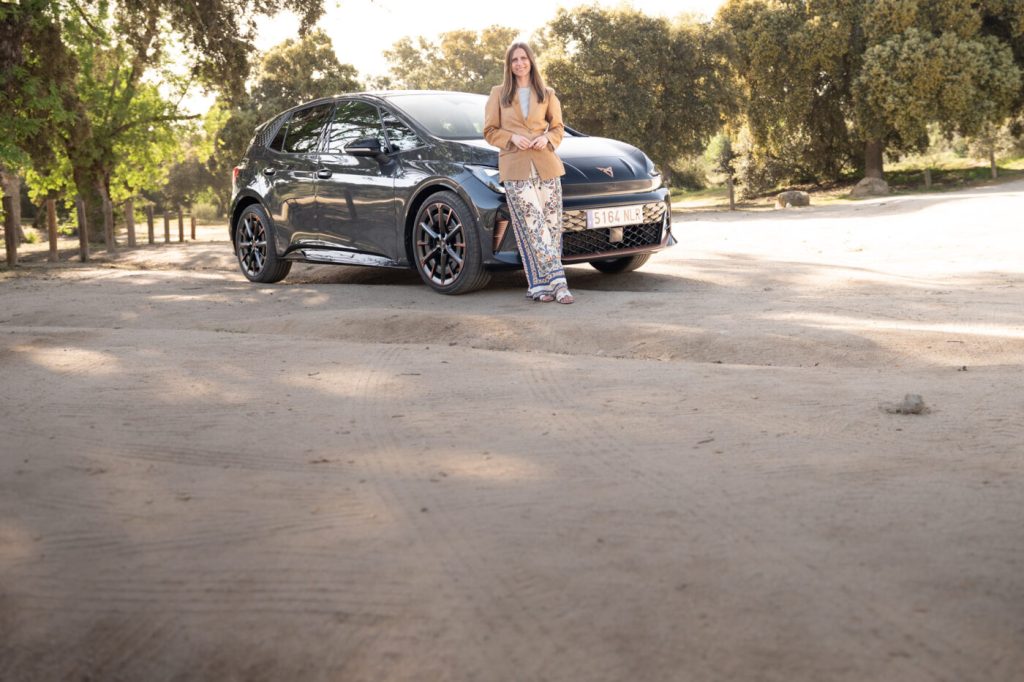
The Cupra Born already positioned itself as the emotional counterpoint within the group at its market launch: same platform, same technology – but a different ambition. With the facelift, Cupra aims to intensify exactly that. More design, more performance, more emotion. The key question: how much of that actually translates into everyday driving?
Madrid provides the right stage. Dense urban traffic, dual carriageways and winding roads in the surrounding area quickly reveal the breadth of its capabilities. They also show that the new Born remains, at its core, a typical MEB vehicle, but interprets the familiar layout in a noticeably more distinctive way.
That is clear at first glance: the new ‘shark nose’ front, the more striking light signature with triangular elements and the illuminated logo at the rear create a far more confident appearance. While other models on the platform adopt a deliberately restrained look, the new Born clearly seeks an emotional presence.
While Cupra aims to stand out visibly in design, its scope is naturally more limited when it comes to technology. The Born becomes the first of the existing MEB models to switch to the updated MEB+ platform, offering a preview of what the ID.3 Neo will deliver in future. But ultimately, Cupra remains tied to what the group platform provides. Cupra does offer the more powerful variants where possible, but this is essentially the drivetrain already known from the ID.3 GTX Performance.
For the drivetrain, Cupra continues to offer several power levels: from the entry version with 140 kW and a 58 kWh battery, through 170 kW with the larger 79 kWh battery, up to the 240 kW VZ version. The base model uses the new APP350 electric motor, which promises more torque and higher efficiency. As reported, LFP cells also make their debut. In the other variants with ranges of over 600 kilometres, however, Cupra continues to rely on the familiar NMC batteries.
The VZ version marks the dynamic peak of the range – and it was available for an initial test drive. With its 240 kW output, the new Born responds noticeably more directly to accelerator inputs. From the first few metres, it becomes clear how little pedal travel is needed to generate strong acceleration. Launch Control further sharpens the start, making the initial surge even more pronounced and underlining its sporty credentials. How often drivers will use this in everyday life remains a personal choice – but it is certainly enjoyable.
One-pedal driving is also new. Using the strongest recuperation setting, the Born can be controlled largely via the accelerator in everyday driving. After a short familiarisation period, this works surprisingly well in dense city traffic, delivering smoother progress and providing a real comfort benefit, especially in stop-and-go conditions.
On faster roads, the new Born impresses with confident acceleration and stable straight-line performance. A brief press of the pedal is enough to complete overtaking manoeuvres quickly. Even at higher speeds, the handling remains calm and controlled. However, it truly excels on winding country roads: the rear-wheel drive ensures balanced handling, and the steering is tuned for direct response. Combined with the adaptive dampers, this results in driving characteristics that blend comfort and sportiness effectively – with a clearly sportier setup than its more restrained counterpart within the range.
The driving modes noticeably alter the character. While ‘Range’ and ‘Comfort’ focus on efficiency, the Born feels significantly sharper in the sportier modes. The acoustic staging via the optional sound system reinforces this impression, although at times it feels deliberately engineered. Some of the sportiness thus comes not only from the hardware, but also from the presentation.
In terms of consumption, the new Born VZ achieves an official figure of around 14 to 16 kWh per 100 kilometres, a solid level for this performance class. In practice, much depends on driving style: those who regularly exploit the additional performance will see higher figures, while a more restrained approach can achieve values close to the official rating. Ranges of up to around 600 kilometres (depending on the variant) and DC charging of up to 185 kW ensure that longer journeys are easily manageable.
Finally, real buttons return to the steering wheel
Not only the drivetrain but also the interior improvements become immediately apparent in everyday use. The return of physical buttons on the steering wheel and conventional window switches makes operation far more intuitive again – a step currently being implemented across much of the VW Group. The central 12.9-inch touchscreen remains the control hub, but it responds faster and feels more refined than in earlier versions. This is complemented by a larger digital cockpit and, depending on specification, a head-up display.
Cupra has also upgraded the materials – the hard plastic feel of the first MEB generation was a well-known point of criticism. Recycled fabrics and redesigned surfaces noticeably enhance the interior without being overly conspicuous. The standard bucket seats in the VZ version offer good lateral support while maintaining solid comfort, and the seating position is pleasantly low and sporty. In the rear, the flat floor provides ample space, although taller passengers may need to take a little care when getting in.
Prices for the new Born in Germany start at €35,990, while the VZ version begins at €46,990.
Conclusion
In the end, the new Cupra Born remains closely tied to the familiar group toolkit but makes consistent use of its available scope. It does not feel completely different – but different enough to establish a clear position. The Born does not aim to be a sober electric car, but an emotional one. Its design, sharper tuning and deliberately crafted visual and acoustic elements set it apart clearly.