
On April 24, China’s Commerce Ministry banned exports of dual-use items to seven European entities, placing them on its export control list. The stated reason: “arms sales to or collusion with Taiwan.” Those sanctioned include Germany’s Hensoldt AG, Belgian arms manufacturers FN Herstal and FN Browning, and four Czech companies: Excalibur Army, Omnipol, VZLU Aerospace, and SpaceKnow.
By restricting European defense companies cooperating with Taiwan, Beijing is doing more than enforcing its One China Principle. It is severing Europe’s access to a valuable combination: Ukraine’s battlefield drone know-how and Taiwan’s high-tech components. Together, the Ukraine-Taiwan link offers a cheap, scalable war doctrine Europe increasingly needs.
The move came just days after the head of the European Parliament’s security committee visited Taipei – a sign the EU is aware of Taiwan’s importance for European defense.
Several European countries have been quietly developing a new drone doctrine built on both Ukraine’s battlefield experience – accumulated over four years of war – and Taiwan’s high-tech components, including chips, batteries, and motors sourced outside Chinese supply chains.
Ukraine’s war has rewritten the fundamentals of aerial warfare. Development cycles for drones have been reduced from months to as little as four to six weeks through decentralized procurement, direct frontline feedback, and a manufacturing logic that treats battlefield data as real-time engineering input. This stands in stark contrast to the costly approach used by the United States in its conflict with Iran, where million-dollar Patriot missiles were fired to intercept cheap Shahed drones.
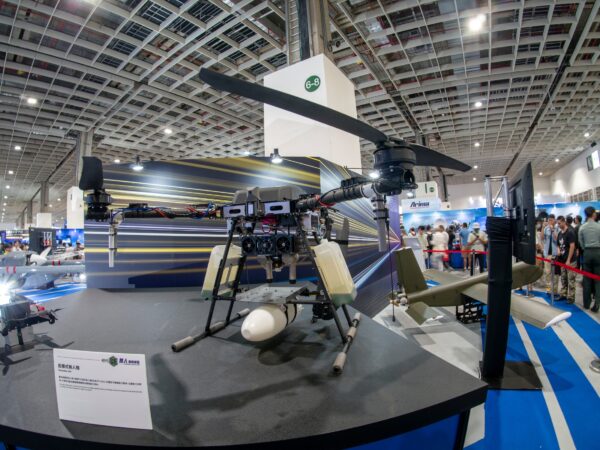
Taiwan has become a critical node in sustaining the creation of new war doctrine. Taiwanese firms provide components that both Ukraine and Europe urgently need to source outside China. According to a March 2026 report in The Economist, Taiwan’s drone export sector has grown 749 percent year-on-year. Exports to Czechia alone rose from negligible levels to approximately 20,000 units per month in October 2025, before doubling again to 40,000 by January 2026. Poland is among the other active recipients – partly to facilitate transfers to Ukraine, and partly for its own military use. The surge in demand is leading to a drone-related renaissance in Taiwan, which now hosts 270 drone-related companies.
This is not merely commercial cooperation, however. On March 28, a Ukrainian combat veteran – whose rank was withheld for security reasons – addressed Taiwan’s Legislative Yuan alongside drone and disinformation experts. The event, co-organized by the Liberal Democratic League of Ukraine, saw Ukraine’s battlefield experience being directly shared with Taiwan’s parliament.
On April 23 – one day before Beijing’s sanctions announcement – another drone related event took place in Taipei. The Research Institute for Democracy, Society, and Emerging Technology (DSET), a national think tank established under the National Science and Technology Council, launched two new research reports: “Drone Superpower: Ukraine’s UAV Success and Where Taiwan-Ukraine Cooperation Fits In” and “The Invisible Drone Wall: Taiwan’s Quiet Support for a China-Free European Drone Supply Chain.” The first report documented Ukraine’s UAV battlefield success and Taiwan’s role within it. The other described Taiwan’s emerging position as the backbone of a European drone supply chain that sidesteps China.
According to Samara Duerr of DSET, a policy analyst who presented the reports, drones now account for an estimated 95 percent of battlefield casualties in the Russia-Ukraine war. With UAVs’ centrality in modern warfare on stark display, the DSET reports found that cooperation between Taiwan, Europe, and Ukraine in drone supply chains has grown rapidly. According to DSET, Taiwan exported nearly 130,000 drones to Poland and Czechia in 2025, most of which were then exported on to Ukraine. In the first quarter of 2026 alone, Taiwan’s exports to Central and Eastern Europe had already exceeded those numbers.
Europe recognizes the value of the new links being built. In early April 2026, Marie-Agnes Strack-Zimmermann, chair of the European Parliament’s Committee on Security and Defense, led a delegation to Taipei. She met President Lai Ching-te, Foreign Minister Lin Chia-lung, National Security Council Secretary-General Joseph Wu, and Legislative Yuan Speaker Han Kuo-yu.
Speaking to foreign correspondents, Strack-Zimmermann stated that Europe is interested in developing joint defense capabilities and industrial cooperation with Taiwan. The visit was an institutional signal that Europe intends to access the Taiwan–Ukraine drone corridor as a participant, not a bystander. The doctrine being developed there is battlefield-tested, component-specific, and directly applicable to the security environment European militaries are now preparing for.
Now China has delivered its answer. The new export controls are designed not only to punish European firms for drawing too close to Taiwan – a permanent neuralgia point for Beijing – but to sever the supply chains and security cooperation stretching from Taipei to Kyiv and beyond.
Czechia’s prominence on Beijing’s sanctions list reflects how far Prague has advanced down this path. Four of the seven sanctioned entities are Czech – a consequence of the country’s deep engagement with Taiwan across defense procurement, parliamentary diplomacy, and think tank networks. Czechia is also one of the few European states with its own Indo-Pacific strategy, developed under former Foreign Minister Jan Lipavský, who visited Taiwan in March 2026. Prague did not stumble into Beijing’s sanctions list. It walked there deliberately.
The sanctions are formally targeted at “arms sales.” But their practical effect reaches into the industrial links, component flows, and knowledge exchanges through which a new European drone doctrine is taking shape. The intention is clearly to warn other European companies away from this promising field of cooperation. According to a statement made by the spokesperson of China’s Ministry of Commerce, “honest and law-abiding EU entities need not be concerned at all.”
Europe’s access to the Taiwan-Ukraine combination – the only battlefield-tested source of next-generation drone doctrine available to it – has just become more complicated.