
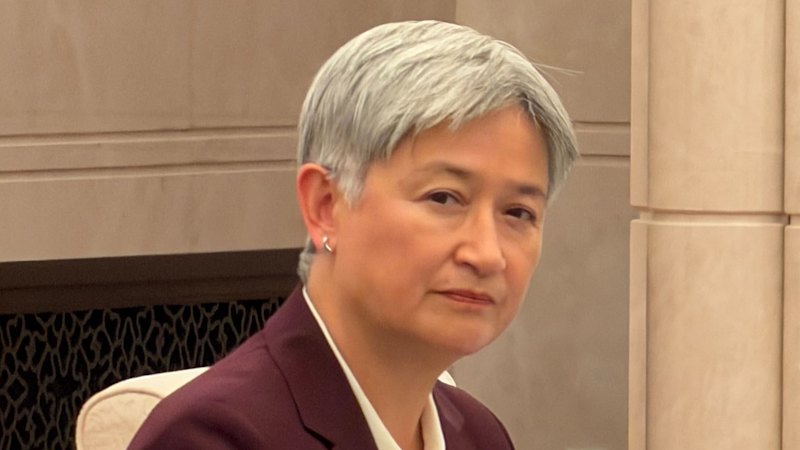

Beijing: A high-stakes meeting between Foreign Minister Penny Wong and Chinese Vice Premier Han Zheng has been disrupted by an awkward incident when Chinese officials attempted to usher Australian media out of the room before she had completed her opening remarks.
One Chinese official moved in front of the Australian government’s official cameraman obstructing his efforts to film Wong’s prepared statement.
Wong had arrived at The Great Hall of People in Beijing at the start of a busy one-day blitz on the capital to discuss fuel and trade.
Ignoring the efforts to move them on, Australian media remained in place until Wong finished speaking, where she used her statement to discuss the fuel crisis and the importance of the Australia-China trade relationship.
“Obviously, the Middle East conflict and the closure of the Strait of Hormuz continues to disrupt global energy markets, with Asian refineries and the Indo-Pacific Region disproportionately affected,” Wong said in her opening remarks.
“In that context, it’s more important than ever that we continue to engage and find ways to work together to keep fuel and goods flowing.”
Vice premier Han, who addressed the meeting before Wong, said the China-Australia relationship had over the past decade experienced growth but also setbacks.
“The Chinese side is ready to follow through on an important consensus reached between our leaders and offering a more mature, steady and more fruitful China Australian comprehensive strategic partnership,” he said.
Wong is expected to use the meeting to press the case for Australia’s access to jet fuel and fertiliser exports, which China has heavily restricted since the outbreak of the Iran war.
She will meet with Chinese Foreign Minister Wang Yi later in the day.
Wong’s trip to Beijing – part of a flying visit through East Asia with stops in Tokyo and Seoul this week – could be well-timed.
China is signalling that it will resume exporting jet fuel, gas and diesel from May after heavily curtailing exports since the start of the Iran war to build up its own domestic supplies.
UK Newspaper The Financial Times reported today that China’s largest state oil companies have applied for export permits to ship fuel in May, signalling that the defacto ban on exports may soon be lifted.
Australia imports 30 per cent of its jet fuel from China, as well as a considerable amount fertiliser.
Other Asian countries, such as the Philippines, are running extremely low on jet fuel due the energy crisis and the strangling of the Strait of Hormuz. The Philippines sources half of its jet fuel from China, and has declared a state of emergency due to a shortage of fuel and oil.
In June 2024, a Chinese official stood in front of Australian journalist Cheng Lei during an official function at Parliament House in Canberra in an attempt to make sure Cheng did not appear in any photographs or video of the meeting between Prime Minister Anthony Albanese and Chinese Premier Li Qiang.
Cheng had previously spent time in a Beijing detention facility after being accused of vague national security charges and was only released after strenuous lobbying by Australian officials.
more to come
 Lisa Visentin is the North Asia correspondent for The Sydney Morning Herald and The Age based in Beijing. She was previously a federal political correspondent based in Canberra.Connect via X or email.