
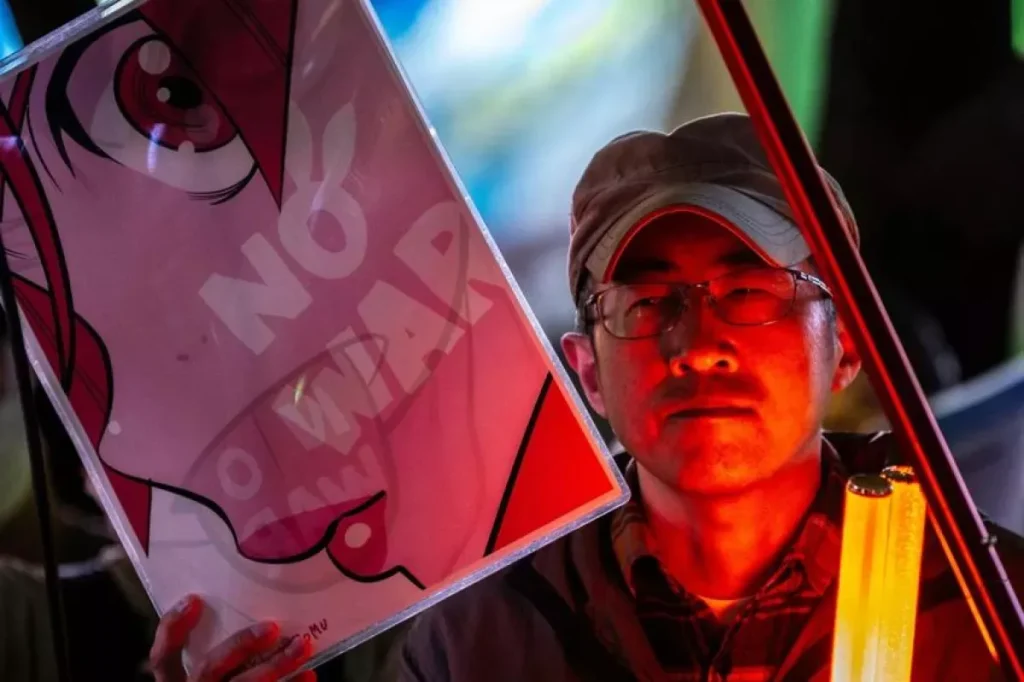
Dozens of protesters gathered in Tokyo on Friday, April 24, to demonstrate against the government’s decision to ease long-standing restrictions on arms exports, a move critics say undermines Japan’s post-war pacifist principles.
The revised policy, announced earlier this week on Tuesday by the government of Prime Minister Sanae Takaichi, allows for the export of lethal weapons overseas. The change represents a significant shift in Japan’s defence posture as the country seeks to expand its military capabilities and establish a presence in the global arms market, partly to support economic growth.
The decision has prompted concern and criticism among segments of the Japanese public. On Friday, demonstrators assembled outside a busy train station in Tokyo’s Shinjuku district, holding placards reading “Stop exporting lethal weapons!” and “No war”, as per Japanese media.
“The government must not decide on its own,” protesters chanted.
Some participants voiced strong personal objections to the policy shift. Tokyo resident Ryozo Sawada, 74, said he felt “an unbearable sense of humiliation.”
“Ever since I was a child, the one thing about Japan I could truly be proud of was that we renounced war,” he said.
Another resident, Masako, 29, who provided only her first name, described the move as deeply troubling.
“The fact that they actually decided to export weapons is incredibly frightening,” she said.
“I’m angry that, even though Japan has been a peaceful nation for the past 80 years, a small group of people did something that outright denies that,” she added.
When announcing the policy change, Takaichi emphasised that Japan’s “core principles” and “history” as a pacifist nation remain unchanged.
Under the new framework, Japan will be permitted to export weapons only to countries that commit to using them in accordance with the United Nations Charter.
Public opinion appears divided. A survey conducted in March indicated that around half of the respondents oppose the policy change, while 32 per cent expressed support.
The protests are part of a broader wave of demonstrations organised by peace activists across Japan, driven by concerns that Takaichi’s more assertive security stance and her open support for U.S. President Donald Trump could increase the risk of Japan becoming involved in international conflicts.
By Tamilla Hasanova