
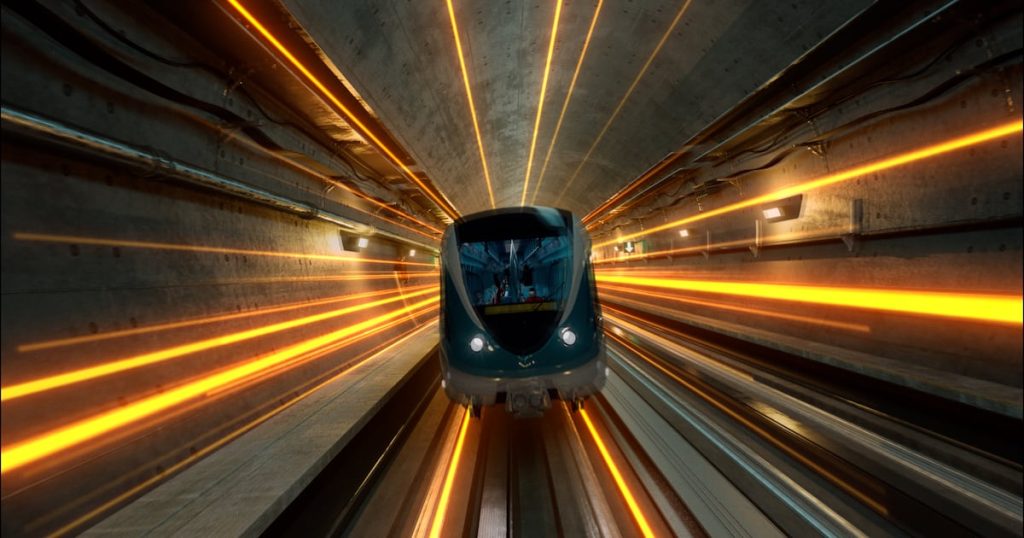
Dubai on Wednesday unveiled ambitious plans for a new Dh34 billion ($9 billion) Metro Gold Line to serve more than 1.5 million residents, in what is being hailed as the largest transport project in the emirate’s history.
Sheikh Mohammed bin Rashid, Vice President and Ruler of Dubai, said the Dubai Metro expansion would pass through 15 key areas of the city and connect to dozens of real estate developments under construction, as well as the coming Etihad Rail passenger train services.
The underground 42km route will extend the length of the vast network by a further 35 per cent and is due to open on September 9, 2032 – 23 years to the day since the launch of Dubai Metro in 2009.
“Today we announce Dubai’s largest transport project; a new Dubai Metro line spanning 42 kilometres, at a depth of 40 metres underground,” Sheikh Mohammed said.
“This new route will connect 15 strategic locations in Dubai, serving 1.5 million people and supporting mobility across 55 mega development projects currently under construction.”
Sheikh Mohammed said the announcement of the mega project served to demonstrate Dubai’s continued investment in its future.
“Our major projects to build the world’s best city to live in are ongoing. Our future projects will not stop; rather, they will gather pace. Our mission is to build a better future for millions—for we are a people who say what we do and do what we say.”
Mapping the future
Authorities said the Gold Line will include 18 stations and feature the emirate’s first fully integrated underground route.
The route will stretch from the heart of Old Dubai in Al Ghubaiba to Jumeirah Golf Estates and will be linked to the Green and Red lines and Etihad Rail, which is set to launch passenger services this year.
A map setting out the expanded Dubai Metro network – as it will look in 2032 – shows the Gold Line cutting through large parts of the city, within reach of residential and commercial areas such as Mina Rashid, City Walk, Business Bay, Mohammed Bin Rashid City, Nad Al Sheba, Mohammed bin Rashid Gardens, Meydan, Al Barsha South, Jumeirah Village Circle (JVC).

The Gold Line will be linked to Etihad Rail passenger train stations at Jumeirah Golf Estates, now under construction, and a future Etihad Rail Station in Meydan.
The 2032 public transport map also shows a high-speed rail line linking the Expo City Dubai area to Ras Al Khor, linking at its end point with both the Blue and Green Lines.
it will also connect with the Red Line at two locations; Business Bay and Jumeirah Golf Estates, and to the Green Line at Al Ghubaiba.
The Gold Line will carry up to 465,000 passengers a day after 2040, offering a major boost to Dubai’s long-term drive to encourage commuters to swap cars for public transport. It will have an advanced tunnel network that will be twice the size of the Dubai Metro’s existing tunnel infrastructure.
Future of transport
The launch of the Gold Line is the latest step forward for Dubai’s fast-growing Metro network, as the emirate’s leadership seeks to keep pace with a growing population.
The major rail plan is critical to Dubai’s efforts to boost connectivity and encourage drivers to shift to public transport to ease congestion, amid the emirate’s population boom. Dubai had previously announced that the Dubai Metro Blue Line was set to launch in September 2029, marking the 20th anniversary of Dubai Metro.
The Dh20.5 billion Blue Line project will include 14 stations, connect with the existing Green and Red lines, and serve expanding neighbourhoods such as Mirdif, Dubai Silicon Oasis, Dubai Creek Harbour and Dubai International City.
It will add 30km to the Metro network, 15.5km of which will be underground.
The addition of the Gold Line will extend the Dubai Metro network from 120km – including the Blue Line – to 162km and increase the number of stations from 67 to 85.
Growing the economy and cutting congestion
Mattar Al Tayer, director general and chairman of the board of executive directors of the Roads and Transport Authority, said the initiative marked a “strategic milestone in the evolution of Dubai’s public transport network”.
He said the Gold Line was expected to generate a 430 per cent economic return on the Dh34bn investment, driven by savings made in time and fuel as well as reductions in road accident fatality rates and carbon emissions.
He said the large-scale infrastructure scheme would act as a catalyst for economic growth, driving up property prices along the route.
Mr Al Tayer said the Gold Line would ease pressure on sections of the busy Red Line and on key roads across the emirate, with the aim of slashing the number of vehicle journeys by 40 million each year.
Going underground
Mr Al Tayer said the latest tunnel boring machine technology would be utilised to develop the entirely underground route, minimising disruption during construction work.
The project is scheduled to go out for tender this year, with a contract for its construction to be awarded in 2027, paving the way for work to start.
Since its launch in September 2009 up until the end of 2025, the Dubai Metro has transported more than 2.8 billion passengers.
With a daily average of one million users, the Dubai Metro accounts for 40 per cent of all public transport use across the emirate.