
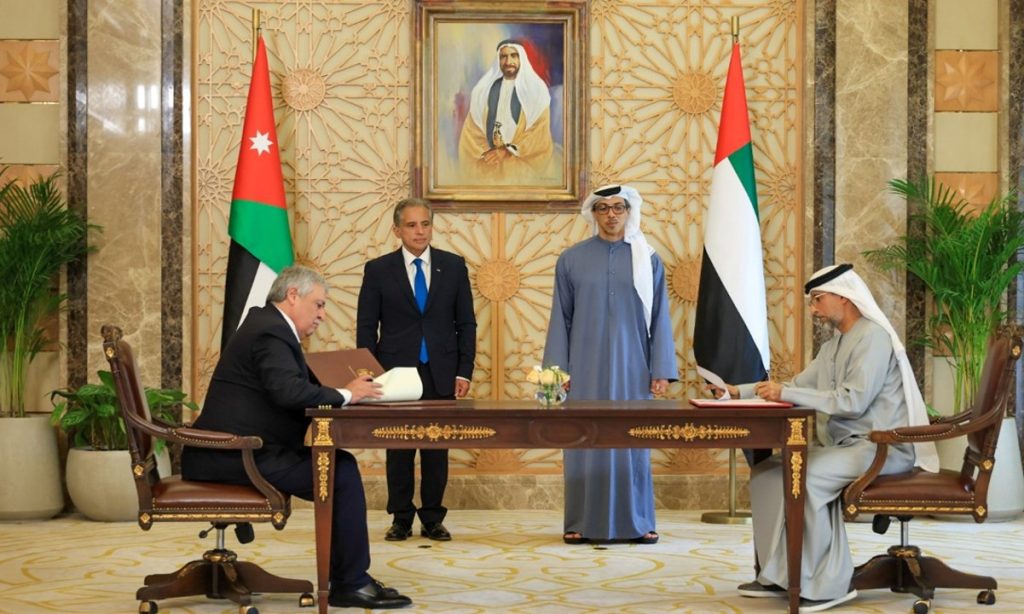

The railway agreement between the United Arab Emirates and Jordan marks the launch of the Port of Aqaba railway project, a landmark initiative in the development of the transportation system. It plays a central role in connecting mines, logistics infrastructure, and the mining industry, creating a logistics hub not only at the national level but also regionally and internationally.
The United Arab Emirates (UAE) and Jordan have signed an agreement for the development of Jordan’s railway network, which includes the Port of Aqaba railway project, as well as the establishment of the joint venture UAE–Jordan Railway Company (UJRC).
The agreement was signed on behalf of the United Arab Emirates by Suhail bin Mohamed Al Mazrouei, Minister of Energy and Infrastructure, and on behalf of Jordan by Nidal Al-Qatamin, Minister of Transport.
Prime Minister Jafar Hassan and Sheikh Mansour bin Zayed Al Nahyan, Vice President of the United Arab Emirates, Deputy Prime Minister of the Cabinet and Chairman of the Presidential Council, witnessed the signing of agreements regarding the commencement of actual implementation procedures for the Aqaba Port railway project, as well as the establishment of the joint venture responsible for the construction and operation of this project.

The Aqaba Port railway project is based on a balanced partnership between two parties: on the one hand, Jordan, represented by the Phosphate and Potash Companies, the Government Contributions Company, and the Social Security Funds Investment Fund, and on the other hand, the United Arab Emirates, through “Lemad Kabda,” the sovereign investment platform of the Abu Dhabi government.
This project represents the largest railway initiative of its kind in Jordan, with a total estimated investment of approximately 2.3 billion USD, jointly undertaken by the two countries. It includes a series of major infrastructure components, such as railway lines, bridges, and overpasses, all designed and constructed in accordance with international standards in the field of rail transport.
Through its implementation, the project will significantly contribute to increasing the competitiveness of the Port of Aqaba, transforming it into a strategic regional hub for transport, logistics, and maritime services. At the same time, it will generate new opportunities for economic and social development, particularly in southern Jordan and the Aqaba area.
This initial phase represents the first concrete step toward developing a modern national railway network in Jordan. In the long term, the objective is to connect Aqaba and the entire country with neighboring Arab states, as well as to integrate the Port of Aqaba into transport corridors extending to ports in Syria and the Mediterranean region.
Rail Network for the Mining Sector and Logistics Development
The project aims to develop a modern rail network of approximately 360 km, designed to connect the main phosphate and potash mining areas with the industrial port. The route is organized into two main corridors, serving production centers in the Al-Shidia and Ghor Safi regions.
Through this infrastructure, annual transport of approximately 16 million tons of raw materials is estimated, of which about 13 million tons are phosphates and 2.6 million tons are potash. This volume will significantly contribute to increasing Jordan’s export capacity and strengthening the mining sector’s competitiveness in international markets.
At the same time, authorities have initiated studies to extend the railway connection to the mining areas in Al-Shidia Basla, with an extension to the Ma’an development region in the south of the country. Additionally, the creation of a logistics corridor between Ma’an and the Port of Aqaba is being analyzed, which could become an integrated hub for industrial, customs, and transportation activities.
Project financing is scheduled to be finalized in early 2027, and construction work is expected to take place over a period of approximately five years, according to a phased timeline.
For implementation, the government will provide compensation to landowners affected by expropriations in the Al-Ghor area or, where possible, offer alternative land on fair terms. The Al-Ghor region, part of the Jordan Valley, is a fertile tectonic depression approximately 110 km long, located between the Sea of Galilee and the Dead Sea.
The project is being developed in partnership with the United Arab Emirates, which is contributing advanced technical expertise in the field of railway infrastructure and supporting the development of the national skills necessary for the operation and maintenance of this type of network.
The UAE–Jordan Joint Railway Company
As part of the bilateral agreement, the UAE–Jordan Railway Company was established, a joint venture created between L’IMAD Holding in Abu Dhabi and several institutional partners in Jordan. This structure represents a strategic cooperation mechanism designed to support the development of modern railway infrastructure in the region.

Under the agreement, the new company will have primary responsibility for the implementation, operation, and maintenance of Jordan’s national railway network. Operational activities will be carried out in collaboration with Etihad Rail, the company that develops and manages the United Arab Emirates’ national railway network.
This joint venture plays a key role in transferring technical and managerial expertise to the Jordanian side, contributing to the development of modern operating standards in the railway sector. At the same time, it strengthens economic cooperation between the two countries and supports the creation of a sustainable infrastructure capable of supporting large-scale logistics and industrial projects in the long term.
Economic Impact of the Aqaba Railway Corridor
The Aqaba Port railway project is part of a comprehensive joint investment agreement, valued at approximately 5.5 billion USD, signed at the end of 2023. The initiative is designed to support the development of strategic economic sectors and to bring about a structural shift in transportation and logistics by directly connecting mining areas to ports.
This infrastructure aims to significantly reduce transportation costs, streamline logistics and export chains, and double the volume of phosphate and potash exports. The project thus becomes a central element for the mining sector, improving operational performance and increasing the competitiveness of the industry and related sectors.
From a broader perspective, the Aqaba rail corridor is envisioned as a starting point for expanding the network toward the Madouna region, a logistics hub located southeast of Amman. The project also opens up connectivity routes northward, through Syria, to Mediterranean ports, continuing on to Turkiye and Europe. At the same time, it strengthens trade ties with Saudi Arabia and the Gulf States, supporting regional economic integration and positioning Jordan as a key logistics hub in the Middle East.
Aqaba Port – A Strategic Export Hub
The Port of Aqaba is Jordan’s main maritime hub and its only direct outlet to the Red Sea, located in the south of the country on the shore of the Gulf of Aqaba. Due to its geographical position, it plays an essential role in the national economy, concentrating the majority of the country’s foreign trade flows, both imports and exports.
Exports through Aqaba are dominated by phosphates and potash, resources that form the basis of Jordan’s mining industry, along with petroleum products, grains, and industrial goods. Its strategic importance has led to the port’s integration into major infrastructure development plans, including the Aqaba railway project, which aims to directly connect production areas to the port, reduce logistics costs, and increase the competitiveness of exports.

A central element of the port is the Aqaba Container Terminal (ACT), which serves as the logistics pillar of the Aqaba Special Economic Zone Authority (ASEZA). It is one of the most important transit hubs in the Middle East, serving regional and international markets such as Iraq, Syria, Saudi Arabia, the West Bank, and Lebanon.
In recent years, ACT has seen a significant increase in volumes, surpassing the 1,000,000 TEU threshold for the first time—a historic milestone reflecting the expansion of operational capacities and adaptation to the demands of modern logistics, based on advanced technologies.
In 2006, to consolidate the terminal’s development, a 25-year “build-operate-transfer” agreement was signed between the Aqaba Development Company (ADC) and APM Terminals, a company that holds a majority stake in the operation of the port infrastructure.
Share on: 


