
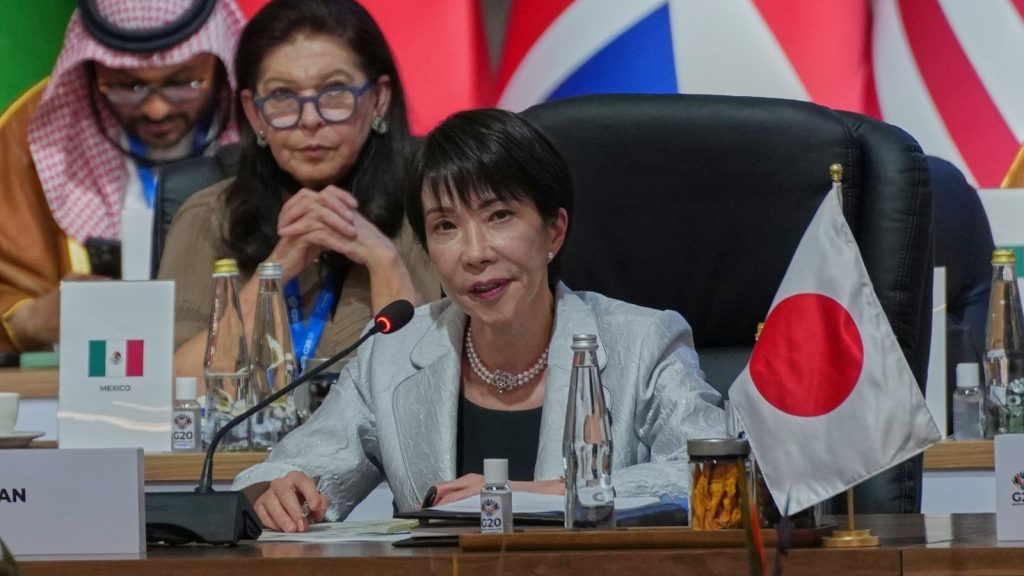
Amid the escalating US-driven wars in the Middle East and Ukraine, Japan’s far-right government has taken another significant step toward full industrial re-militarisation.
On Tuesday, Japanese Prime Minister Sanae Takaichi announced that her government will permit the country’s arms manufacturers to sell lethal weapons abroad. This effectively marks a further major reversal of what is left of Japan’s post-World War II pacifist constitution.
The change allows Japanese companies to sell arms, initially to 17 countries with which Japan has signed military equipment and technology transfer agreements. These include the United States, United Kingdom, Australia and several Southeast Asian nations with whom Tokyo is expanding military ties.
Until now, Japanese companies were allowed to export military equipment under five “non-lethal” categories: rescue, transport, warning, surveillance and minesweeping. With the new guidelines, exports of all types of military weaponry will be permitted.
According to Japan’s Defense Ministry, such exports to countries in active combat will not be allowed, but there may be exceptions if the Japanese government determines there are national security reasons to do so.
This shift has been under discussion in ruling and parliamentary circles for some time—reflecting nervousness about igniting popular opposition to war preparations—but it has been brought forward under conditions of a plunge into war globally, spearheaded by the Trump administration.
A global remilitarisation is underway. Japan’s government is rushing to match the huge increases in military spending and other war preparations being made, not just by Donald Trump’s administration—backed by the Democrats—but by every European and other imperialist power.
Japan’s weapons exports ban was first implemented in 1967 and broadened in 1976 to formally align with Article 9 of Japan’s 1947 constitution, drafted under US occupation, which makes it illegal for Japan to maintain a military or wage war abroad. The export ban was introduced as governments faced widespread anti-war opposition among workers and youth, though exceptions existed for things such as technology transfers to the US.
Takaichi’s announcement, made via a tweet on X, accelerates a turn to rearmament that was taken up by Prime Minister Shinzo Abe’s government in 2014 when it allowed sales of “non-lethal” equipment.
In 2023, Fumio Kishida’s government went further, permitting finished products to be sent to countries that held the item’s license. That paved the way for shipping Patriot missiles to the US to replenish Washington’s supply depleted by the arming of Ukraine in the US/NATO-instigated war against Russia, thus making Japan an indirect supplier of arms to Kiev.
In a bid to placate domestic and international apprehension, Takaichi wrote yesterday: “There will be no change whatsoever to Japan’s postwar path as a pacifist nation for over 80 years, nor to its fundamental principles.”
Yet her claim flies in the face of the record.
The ruling Liberal Democratic Party (LDP) and its likewise far-right, pro-war coalition partner, Nippon Ishin no Kai, view Japan’s export restrictions as an impediment to the expansion of Japan’s military industry and capabilities, first of all for preparing for a US-led war against China.
The Takaichi government’s move remains, for now, within the framework of Japan’s alliance with Washington since Tokyo’s defeat in World War II. But it also signals an accelerating drive to re-establish a full military-industrial capacity to assert the interests of Japanese imperialism. Reporting on the shift, the Washington Post noted: “It also reflects Tokyo’s anxieties over the shifting geopolitical landscape and the reliability of the US as a security ally.”
Most immediately, Takaichi’s announcement is unmistakably part of her government’s deliberate ratcheting up of tensions with China. Beijing’s foreign ministry spokesman Guo Jiakun accused Tokyo of accelerating toward “remilitarisation.” Guo stated: “The international community, including China, will remain highly vigilant and firmly oppose any moves toward Japan’s ‘new militarism’.”
Last November, soon after taking office, Takaichi declared that Japan would join any US war against China over Taiwan, which Beijing regards as part of China. She told the Japanese parliament that a Chinese attack on Taiwan, such as a naval blockade, could trigger the deployment of the Self-Defense Forces, the official name of Japan’s military.
Takaichi also sped up plans for Japan to allocate 2 percent of its gross domestic product (GDP) to military spending. She initiated an overhaul of Japan’s national security and defense strategies by the end of the year. She is also seeking amendments to the constitution, potentially including the Article 9 pacifist clause.
In recent years, Japanese governments have stepped up military partnerships with others that are re-arming. For example, Japan, Italy and the UK are jointly developing a next-generation fighter jet.
This month, Japan formally signed a deal for Mitsubishi Heavy Industries to sell a fleet of 11 upgraded Mogami-class stealth frigates to Australia, at an estimated price of $A15 billion to $20 billion over the next decade. Starting with about $10 billion for the first three warships, this marks Japan’s largest post-war arms export so far.
Other Japanese military giants expected to profit from the lifting of the export ban include Kawasaki Heavy Industries, Mitsubishi Electric, IHI Corporation, NEC Corporation and Toshiba. The Japan aerospace and military market is already rapidly growing, valued at approximately 11 trillion yen (about $US71.26 billion) for 2026. The government previously committed to a total of 43 trillion yen (about $US275 billion) in military-related spending between 2023 and 2027.
Takaichi met with US President Donald Trump in Washington in March where the two discussed Tokyo’s involvement in the criminal US-Israeli war against Iran. While Takaichi’s government has avoided making a formal statement, Tokyo has backed the war from the start.
There are other signs that the US and Japan are preparing to expand the Gulf war into an even larger conflict, above all aimed at China. This includes the further joint militarisation of Japanese islands in the East China Sea and the Pacific, which has been underway since Shinzo Abe was prime minister from 2012 to 2020.
Missiles, radar installations and garrisons have been established on Ryukyu islands, including Miyako, Ishigaki, Amami and Yonaguni, the last of which is just 110 km east of Taiwan.
On March 31, for the first time, the Japanese military deployed long-range missiles within the country capable of striking China and North Korea. It plans to soon extend the deployments to islands in the southern Ryukyu chain, which includes Okinawa, giving Japan the capability of firing deep into Chinese territory.
Just as the US and NATO goaded Russia into the conflict in Ukraine, Washington and Tokyo have been at the forefront of provoking Beijing over Taiwan, which China regards as a renegade province to be reunited with the mainland by force if it were to declare independence.
Beijing is conscious that an independent Taiwan would become a staging ground for US military actions against China, while setting a dangerous precedent for the further occupation of Chinese territory, as Japan did in the 1930s.
Japan is not simply acting as a loyal junior ally to US imperialism. It is using the Gulf crisis to reassert itself as an imperialist power capable of projecting military power abroad again in an attempt to offset its economic crisis and decline.
That also means securing greater access to energy resources, as Tokyo sought to do in the lead-up to World War II. Today, Japan remains exposed on this front. It receives nearly 95 percent of its oil from the Middle East.
Tokyo’s involvement in any war could spark mass anti-war protests like those that erupted in 2015 against the passage of legislation allowing Japan to go to war overseas to fight alongside an ally. Abe, the prime minister in 2015, specifically referred to the blockading of the Strait of Hormuz as an example of such a situation.
The Japanese ruling class is terrified that its pro-war agenda will spark opposition from the working class. That is why the Takaichi government is also planning to clamp down on dissent by pursuing a so-called anti-espionage bill and boosts to Tokyo’s intelligence agencies.
Other changes being pursued include a state-of-emergency clause in the event of foreign invasion or “domestic rebellion,” and a proposal to allow the military to be deployed on the streets to “maintain public order.”
For workers, the war on Iran is exacerbating a significant social crisis, with fuel prices soaring. Workers have suffered years of stagnant or declining real wages and dramatic increases in prices on major food items like rice. Massive increases in military spending will mean deeper cuts to social services, intensifying political discontent.