
The previous world record was held by Uganda’s Jacob Kiplimo who smashed the race in 57 minutes in March
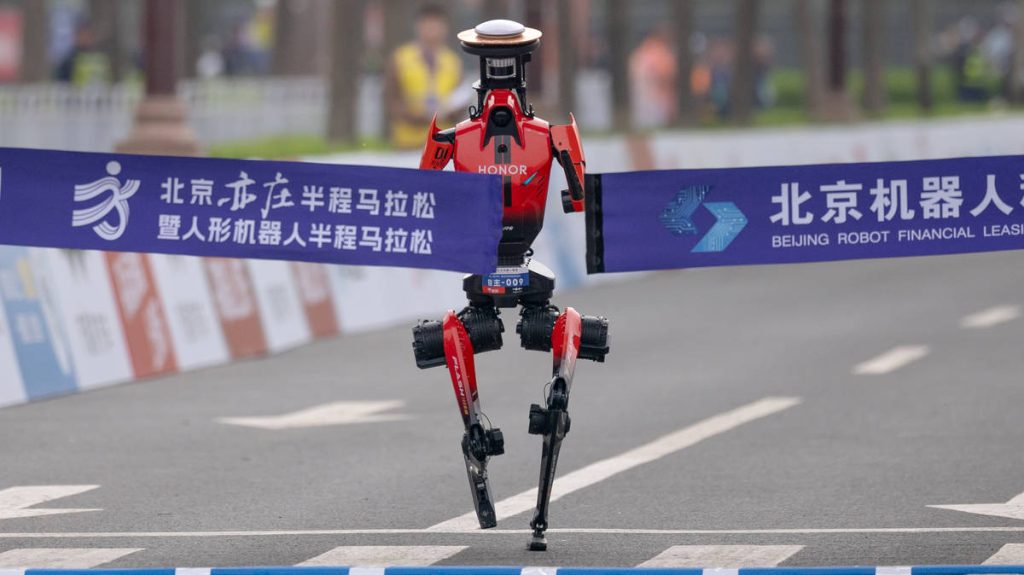
A humanoid robot has beaten the world record for the half-marathon in Beijing, marking a technological win for China on the world stage.
The winning robot completed the 21-kilometre race in 50 minutes and 26 seconds, according to a WeChat post by Beijing E-Town, the economic development area where the race kicked off.
The race is the second instalment of its kind, following its inaugural race last year, in which humans were able to compete against the robots.
The winning humanoid belongs to Chinese smartphone producer, Honor, and beat the human world record holder, Jacob Kiplimo from Uganda, who completed the same feat in 57 minutes in March in Lisbon.
Read more: China holds first-ever half-marathon race between humans and robots
Read more: Silicon Valley goes full sci-fi! Robots, robotaxis and ‘physical AI’ dominate at CES trade show

Picture:
Getty
The new record marked a distinct improvement on last year’s performance, which saw the winning robot complete the race in 2 hours, 40 minutes and 42 seconds.
The competition, which took place alongside a human race, wasn’t without bumps: one robot collapsed at the start line, and another banged into a barrier.
Du Xiaodi, Honor’s test development engineer, told AP that his team was happy with the results.
The design of the winning robot was modelled on the physiques of outstanding human athletes, and came replete with long 95cm legs and a liquid-cooling system, largely developed in-house.

Picture:
Getty
He told AP: “Looking ahead, some of these technologies might be transferred to other areas. For example, structural reliability and liquid-cooling technology could be applied in future industrial scenarios.”
According to Beijing E-Town, around 40% of the robots traversed the race autonomously, while the remaining 60% were controlled remotely.
Global Times, a state media outlet, said another remote-controlled Honor robot completed the race first in 48 minutes and 19 seconds, but that the winning robot was autonomous and therefore won the title under the event’s weighted scoring rules.

Picture:
Getty
The runners-up (also autonomous robots from Honor) completed the race in 51 and 53 minutes respectively, according to state broadcaster CCTV.
Another robot acted as the race’s traffic officer, directing the others using both its voice and arm gestures, the broadcaster added.
China’s bot technology has made leaps and bounds over the past few years, sparking both fierce rivalry with the US, as well as concerns around national security repercussions.
The country’s most recent five-year plan outlines its plans to “target the frontiers of science and technology”, of which robots and AI appear to be a crucial part.