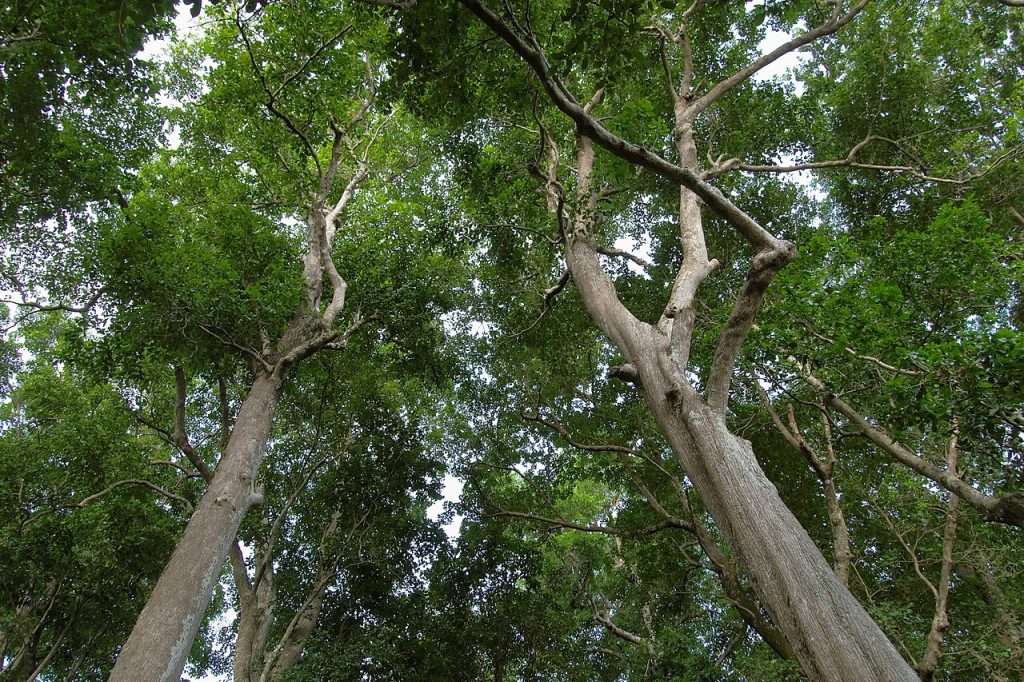
Indian forests deliver more than ₹2.5 trillion (roughly US$30 billion) in ecosystem services annually and directly support the livelihoods of nearly 275 million people, with a further 100 million employed in forestry-related occupations. That is according to the first peer-reviewed meta-regression to aggregate those services nationally, published through Elsevier and co-authored by Charles Darwin University’s Research Institute for the Environment and Livelihoods alongside a consortium of Indian forestry research bodies.
The paper, “Contribution of forest ecosystem services in India using meta-regression approach,” argues that single-service valuation has distorted Indian forest policy for a generation by making industrial plantations appear more economically productive than intact multi-use forests, an argument the authors say collapses once the full service bundle is priced. It reaches policymakers as the country’s forest estate, now covering 21.76 per cent of total land area, comes under sustained pressure from mining, irrigation and infrastructure approvals that have diverted close to 96,000 hectares to non-forestry use over the past five years alone.
Non-timber forest products carry much of the weight in the researchers’ numbers, with medicinal plants, bamboo and honey alone generating an estimated ₹1.75 lakh crore (about US$21 billion) a year and supporting close to 300 million rural residents. Water regulation services, which are critical to agricultural communities dependent on a stable supply for crop production, are priced at a further ₹20,000 crore (about US$2.4 billion) annually, and the researchers argue both streams would be prohibitively expensive to replace with built infrastructure if forest cover continues to degrade.
Those services are generated across radically different forest types, each contributing to biodiversity, climate regulation and national output in distinct ways. Himalayan moist temperate belts regulate river flows for mountain communities and produce timber, herbs and medicinal plants, whilst tropical thorn forests in arid regions prevent soil erosion and desertification and supply fodder for livestock.
Along the coast, littoral and mangrove forests sustain fisheries, tourism, and wood production, and shield shorelines from erosion, tsunamis, and extreme weather events, offering protection, the paper argues, that must be priced into any honest ledger of forest value.
The research team is led out of the Institute for Social and Economic Change in Bangalore and draws on the ICFRE-Institute of Forest Productivity, the Indian Council of Forestry Research and Education, the State Forest Research Institute in Chennai and Charles Darwin University in the Northern Territory, whose team has been building a decade-long pipeline of ecosystem services valuation research across the Western Ghats with the Bangalore group.
The argument for aggregate valuation comes as Australia runs a parallel debate on forest financial disclosure, as Wood Central reported ahead of the 2026 Forest Valuation Summit in Melbourne, where asset managers, foresters and policy specialists argued new AASB S1 and S2 climate reporting rules are forcing natural capital onto mainstream balance sheets.
According to the lead authors, only aggregate valuation is now capable of defending the 275 million livelihoods India’s forests carry and the ₹2.5 trillion in services they deliver each year — against the replacement-cost logic that has driven nearly 96,000 hectares into non-forestry use over the past five years.