
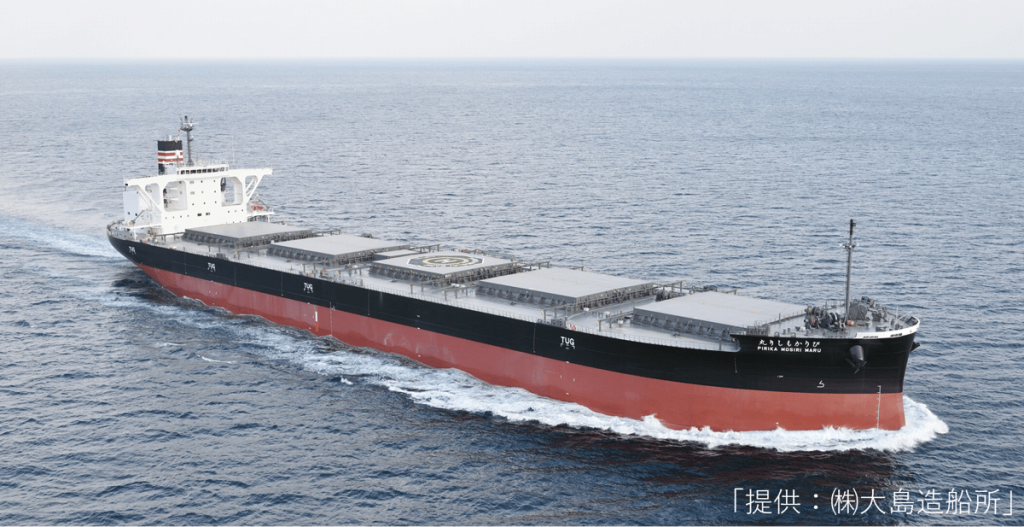
Japan-based NYK Line and Hokkaido Electric Power Co (HEPCO) will jointly advance a demonstration project to decarbonise maritime transport using carbon capture and storage (CCS) technology fitted onboard a coal carrier.
The three-year project will explore the design and operation of test equipment to be installed on the Pirika Moshiru Maru, a vessel owned by NYK and operated by HEPCO.
The partners also plan to study appropriate methods for unloading captured carbon dioxide (CO2) and exploring avenues for its utilisation.
Onboard CCS is being explored by Japan as a promising option to reduce maritime emissions. Studies such as this aim to address key challenges, such as the optimal handling and storage of CO2 and downstream processing.
Unlike alternative fuels, onboard CCS can be retrofitted to conventional ships, capturing CO2 directly from exhaust gases for storage and later offloading.
Japan-based classification society ClassNK recently issued approvals in principle for two vessel concepts and advanced its guidance on onboard carbon capture.
The approvals cover a bulk carrier equipped with a membrane-based onboard CCS system and an 83,000 cubic metre ammonia carrier.
Compared with amine absorption – a traditional carbon capture method – membrane systems typically require less power and require a smaller onboard footprint.
They also avoid the need for chemical solvent supply and handling.
However, membrane systems usually involve trade-offs in capture efficiency and may require multi-stage configurations to achieve higher purity CO2 streams.
Japan is not the only country pursuing onboard CCS. The EverLoNG project is a collaborative effort involving 16 partners from five countries.
The project has designed and built a mobile CO2 capture pilot capable of capturing around 250kg of CO2 per day for installation on existing ships.
The pilot was deployed and operated on two vessels, one of which is a TotalEnergies-chartered liquefied natural gas carrier.
A life cycle assessment study undertaken found that one vessel saw a CO2 reduction of 72% during ship operations with large-scale carbon capture and up to 82% for the LNG carrier.