
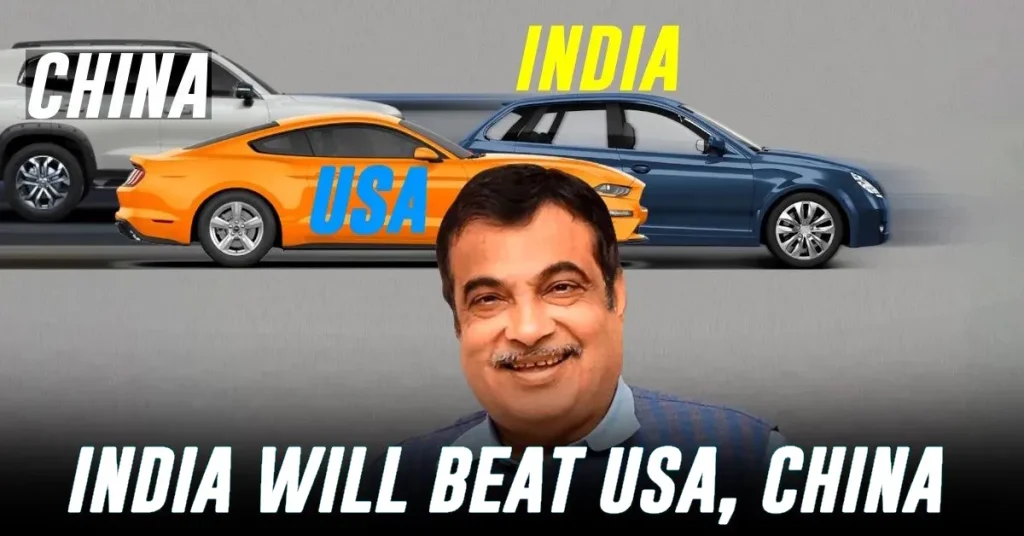
Road Transport and Highways Minister Nitin Gadkari set a clear target at the All-India Management Association’s annual conference on April 9, 2026: the automobile sector here will become the world’s largest within seven years. The goal is to overtake China and the United States, currently ranked second and first respectively by market size.
The scale of what that involves starts with the current numbers. The automobile industry here is valued at approximately Rs 22 lakh crore. The US market stands at around Rs 79 lakh crore. China is at Rs 49 lakh crore. The gap is substantial. Gadkari’s own framing was honest: “It is difficult, but it is possible.”
The starting point of this ambition is not a fantasy. In 2014, the automobile industry here was Rs 7 lakh crore. By 2026, it has grown to Rs 22 lakh crore, a three-fold increase in twelve years. About seven to eight months ago, Japan was overtaken to become the third-largest automobile market in the world by volume. That was not a planned event; it was a consequence of consistent domestic volume growth combined with Japan’s own market stagnation.
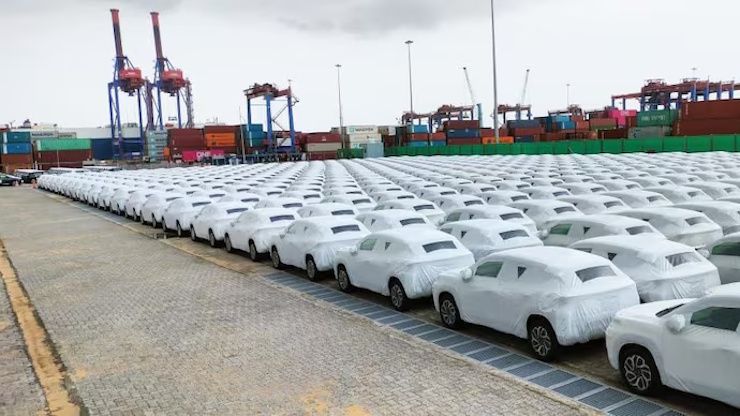
Total passenger vehicle sales in FY26 crossed 4.67 million units. Two-wheeler volumes are among the highest in the world. The commercial vehicle and three-wheeler segments add further to the national count. The combined vehicular ecosystem supports approximately 4.5 crore jobs and is the largest single contributor to GST revenue for both the central and state governments.
What also stands out is the pace required from here. To move from Rs 22 lakh crore to China’s current Rs 49 lakh crore in seven years would need the sector to more than double again. To catch the US at Rs 79 lakh crore would require an even sharper jump. Put differently, the industry must add Rs 27 lakh crore just to draw level with China and Rs 57 lakh crore to match the current US scale.
Even the journey from Rs 7 lakh crore to Rs 22 lakh crore, impressive as it is, added Rs 15 lakh crore over twelve years. The next phase would therefore have to be materially faster than the previous one. That is why Gadkari’s target makes sense only if the sector expands not just through domestic retail sales, but also through exports, components, EVs, alternative fuels, and logistics-led manufacturing competitiveness.

Gadkari outlined three levers for the next phase of growth. The first is technology, specifically electric mobility, hydrogen fuel, and alternative fuels. He noted that EV scepticism has been replaced by mainstream adoption, with electric cars, scooters, buses, and trucks now all in active use. The second lever is logistics cost reduction. Gadkari cited the cost differential between road, rail, and waterway transport: road at Rs 10 per unit, rail at Rs 6, and waterway at Rs 1. Lowering the logistics cost of manufactured goods makes domestic manufacturing more competitive for both domestic sales and export.

The third lever is export growth. To become the world’s largest auto market in seven years purely on domestic consumption would require annual passenger vehicle volumes to approach 8 to 10 million units by 2033, which is an extremely aggressive projection given current growth rates. The more realistic interpretation of Gadkari’s goal is a combination of domestic volumes and export value, measured by the total size of the automobile sector rather than domestic retail units alone.
On exports, the country already ships passenger vehicles, two-wheelers, and components to over 100 markets. Maruti Suzuki, Hyundai, Tata, and Bajaj Auto are among the top exporters. The EV transition globally is an opportunity because it partially resets supply chains and creates space for new exporters to enter markets that were previously dominated by established players.

Gadkari also pointed to infrastructure investments as a prerequisite for this auto market growth. He mentioned the use of steel slag, previously treated as industrial waste, now being used in road construction on projects including the Dwarka Expressway, the Mumbai-Delhi Highway, and the Ahmedabad-Delhi Road. Approximately 80 lakh tonnes of waste material has been repurposed in road building so far. Better roads increase vehicle usage, which in turn sustains demand for new vehicles, spare parts, and fuel.
That 80-lakh tonne figure is significant because it shows the auto and infrastructure story is not only about vehicle sales. It is also about lowering construction costs, improving freight efficiency, and widening the use of industrial by-products across sectors. In that context, the seven-year target is not merely about selling more cars. It is about making the broader mobility and manufacturing chain more productive.
The seven-year target is ambitious by any measure. Whether it is achievable will depend on how quickly EV adoption scales, how competitive domestic manufacturers become on the global stage, and whether infrastructure investment keeps pace with vehicle growth.