
Overview
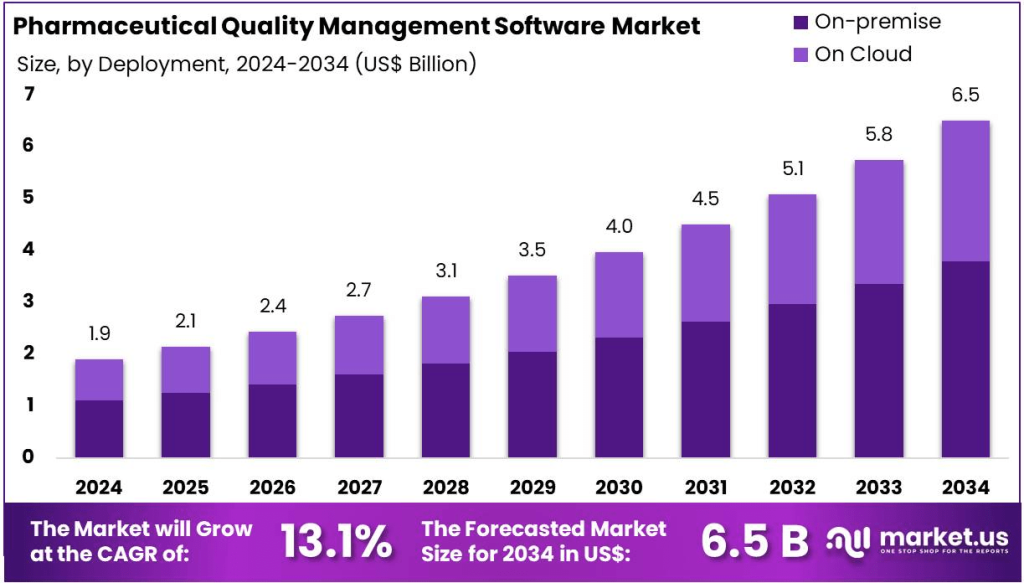
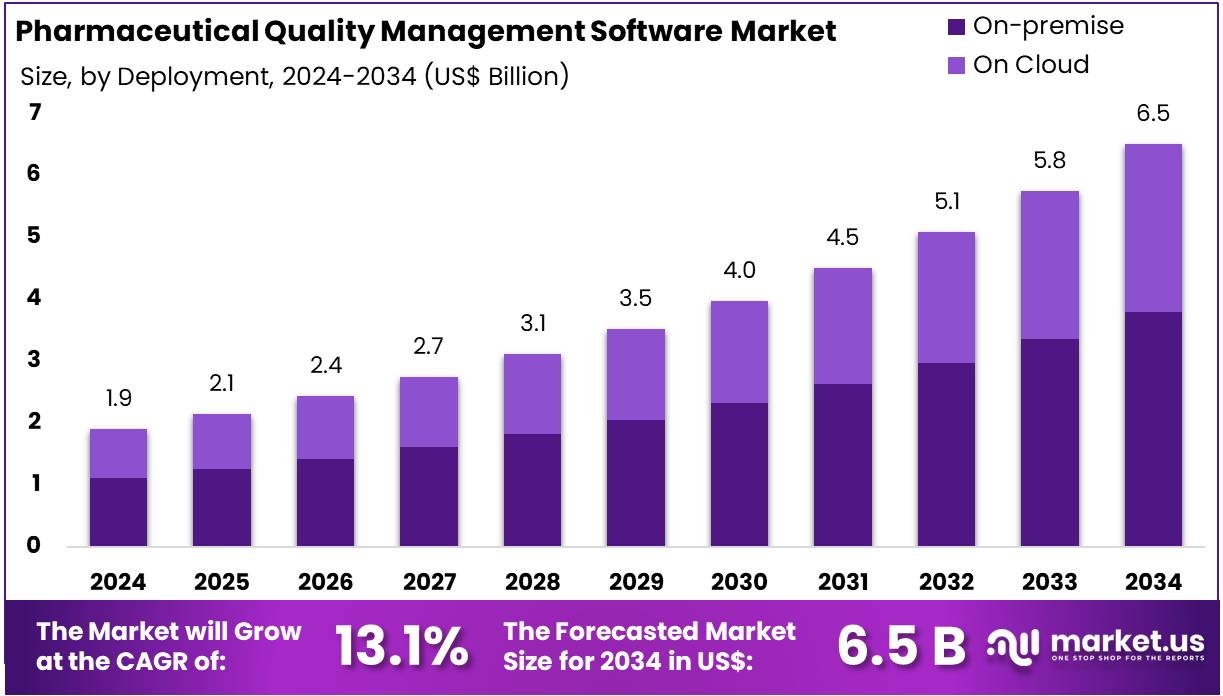
New York, NY – June 09, 2026 – The Pharmaceutical Quality Management Software Market size is expected to be worth around US$ 6.5 billion by 2034 from US$ 1.9 billion in 2024, growing at a CAGR of 13.1% during the forecast period 2025 to 2034.
Pharmaceutical Quality Management Software (QMS) is becoming an essential solution for pharmaceutical manufacturers seeking to maintain regulatory compliance, improve product quality, and streamline operational processes. The software provides a centralized platform for managing quality-related activities, including document control, change management, audit management, corrective and preventive actions (CAPA), training management, risk assessment, and supplier quality management.
The growing complexity of pharmaceutical production and increasing regulatory requirements from global health authorities have accelerated the adoption of advanced quality management solutions. Pharmaceutical QMS platforms help organizations ensure compliance with Good Manufacturing Practices (GMP), Good Documentation Practices (GDP), and other industry-specific standards while reducing the risk of non-compliance and product recalls.
Cloud-based deployment models are gaining significant traction due to their scalability, flexibility, and cost-effectiveness. Integration with enterprise systems such as Enterprise Resource Planning (ERP), Laboratory Information Management Systems (LIMS), and Manufacturing Execution Systems (MES) further enhances operational efficiency and data visibility across the organization.
Artificial intelligence, automation, and advanced analytics are emerging as key technology trends in the pharmaceutical quality management software market. These capabilities enable real-time monitoring, predictive quality management, and faster decision-making processes.
As pharmaceutical companies continue to prioritize quality assurance, regulatory compliance, and operational excellence, demand for robust quality management software solutions is expected to witness sustained growth across global markets in the coming years.
Key Takeaways
- The pharmaceutical quality management software market was valued at US$ 1.9 billion in 2024 and is projected to reach US$ 6.5 billion by 2034, expanding at a CAGR of 13.1% during the forecast period.
- By solution type, the Corrective Action Preventive Action (CAPA) Management segment dominated the market in 2024, accounting for 32.5% of the total revenue share.
- Based on deployment mode, the on-premise segment held the largest market share of 58.4% in 2024.
- By enterprise size, large enterprises emerged as the leading segment, capturing 64.3% of the overall market revenue in 2024.
- North America remained the dominant regional market, contributing 41.2% of the global pharmaceutical quality management software market revenue in 2024.
Regional Analysis
North America accounted for the largest share of the pharmaceutical quality management software market, representing 41.2% of total revenue. This dominance is driven by the region’s stringent regulatory framework and strong focus on drug safety, quality, and compliance. Regulatory requirements established by the FDA under Current Good Manufacturing Practice (CGMP) regulations mandate comprehensive quality management throughout pharmaceutical manufacturing processes.
Continuous regulatory oversight, inspections, and guidance from the FDA encourage pharmaceutical companies to adopt advanced software solutions for quality control, documentation management, and regulatory compliance. The implementation of the Quality Management System Regulation (QMSR), aligned with ISO 13485:2016, has further increased demand for sophisticated quality management platforms.
Meanwhile, Asia Pacific is projected to register the fastest growth during the forecast period. Rapid expansion of pharmaceutical manufacturing in countries such as China and India, coupled with rising compliance requirements for global quality standards, is driving software adoption. Growing domestic demand for high-quality medicines and increasing integration of digital technologies are also supporting market growth across the region.
Emerging Trends
- Risk-Based Quality Systems (ICH Q10 and FDA Guidance): QMS software increasingly supports science- and risk-based quality management across product development, manufacturing, and distribution. Integrated Quality Risk Management (QRM) tools aligned with ICH Q9 enable organizations to identify, assess, and mitigate risks proactively, improving compliance and operational decision-making.
- Adoption of Process Analytical Technology (PAT): PAT-driven quality systems enable continuous monitoring of critical process parameters that affect product quality. Modern QMS platforms integrate real-time manufacturing data, supporting enhanced process control, reduced variability, early deviation detection, and consistent compliance with FDA-recommended quality frameworks.
- Cloud-Based Deployment as Preferred Architecture: Cloud-based QMS solutions account for most new implementations due to their scalability, remote accessibility, automatic updates, and lower infrastructure requirements. Growing regulatory complexity and global operations are accelerating adoption, enabling real-time collaboration, centralized data management, and improved compliance oversight.
- Regulatory Compliance Automation: Automated QMS functions streamline document control, audit trails, reporting, and change management while reducing manual intervention. By minimizing human errors associated with regulatory failures, organizations improve compliance efficiency and support validation requirements under FDA Computer Software Assurance principles.
- Integration of AI and Machine Learning: Artificial intelligence and machine learning capabilities are increasingly embedded within QMS platforms to identify anomalies, predict quality trends, and assess compliance risks. Regulatory agencies support responsible AI adoption, encouraging lifecycle-based monitoring and improved decision-making within regulated environments.
- Quality-by-Design (QbD) and Lifecycle Control: QMS platforms increasingly support Quality-by-Design initiatives by integrating design of experiments, multivariable analysis, and process monitoring capabilities. These features help manufacturers build quality into products from development through commercialization, reducing defects and strengthening lifecycle quality management.
- Traceable Supply Chain and Incident Response: Growing regulatory focus on product safety has increased demand for end-to-end supply chain traceability. QMS solutions now incorporate supplier quality management, batch tracking, incident reporting, and automated alerts, enabling faster investigations, recalls, and corrective actions when quality issues arise.
Use Cases
- Document Control and Electronic Records (21 CFR Part 11): QMS software manages document creation, revision control, electronic signatures, secure storage, and audit trails to support regulatory compliance. Automated tracking ensures document integrity, facilitates inspections, and enables efficient management of thousands of records and validation activities.
- Corrective and Preventive Actions (CAPA): CAPA modules automate issue investigation, root-cause analysis, action assignment, effectiveness verification, and closure tracking. Digitized workflows improve transparency, accelerate resolution timelines, enhance compliance readiness, and significantly reduce the time required to complete corrective actions.
- Risk Management and Quality Risk Assessments: QMS solutions facilitate structured risk assessments through standardized scoring models that evaluate probability, severity, and impact. These tools help organizations prioritize critical quality risks, support informed decision-making, and strengthen compliance with risk-based regulatory expectations and quality frameworks.
- Audit Management and Trending Analytics: Audit management modules automate scheduling, findings documentation, corrective action tracking, and closure verification. Integrated analytics evaluate quality, supplier, complaint, and manufacturing data trends, enabling organizations to identify emerging issues early and improve overall quality performance.
- Training Management: Training management systems automate course assignments, competency tracking, certification monitoring, and retraining schedules based on employee roles. Centralized records ensure compliance with regulatory personnel requirements while improving workforce readiness, training effectiveness, and inspection preparedness across operations.
- Change Control and Management of Change: QMS software standardizes change management processes for procedures, equipment, facilities, and manufacturing operations. Structured approval workflows, impact assessments, and documentation controls reduce implementation risks, improve consistency, and support regulatory expectations for controlled organizational changes.
- Process Analytical Technology and Continued Process Verification: Integrated PAT capabilities enable continuous monitoring of manufacturing performance through real-time collection and analysis of critical process and quality data. Automated alerts and workflows support rapid intervention, improved process stability, and ongoing verification of operational control.
- Electronic Trial Master File (eTMF) and eCTD Submissions: QMS platforms support secure management of clinical and regulatory documentation through controlled workflows, audit trails, metadata management, and access controls. These capabilities streamline eTMF administration and facilitate preparation of submission-ready electronic Common Technical Document packages.
Frequently Asked Questions on Pharmaceutical Quality Management Software
- Why is Pharmaceutical Quality Management Software important for pharmaceutical companies?
Pharmaceutical Quality Management Software is important because it centralizes quality processes, reduces manual errors, improves traceability, and supports regulatory compliance. The software enables companies to maintain consistent product quality, accelerate issue resolution, enhance operational transparency, and minimize risks associated with manufacturing and quality control activities. - What are the key features of Pharmaceutical Quality Management Software?
Key features typically include document management, change control, deviation tracking, CAPA management, audit management, training management, complaint handling, supplier quality management, and reporting tools. These functionalities help pharmaceutical companies maintain quality standards while improving workflow automation and compliance management. - What benefits does cloud-based Pharmaceutical Quality Management Software provide?
Cloud-based solutions offer scalability, remote accessibility, automatic updates, reduced infrastructure costs, and improved collaboration across multiple locations. They enable pharmaceutical organizations to access quality data in real time while maintaining security, business continuity, and compliance with industry regulations. - How does Pharmaceutical Quality Management Software improve product quality?
The software improves product quality by standardizing procedures, identifying quality issues early, automating corrective actions, and enhancing process visibility. Real-time monitoring and comprehensive reporting help organizations reduce defects, improve consistency, and ensure that products meet established quality specifications. - Can Pharmaceutical Quality Management Software integrate with other enterprise systems?
Yes, most modern solutions can integrate with enterprise resource planning systems, laboratory information management systems, manufacturing execution systems, and document management platforms. Integration improves data consistency, streamlines workflows, reduces duplication, and supports more informed decision-making across departments. - Which regions are leading the Pharmaceutical Quality Management Software Market?
North America remains a leading market due to its advanced pharmaceutical industry and strict regulatory environment. Europe also holds a significant share, while Asia-Pacific is experiencing rapid growth driven by expanding pharmaceutical manufacturing activities and increasing investments in digital quality management technologies. - What technological trends are shaping the Pharmaceutical Quality Management Software Market?
Key technological trends include artificial intelligence, machine learning, predictive analytics, automation, cloud computing, and mobile accessibility. These innovations enhance quality monitoring, improve decision-making capabilities, accelerate issue resolution, and provide deeper insights into quality performance metrics. - How competitive is the Pharmaceutical Quality Management Software Market?
The market is highly competitive, with established software providers and emerging technology companies offering specialized solutions. Vendors compete based on functionality, compliance capabilities, scalability, integration features, customer support, and innovation aimed at addressing evolving pharmaceutical industry requirements.
Conclusion
The Pharmaceutical Quality Management Software market is experiencing strong growth as pharmaceutical companies increasingly prioritize regulatory compliance, product quality, and operational efficiency. Rising global regulatory requirements, expanding pharmaceutical manufacturing activities, and the growing adoption of cloud-based technologies are driving market demand.
Advanced capabilities such as artificial intelligence, automation, predictive analytics, and integrated risk management are further enhancing the value of QMS platforms. North America remains the leading market, while Asia Pacific is emerging as the fastest-growing region. As quality assurance and digital transformation become strategic priorities, Pharmaceutical Quality Management Software is expected to play an increasingly critical role across the industry.
Discuss your needs with our analyst
Please share your requirements with more details so our analyst can check if they can solve your problem(s)
