
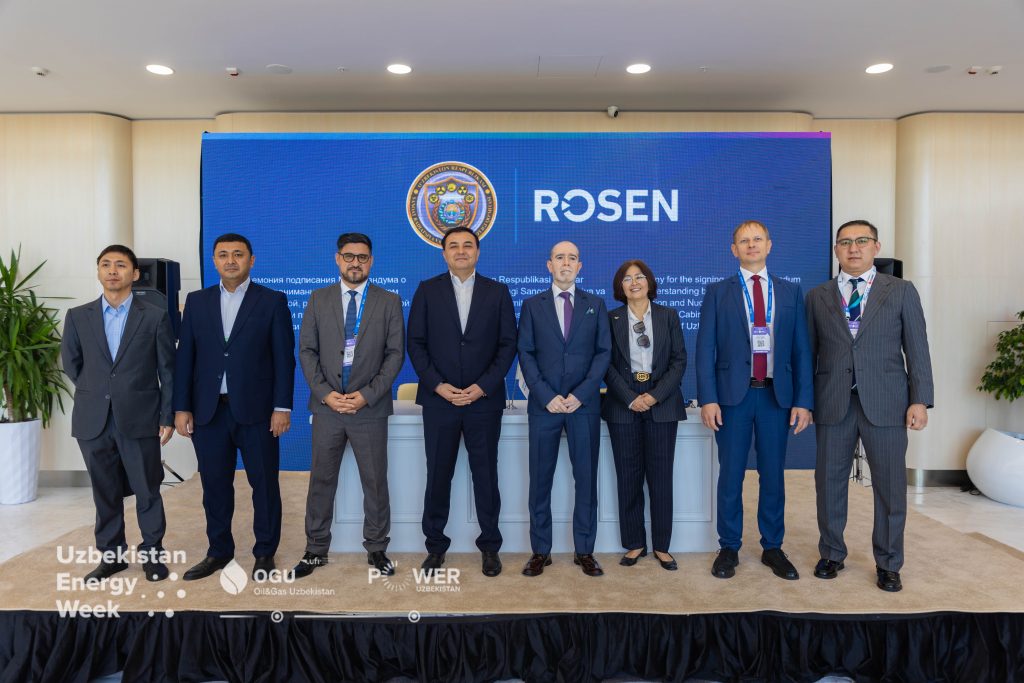
The MoU provides a structured basis for collaboration, with a focus on technical dialogue, knowledge exchange, consultancy, and advisory support. With this the cooperation aims to strengthen industrial safety, enhance regulatory capabilities, improve risk management practices, and support the adoption of internationally recognized best practices in asset integrity management across Uzbekistan’s oil, gas, and related industrial infrastructure.
Commenting on the signing, Mr. Isoqjonov Akhadkhan Ikromjonovich, First Deputy Chairman of the Industrial, Radiation and Nuclear Safety Committee of the Republic of Uzbekistan, said: “This cooperation with ROSEN represents an important step toward strengthening Uzbekistan’s industrial and oil and gas safety framework. By leveraging international expertise and experience, we seek to enhance regulatory oversight, build national technical capacity, and ensure that our infrastructure development supports sustainable growth and public safety for future generations.”
A systematic review of international best practices and their adaptation to the national characteristics of the Republic of Uzbekistan is considered an important priority for the continued development of the industrial safety framework. The long-term objective of the cooperation is to protect critical assets, safeguard the public as well as the environment, and ensure a reliable and secure energy supply aligned with the country’s national development priorities.
From ROSEN’s perspective, the MoU reflects a shared ambition to strengthen infrastructure integrity through close cooperation with national regulators. Hernando Caceres, Senior Vice President at ROSEN, emphasized the value of this collaboration, stating: “This Memorandum of Understanding reflects our shared commitment to safety, transparency, and technical excellence. By working closely with the IRNS Committee, we aim to support Uzbekistan in the study and potential adaptation of proven integrity and inspection practices in a way that is fully aligned with local regulatory needs and long-term national priorities. Effective infrastructure integrity is fundamental to public safety and energy security.”
Strategic Importance for Uzbekistan
Uzbekistan continues to invest in the modernization and expansion of its energy and industrial infrastructure. In this context, the IRNS Committee seeks to further strengthen its regulatory oversight by incorporating global experience and advanced technical approaches, while ensuring that national regulatory, operational, and safety requirements remain central to implementation.
“The MoU signing clearly demonstrates how international expertise and trusted partnerships can support the modernization and resilience of critical oil and gas infrastructure,” stressed Feruza Tatybaeva, Honorary Consul of the Kingdom of the Netherlands in the Republic of Uzbekistan, who witnessed the signing ceremony, held during the Oil & Gas Uzbekistan 2026 event.
ROSEN Group was selected as a cooperation partner due to its long‑standing experience working with regulators and operators worldwide, its comprehensive technical expertise in asset and pipeline integrity, and its strong regional presence and understanding of local operating conditions in Central Asia. The cooperation also includes pilot initiatives designed to demonstrate the application of modern, risk‑based inspection methodologies as an alternative to traditional inspection approaches, where appropriate and fully compliant with regulatory requirements.