
Nova Scotia’s premier is crediting a change in federal leadership for renewed traction in the province’s pursuit of offshore oil and gas development.

Tim Houston said Thursday that former prime minister Justin Trudeau opposed fossil fuel projects, but Prime Minister Mark Carney is supporting the province’s efforts to grow the economy by exploiting its resources.
Houston, who has been trying to overcome the province’s economic woes through wind energy, oil and gas and mining development, said Trudeau pressured the province in 2023 to reject a winning bid by U.K.-based Inceptio Oil and Gas Ltd. to explore for fossil fuels in Nova Scotia’s offshore.
Both governments ended up vetoing the proposal, and the premier said Thursday that his Progressive Conservatives agreed to do so only because Trudeau said he would not discuss provincial plans for offshore wind if it also explored for oil and gas.
“We wanted to move something forward and it was the offshore wind that we pushed forward,” Houston said after a cabinet meeting Thursday morning.
“Now we have a new prime minister and a new energy minister who want to grow our economy so we can do more, so we support the services across the country, but certainly in Nova Scotia. So I think what has changed is the political environment.”
A joint federal-provincial regulator approved another $210-million exploration bid from the same company, led by Nova Scotian James Edens, last week. Houston was blunt when asked what has changed since 2023.
“Justin Trudeau is now gone,” he said.
“I mean, we have huge opportunities in offshore wind — massive. Massive opportunities in offshore oil and gas. Justin Trudeau is anti-oil and gas and essentially said, ‘If you approve that I won’t talk to you about offshore wind.’”

Houston said Nova Scotia has had to overcome a general feeling from the resource sector that it’s too risky to do business in the province. He cited previous provincial bans on things like fracking and uranium mining, which he has since lifted, as well as a lack of major projects during Trudeau’s decade in power.
Steven Guilbeault, a Liberal member of Parliament who served as Trudeau’s environment minister from 2021 to 2025, said he was unaware of any ultimatum.

Get breaking National news
Get breaking Canada news delivered to your inbox as it happens so you won’t miss a trending story.
“All I can say is that in all the years I was in cabinet under (prime minister) Trudeau, I never (heard) such a thing mentioned once!” he said in an email Thursday.
Guilbeault, however, resigned as culture minister in Carney’s cabinet in November to protest his government’s new pact with Alberta on a proposed new pipeline.
Carney’s office did not immediately respond on Thursday to a request for comment.
Nova Scotia NDP Leader Claudia Chender expressed concern that the province is doing business with the same company it rejected three years ago. She said the government should be seeking a larger partner with the financial resources to do things right and cover the costs of any cleanup.
“(Trudeau is) a very convenient enemy for a premier who always likes to have an enemy,” she told reporters.
Iain Rankin, interim leader of the provincial Liberals, said there’s more interest in oil and gas development because of elevated prices, and projects would be coming forward regardless of which party was in power.
“Oil and gas was approved under Trudeau off the coast of Newfoundland; we bought the Trans Mountain pipeline,” he said, referring to the federal government’s purchase in 2018 of the pipeline for $4.5 billion from Kinder Morgan Canada.
“It’s more rhetoric from the premier who didn’t really focus on economic development at all in his first term.”
Houston has cast Trudeau as his adversary before. In 2024 he broke his own fixed election date legislation, calling a snap vote and claiming he needed a strong mandate to stand up to Ottawa. Trudeau’s imposition of carbon pricing in the province, and Ottawa’s refusal to pay the entire bill for the costly work needed to protect the Chignecto Isthmus — the low-lying land link between New Brunswick and Nova Scotia that is increasingly prone to severe flooding — were high on the list of irritants.
Houston’s Tories cruised to a majority government with 43 of the legislature’s 55 seats in November 2024, with political commentators saying the premier took advantage of Trudeau’s damaged federal Liberal brand to cast the provincial party in the same light.
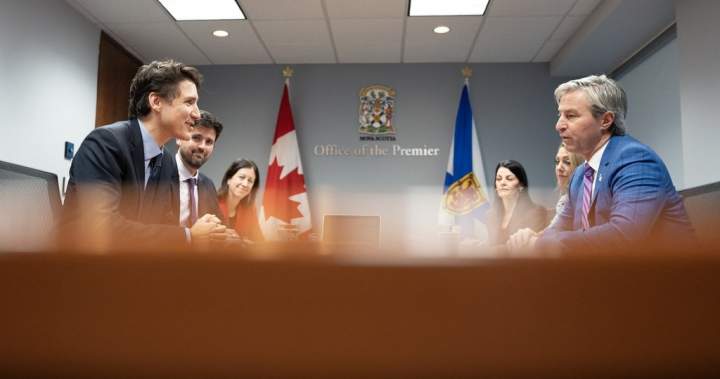
The premier softened his tone shortly after the election, saying a meeting with Trudeau the next month was conducted with a “spirit of collaboration.” A few months later, Trudeau was out as Liberal leader, setting the stage for Carney’s assent.
Carney has been supportive of Houston’s plans for Wind West, a massive offshore wind project that could cost $60 billion in the first phase. If additional phases are fully built, it could generate up to 62 Gigawatts of clean energy. Quebec and Massachusetts have expressed interest in potentially buying the project’s energy exports.
© 2026 The Canadian Press