
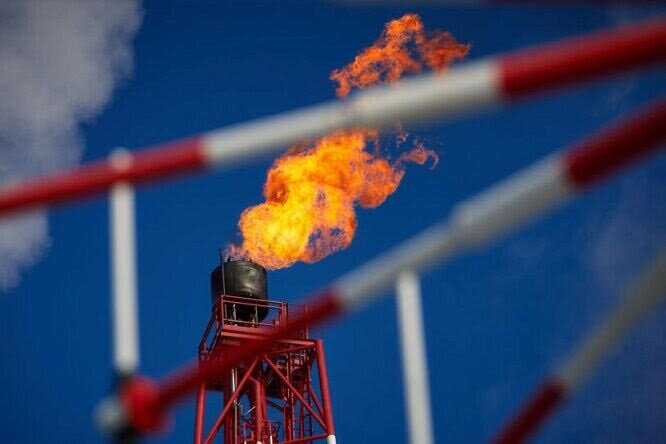
TEHRAN- Increasing the collection of flare gases in Iran’s oil industry can compensate for part of the gas shortage in winter; a capacity that both prevents resource wastage and helps sustain energy supply.
According to Mehr News Agency, flare gases are among the most well-known symbols of oil regions worldwide. Flames that have been seen for years in Iran’s oil fields were a sign of burning associated petroleum gases; gases produced during oil extraction but inevitably burned if the necessary infrastructure for collection, processing, and transmission is lacking. This process, in addition to causing environmental pollution, means losing a significant volume of energy resources.
In Iran, over the past decades, a large volume of associated petroleum gas has been flared. This has not only had significant environmental impacts but has also been economically detrimental; because gas that could have been used as petrochemical feedstock, power plant fuel, or even as an export commodity has effectively turned into smoke.
With the development of technologies and the expansion of oil and gas industry infrastructure, a new approach to managing these resources has emerged. Now, collecting and utilizing flare gases is on the agenda as one of the key solutions for increasing energy efficiency. Energy experts believe this is one of the lowest-risk and most economical paths for reform in the energy sector; because it simultaneously reduces resource wastage, decreases environmental pollution, and increases the country’s gas supply capacity.
In fact, flare gases are a potential energy source that, if invested in necessary infrastructure, can be returned to the consumption cycle and meet part of the country’s domestic needs. From this perspective, collecting these gases, besides its environmental effects, also has significant importance in managing gas supply and demand.
Increasing flare collection capacity; a shift in energy policies
In recent years, Oil Ministry has placed special focus on reducing flaring and collecting flare gases. This approach is being pursued through the implementation of numerous projects, the most important of which are the development of NGL units, construction of new processing facilities, and upgrading gas refineries.
According to announced plans, the macro-goal in the Seventh National Development Plan is to significantly reduce flare gas burning and increase the collection rate to about 16 billion cubic meters per year. Achieving this goal requires developing infrastructure capable of collecting, processing, and transferring associated petroleum gases to the consumption network.
Available statistics show that before the establishment of the 14th government, about 7 million cubic meters per day of flare gases were being collected in the southern oil-rich regions, the Central Iran Oil Company, and the Arvandan Oil and Gas Company. However, with the commissioning of new units and the completion of some infrastructure projects, this figure has now reached over 16 million cubic meters per day.
At the same time, according to officials of the National Iranian Oil Company, about 80 million cubic meters of associated petroleum gas are currently produced daily in the country. Part of this gas is transferred to NGL units and downstream facilities, but a significant portion is still burned in flares due to infrastructure limitations. Estimates indicate that the amount of flare gas in the country ranges between 40 and 50 million cubic meters per day, depending on crude oil production conditions.
Planning shows that with the development of ongoing projects, it is possible to reduce this figure by up to about 35 million cubic meters per day. Such a reduction would mean freeing up a significant volume of gas that could be used in various sectors of the economy.
One of the most important challenges in Iran’s energy sector in recent years has been the gas imbalance in winter. During this season, gas consumption in the household sector increases dramatically due to heating needs, and in many cases, priority for gas supply is given to this sector. As a result, industries, power plants, and some petrochemical units face gas restrictions or cutoffs.
Collecting flare gases can play an important role as a new source of supply in reducing this imbalance. If we assume the amount of collected gas has increased from about 7 million cubic meters per day to over 16 million cubic meters per day, in practice, nearly 9 million cubic meters of additional gas enters the consumption cycle daily. On an annual scale, this amount is equivalent to over 3 billion cubic meters of gas.
Although such a capacity alone cannot completely resolve the gas imbalance in the country, it can compensate for part of the supply shortage during the cold months of the year. For example, this amount of gas can provide more stable feedstock for some energy-intensive industries or help supply fuel for power plants to reduce the need for liquid fuels such as diesel and fuel oil.
On the other hand, injecting recovered gas into the national gas network can also help increase the stability of feedstock supply for petrochemicals. Many petrochemical units face feedstock restrictions in winter, and their production capacity decreases. Using collected flare gases can compensate for part of this production decline and prevent economic losses caused by the shutdown or reduced activity of industrial units.
Overall, collecting flare gases can be considered one of the fastest and most cost-effective solutions for increasing gas supply in the country. In addition to reducing pollution and preventing resource wastage, this measure can help improve the country’s energy balance and reduce some of the pressure on the gas network during the cold months. If ongoing projects are fully operationalized, this hidden energy source can play a more prominent role in managing Iran’s gas imbalance in the coming years.
MA