
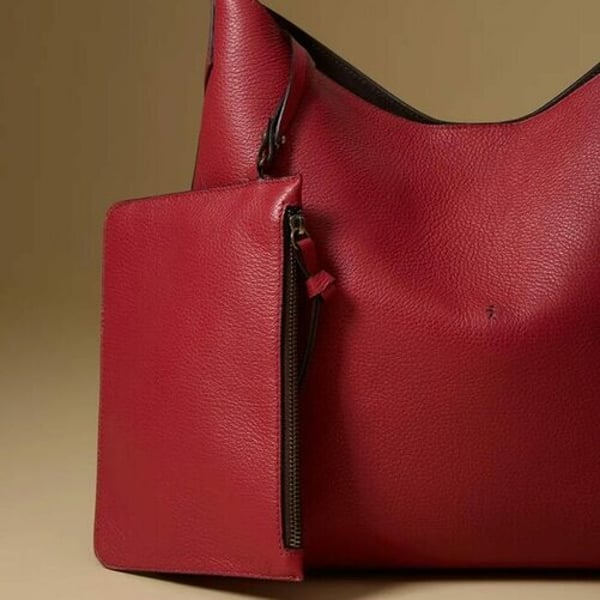
A new chapter for Henry Beguelin. The brand, specialising in handbags, footwear, and small leather goods, is taking part in Pitti Uomo 110 with a renewed emphasis on hand-making and craftsmanship, drawing on its archive and the design codes that have shaped its identity for more than 50 years, while focusing on a programme of mono-brand store openings.

“Our presence at Pitti Uomo stems from a desire to convey a clear vision of product and of luxury: one less tied to seasonality and more attuned to materials, durability, and the relationship that develops over time between an object and its user. We are a fully vertically integrated company, thanks to our factory in Vigevano,” owner Patrick Nebiolo tells FashionNetwork.com.
“At the heart of the new project is the Henry Beguelin Archive- the revitalisation of an archive of approximately 6,000 items from the ’80s, ’90s and 2000s from the Henry Beguelin and Henry Cuir labels, spanning over 50 years of the brand’s history- which over the past six months we have had our artisans recover, select, and recondition, piece by piece, bringing the maison’s heritage to the fore. That’s our starting point: not chasing trends, but returning to what is traditional and timeless; these are unique pieces, all entirely handmade,” continues Nebiolo, former general manager of Woolrich Inc. and founder of Fashion Box USA, who acquired Henry Beguelin in 2023 after his experience with Holubar, the historic American outdoor brand founded in 1947 in Colorado by mountaineers Alice and Roy Holubar, which he acquired in 2019 and later sold to a Korean group (DIAH) in 2023 at the height of its visibility, immediately after a collaboration with Nigel Cabourn, the iconic British designer who passed away just a few days ago.
“The two projects overlapped and it wasn’t possible for me to split my attention between them,” explains Patrick Nebiolo. “We decided to sell Holubar, and we finalised the deal with the Korean group after presenting the brand’s latest collection at Pitti with Nigel Cabourn. To me, he was like a brother and a mentor; he was a pivotal designer in the history of British fashion. A great loss.”

The Henry Beguelin Archive project is also taking shape through the opening of the first Archive space in Topanga, California, and via the dedicated website, where the archive, research, and products come together in a single narrative. At the same time, in Vigevano- the brand’s historic headquarters- a cultural hub for the Henry Beguelin Archive is taking shape: over 50 years of prototypes, collections and historic pieces preserved as a living memory of the brand and a continuous source of inspiration for the present.
Saddle stitching, the embroidery of the stylised little man (the brand’s symbol), hand-sewn seams, vegetable-tanned natural leathers and Henry Beguelin’s emblematic, recognisable silhouettes are once again centre stage in a new chapter for the brand. Also on the stand is a collaboration with Roman artisans Two Arrows.
Henry Beguelin was founded in the 1980s by the leather artisan of the same name, distinguishing itself from the outset through handmade leather goods crafted using traditional techniques, carefully selected natural leathers and vegetable dyes. “Henry is still a friend of the brand today; he lives on the Island of Elba and has rejoined the project,” says Nebiolo. “Around 30 years ago he parted ways with his business partner, who went on to create the brand Henri Cuir. I’ve brought them back together under our umbrella.”
Henry Beguelin’s main market is the United States, where, as part of this relaunch, the label has reopened three mono-brand stores in Malibu, Aspen, and Vail; however, Nebiolo plans to open stores in New York, Chicago, and Los Angeles as soon as possible. “The West Coast is perfect for us, and so is Texas. Once we’ve completed this work in the US, we’ll start again in Japan, where we used to have six mono-brand stores, all of which have since closed. In South Korea, we currently operate another six mono-brand stores in Seoul through a partner.”

Thus, the new Henry Beguelin is a retail project built around concept stores- a format in which the brand can best express itself- as well as a highly selective, high-end wholesale operation that currently sees the brand distributed to 80 retailers worldwide, including the US, South Korea, Japan, Russia, and Germany. “In Italy, we have very limited distribution- just three stores- but we have a showroom in Milan, on Via Carlo Botta,” the owner continues. “We aim to relaunch in our domestic market, where we’ve always been marginal due to what I believe was an oversight in the past. Italy has had about a decade of ‘emptiness’, but now I want to expand Henry Beguelin’s presence to at least 10 stores.”
With expansion plans primarily focused on Italy and Europe- particularly Eastern Europe, and especially Germany, “the market with the greatest potential, with several distributors and agencies contacting us,” says Patrick Nebiolo, who in the meantime has rebuilt the company’s team, which currently consists of 15 people.
Henry Beguelin also offers home furnishings. Its Home line is likewise entirely handmade: high-quality, finely constructed furniture. The range includes armchairs, stools, seating, tables, and coffee tables, pouffes and more. For the 2027 Salone del Mobile, the company is planning a special collaboration with an iconic Italian furniture brand- not yet disclosed.

Henry Beguelin’s core business, however, remains the handbags and footwear categories, which each account for 45% of turnover, following a 2025 that closed with single-digit percentage growth.
In the brand’s Spring/Summer 2027 collection, the colour palette draws on earth tones and natural leather hues- cognac, taupe, espresso, black, and burnt. The collection fosters an ongoing dialogue between the brand’s heritage and contemporary design through handbags, small leather goods, footwear, and a selection of leather and suede garments. The craftsmanship remains clearly visible: hand-stitching, raw-edge finishes, braiding, contrast topstitching, hand-cut fringing and details left deliberately imperfect to preserve authenticity and materiality.
The bags alternate between soft, flowing silhouettes and more minimalist structures. Models such as the Doctor Bag, City Tote, Juliette Bag, and Relaxed Hobo reinterpret everyday shapes with lightweight constructions and natural leathers that evolve with use. Alongside the new models sit “HB Classics” pieces sourced directly from the Henry Beguelin and Henry Cuir archives, such as the Saddle Bag, the Bucket Bag, the Origami Bag, and the brand’s iconic Tote Bag.

Small leather goods also draw on the house’s original design codes with wallets, cardholders, and accessories crafted from New Old Iron, pony skin, reptile leather and natural cowhide, featuring hand-stitched seams and pared-back details. The footwear collection, meanwhile, offers a versatile wardrobe of ballet flats, loafers, Mary Janes, sandals, and clogs crafted with soft volumes and natural materials. Here too, some original styles have been revived, such as the HB Classics Mary Jane and the Cavallerizzo boot in cowhide.
Copyright © 2026 FashionNetwork.com All rights reserved.