
In the modern global economy, few agricultural commodities have achieved the importance and versatility of the soybean. What began as a traditional crop cultivated for centuries has evolved into one of the most strategically important agricultural products in the world.
Today, soybeans are found in everything from tofu, soy milk, and plant-based meat alternatives to livestock feed, biodiesel, biodegradable plastics, and industrial lubricants. As consumer preferences shift toward healthier diets, sustainable products, and alternative protein sources, the soybean industry is emerging as a major beneficiary of these global trends.
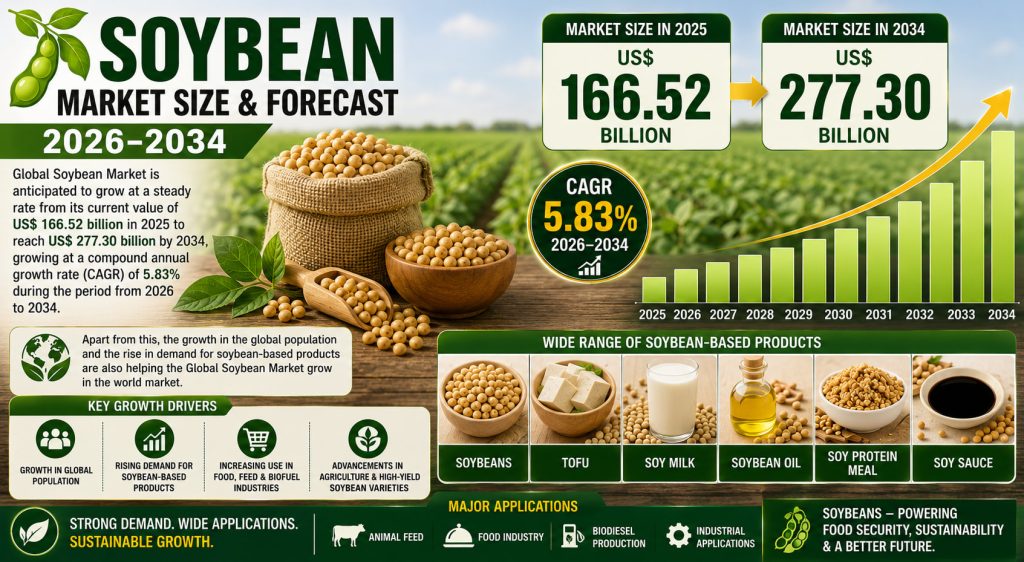
The market’s growth reflects this increasing importance. According to Renub Research, the Global Soybean Market is expected to expand from US$ 166.52 billion in 2025 to US$ 277.30 billion by 2034, growing at a compound annual growth rate (CAGR) of 5.83% between 2026 and 2034. Rising global population, increasing demand for soybean-based products, expanding livestock production, and growing industrial applications continue to drive market expansion worldwide.
As industries search for sustainable raw materials and consumers increasingly prioritize protein-rich foods, soybeans are becoming one of the defining crops of the twenty-first century.
Understanding the Global Importance of Soybeans
Scientifically known as Glycine max, soybeans are among the most valuable legume crops cultivated worldwide.
Their popularity stems from an exceptional nutritional profile. Soybeans contain high levels of protein, healthy fats, vitamins, minerals, and essential amino acids. This unique combination makes them an important food source for both humans and animals.
The versatility of soybeans further strengthens their value. They can be processed into soybean oil, soybean meal, tofu, soy milk, soy protein isolates, fermented foods, and countless industrial products.
Unlike many agricultural commodities that serve limited purposes, soybeans support multiple industries simultaneously. Food manufacturing, livestock farming, renewable energy, pharmaceuticals, and industrial production all depend on soybean-derived products.
This broad utility has helped establish soybeans as one of the most traded and economically significant agricultural commodities in the world.
Plant-Based Diets Are Fueling Unprecedented Demand
One of the strongest growth drivers within the soybean market is the rapid rise of plant-based eating.
Consumers worldwide are becoming increasingly aware of the health benefits associated with reducing animal-based food consumption. Vegetarian, vegan, and flexitarian lifestyles are gaining popularity across both developed and emerging economies.
Flexitarianism, which involves reducing rather than completely eliminating animal products, has become particularly influential.
Soybeans are uniquely positioned to benefit from this trend because they offer a complete and affordable source of plant-based protein.
Products such as tofu, soy milk, soy yogurt, soy protein concentrates, and plant-based meat alternatives have become staples among consumers seeking healthier and more sustainable food choices.
Growing awareness regarding cholesterol management, heart health, weight management, and overall wellness is further strengthening demand for soybean-based foods.
Food manufacturers continue responding with innovative product launches designed to attract consumers looking for nutritious alternatives.
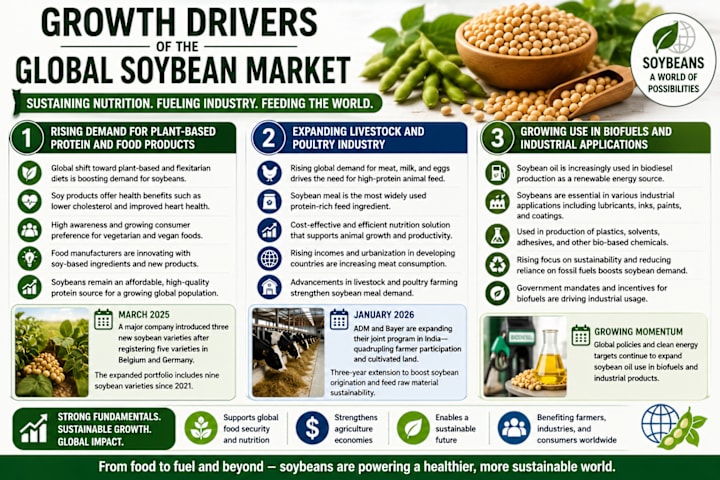
In March 2025, new soybean varieties were introduced in Belgium and Germany, including the first soybean variety in the 00 maturity group designed specifically for moderate climates in northern-central Europe. The development highlights ongoing innovation aimed at expanding soybean production and accessibility.
As plant-based eating becomes increasingly mainstream, soybean demand is expected to rise substantially.
The Livestock Industry Remains a Major Consumer
While plant-based foods often dominate headlines, animal feed continues to represent one of the largest soybean market segments globally.
Soybean meal, a byproduct generated during oil extraction, is one of the most important protein-rich feed ingredients used in poultry, cattle, swine, and aquaculture production.
Its high protein content, nutritional efficiency, and cost-effectiveness make it a preferred choice among livestock producers.
As populations grow and incomes rise, demand for meat, dairy products, eggs, and seafood continues increasing, particularly in developing economies.
This growth directly translates into higher demand for animal feed and, consequently, greater soybean consumption.
Rapid urbanization is further accelerating this trend by changing dietary habits and increasing consumption of animal protein products.
The livestock industry’s reliance on soybean meal ensures that soybeans remain a critical component of global food security.
A significant development occurred in January 2026 when ADM and Bayer announced a three-year extension of their sustainability-focused soybean program in India, aiming to quadruple farmer participation and cultivated land while strengthening long-term feed supply chains.
Biofuels Are Creating New Growth Opportunities
Another major driver of soybean market expansion is the increasing use of soybean oil in biofuel production.
Governments worldwide are pursuing aggressive policies designed to reduce carbon emissions and transition toward cleaner energy sources.
Biodiesel has emerged as an important component of these efforts because it offers a renewable alternative to traditional petroleum-based fuels.
Soybean oil remains one of the most widely used feedstocks in biodiesel manufacturing.
As countries implement renewable fuel mandates and encourage biofuel blending, demand for soybean oil continues rising.
The appeal of biodiesel extends beyond environmental considerations. It can often be integrated into existing fuel infrastructure, making it a practical option for reducing transportation-related emissions.
The growing importance of renewable diesel and sustainable aviation fuel is creating additional opportunities for soybean-based feedstocks.
In January 2026, Corteva announced the launch of Etlas, a joint venture focused on developing oilseed crops for the production of sustainable aviation fuel and renewable diesel. The initiative highlights increasing interest in bio-based fuel solutions.
As global decarbonization efforts accelerate, soybeans are expected to play an increasingly important role within the renewable energy sector.
Industrial Applications Are Expanding Rapidly
Beyond food and fuel, soybeans are finding new applications across various industrial sectors.
Manufacturers are increasingly utilizing soybean-derived materials to create environmentally friendly products such as biodegradable plastics, industrial lubricants, coatings, adhesives, and chemical alternatives.
The growing emphasis on sustainability and circular economy principles is encouraging industries to replace petroleum-based materials with renewable alternatives.
Soybean-based industrial products offer several advantages, including biodegradability, reduced environmental impact, and compatibility with sustainability objectives.
Researchers continue exploring new uses for soybean-derived compounds, expanding the crop’s commercial potential beyond traditional markets.
As industries seek innovative ways to reduce carbon footprints and improve environmental performance, soybean-based materials are becoming increasingly attractive.
Conventional Soybeans Continue to Dominate Production
Conventional soybeans remain the dominant segment within the global soybean market.
Their widespread adoption is largely driven by productivity, efficiency, and affordability.
Modern cultivation practices often utilize advanced fertilizers, crop protection products, and genetically enhanced seed varieties designed to improve yields and pest resistance.
These technologies enable farmers to maximize output while maintaining competitive production costs.
Conventional soybeans support large-scale food processing operations, animal feed production, and industrial manufacturing activities worldwide.
Although organic soybeans continue gaining popularity, conventional production remains the foundation of global soybean supply due to its ability to meet large-scale demand efficiently.
Organic Soybeans Gain Momentum
Consumer interest in natural and environmentally responsible foods has contributed to the growth of the organic soybean market.
Organic soybeans are cultivated without synthetic pesticides, chemical fertilizers, or genetically modified organisms.
They are widely used in premium food products such as organic tofu, soy milk, and plant-based protein products.
Demand is particularly strong in developed markets where consumers are willing to pay premium prices for products aligned with health and sustainability values.
Government support for organic agriculture and increasing awareness regarding environmentally friendly farming practices are further strengthening market prospects.
Although organic production often involves higher costs and lower yields, premium pricing helps maintain profitability and encourages continued expansion.
Food and Beverage Applications Drive Consumption
The food and beverage sector remains one of the most dynamic areas of soybean demand.
Consumers increasingly seek protein-rich, sustainable, and plant-based food options that support healthier lifestyles.
Soybeans serve as essential ingredients in numerous food products, including soy milk, tofu, protein powders, meat alternatives, snacks, beverages, and processed foods.
The growing prevalence of lactose intolerance has further increased demand for dairy alternatives based on soy.
Health-conscious consumers appreciate soy products because they provide high-quality protein while supporting dietary diversity.
As food manufacturers continue introducing innovative soybean-based products, the food and beverage segment is expected to remain a major growth engine.
The United States Leads Global Production
The United States remains one of the largest soybean producers and exporters worldwide.
Advanced agricultural infrastructure, strong research capabilities, favorable growing conditions, and extensive export networks have established the country as a global leader.
Domestic demand for soybean products remains strong across food, feed, and industrial applications.
Government support programs and investments in agricultural innovation continue enhancing competitiveness.
In August 2025, M.S. Technologies and Syngenta announced plans to develop a new herbicide-tolerant soybean trait stack, with commercialization expected later in the decade. The development demonstrates ongoing investment in improving soybean productivity and sustainability.
The United States is expected to maintain its leadership position as global demand continues growing.
India’s Soybean Industry Continues to Expand
India has emerged as one of the world’s most important soybean-producing countries.
The crop plays a critical role in supporting the country’s edible oil, animal feed, and food processing industries.
Growing awareness regarding protein-rich diets, expanding poultry production, and increasing demand for plant-based foods are driving market growth.
Government initiatives supporting agricultural development and oilseed cultivation are further encouraging expansion.
Despite challenges related to weather dependency and monsoon variability, India’s long-term soybean outlook remains positive.
In May 2023, FMC introduced advanced agricultural technologies and soybean-focused crop solutions in Madhya Pradesh, one of India’s largest soybean-producing regions.
Challenges Continue to Affect the Market
Despite strong growth prospects, the soybean industry faces several important challenges.
One of the most significant concerns is price volatility.
Soybean production remains heavily dependent on weather conditions, including rainfall patterns, temperature fluctuations, and soil quality. Droughts, floods, and climate-related disruptions can significantly impact yields and market stability.
Trade restrictions and geopolitical tensions also create uncertainty.
Because soybeans are among the most heavily traded agricultural commodities globally, changes in trade policies, tariffs, and international relations can influence prices and supply chains.
Businesses must continually adapt to evolving market conditions and geopolitical developments.
Addressing these challenges will be essential for ensuring long-term market stability and growth.
Final Thoughts
The soybean market sits at the intersection of some of the most important global trends shaping the future of food, agriculture, energy, and sustainability.
From feeding livestock and supporting plant-based diets to powering biofuels and creating environmentally friendly industrial materials, soybeans have become one of the most versatile agricultural resources available today.
With the global soybean market projected to grow from US$ 166.52 billion in 2025 to US$ 277.30 billion by 2034, opportunities for farmers, food manufacturers, energy producers, and industrial innovators continue expanding.
As consumers seek healthier diets, governments pursue sustainability goals, and industries search for renewable alternatives, soybeans are poised to remain a cornerstone of the global economy. What appears to be a simple bean is, in reality, one of the most powerful drivers of agricultural and industrial transformation in the modern world.