
When people think about global food production, they often picture vast fields stretching across fertile landscapes, producing the crops that eventually find their way onto dining tables around the world. Few places embody this image more clearly than Saskatchewan.
Often referred to as Canada’s “bread basket,” Saskatchewan has built a global reputation as one of the most productive agricultural regions on the planet. Its vast farmlands, favorable growing conditions, and highly efficient farming practices have made it a cornerstone of Canada’s agricultural economy and a critical supplier of grains to international markets.
Today, Saskatchewan’s grain industry is not only supporting local communities and national economic growth but also helping address one of the most important challenges facing humanity: feeding a growing global population.
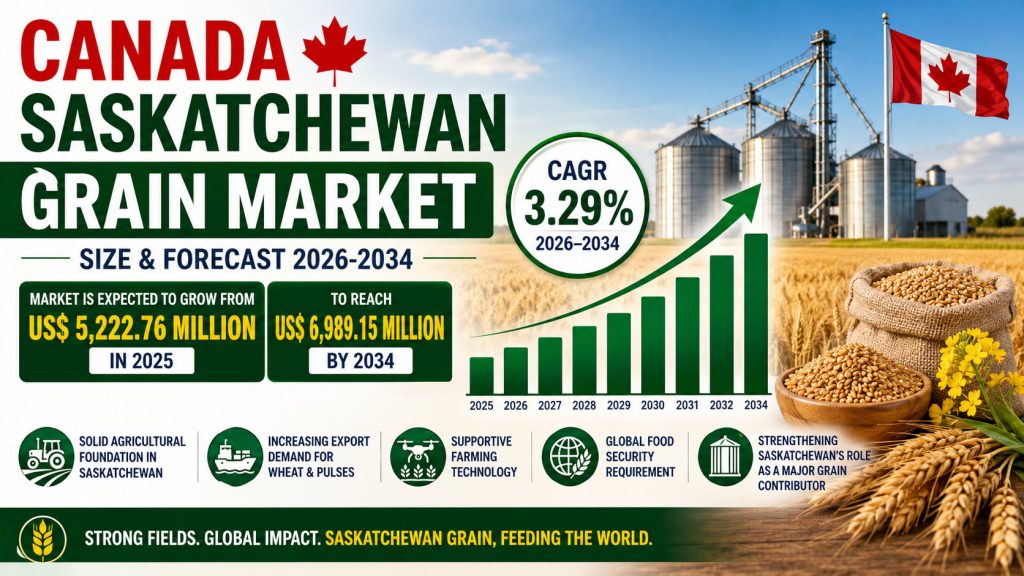
According to Renub Research, the Canada Saskatchewan Grain Market is expected to grow from US$ 5,222.76 million in 2025 to US$ 6,989.15 million by 2034, expanding at a compound annual growth rate (CAGR) of 3.29% between 2026 and 2034. The market’s growth is being supported by strong export demand, technological innovation in farming, infrastructure improvements, and increasing concerns about global food security.
As demand for high-quality grains continues to rise worldwide, Saskatchewan’s role in global agriculture is becoming more important than ever.
Why Grains Remain Essential to the Global Economy
Grains have served as the foundation of human civilization for thousands of years.
Today, they remain among the most important agricultural commodities in the world. Wheat, barley, oats, rye, corn, and pulse crops provide essential nutrition for billions of people while also supporting livestock production, industrial applications, and renewable energy initiatives.
Grains are valued because they are versatile, nutritious, relatively easy to store, and capable of supporting large-scale food systems.
Products derived from grains are found in countless everyday items, including bread, pasta, cereals, baked goods, snack foods, animal feed, and biofuels. As populations continue growing and dietary patterns evolve, demand for reliable grain supplies remains strong.
Saskatchewan has become one of the world’s leading contributors to this global food system.
Its ability to consistently produce large volumes of high-quality grains has established the province as a trusted supplier to markets across Asia, Europe, Africa, the Middle East, and North America.
Saskatchewan’s Agricultural Advantage
Saskatchewan possesses several natural and economic advantages that have helped make it a global agricultural powerhouse.
The province benefits from extensive farmland, fertile soils, favorable growing conditions, and a climate well suited to grain production. Large-scale farming operations, combined with decades of agricultural expertise, allow producers to achieve impressive productivity levels.
Agriculture plays a central role in Saskatchewan’s economy, supporting thousands of jobs and generating significant export revenues each year.
The province is particularly well known for wheat, durum wheat, barley, oats, canola, lentils, peas, chickpeas, mustard, flaxseed, and canary seed production. Many of these crops enjoy strong international demand due to their quality, consistency, and nutritional value.
As global markets increasingly prioritize food security and reliable supply chains, Saskatchewan’s agricultural strengths continue attracting attention from buyers worldwide.
Rising Global Demand Is Driving Growth
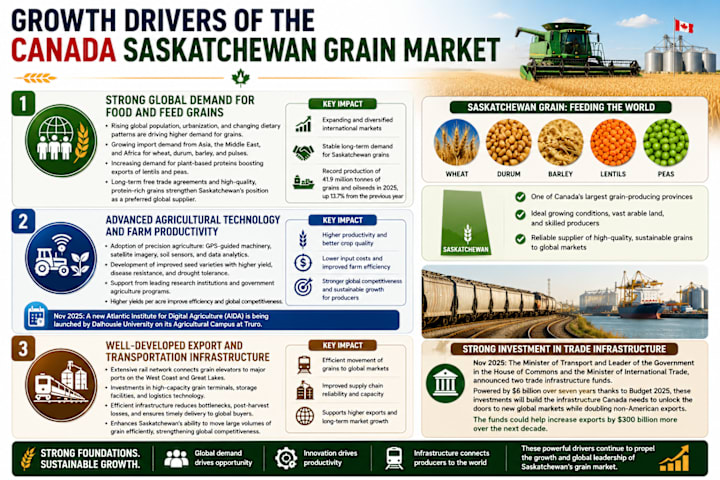
One of the strongest growth drivers for Saskatchewan’s grain market is expanding global demand.
The world’s population continues to increase, creating greater pressure on agricultural systems to provide sufficient food supplies. Urbanization, rising incomes, and changing dietary habits are also influencing consumption patterns across many regions.
Countries throughout Asia, Africa, and the Middle East continue increasing imports of wheat, barley, pulses, and other grains to support growing populations and food industries.
Demand for plant-based protein sources has become particularly important.
Lentils, peas, and other pulse crops produced in Saskatchewan are increasingly used in food manufacturing, meat alternatives, and health-focused products. Consumers around the world are seeking sustainable protein options, creating new opportunities for grain-producing regions.
Strong trade relationships and established export channels have allowed Saskatchewan producers to capitalize on these trends while maintaining access to diverse international markets.
As food demand continues rising globally, Saskatchewan is expected to remain a critical contributor to global food security.
Technology Is Revolutionizing Grain Production
Modern agriculture is increasingly driven by technology, and Saskatchewan’s farmers are among the industry’s most innovative adopters.
Advanced farming technologies have transformed how crops are planted, monitored, and harvested. Precision agriculture tools allow farmers to maximize yields while improving efficiency and sustainability.
GPS-guided machinery, satellite imaging, soil sensors, drones, and agricultural data analytics help producers make informed decisions regarding planting schedules, fertilizer application, irrigation management, and pest control.
These technologies enable more precise resource allocation, reducing waste while improving productivity.
Seed technology has also advanced significantly.
Researchers continue developing crop varieties with improved drought tolerance, disease resistance, and yield potential. These innovations help farmers maintain productivity even under challenging environmental conditions.
By embracing technological advancement, Saskatchewan producers are strengthening their competitiveness while improving their ability to meet growing global demand.
Export Infrastructure Supports Global Reach
Producing grain is only part of the equation.
Efficient transportation and export infrastructure are essential for connecting agricultural products with international markets. Saskatchewan benefits from a highly developed logistics network that supports large-scale grain exports.
Rail systems link farming communities to grain elevators, processing facilities, and major export terminals located along Canada’s West Coast and Great Lakes regions.
Modern grain handling facilities, storage infrastructure, and logistics technologies have improved supply chain efficiency while reducing post-harvest losses.
These investments allow producers to move large quantities of grain quickly and reliably, helping maintain Canada’s reputation as a dependable supplier.
Infrastructure modernization continues to play a critical role in supporting future growth. As global trade volumes increase, maintaining efficient transportation networks will remain essential for sustaining Saskatchewan’s competitive advantage.
Wheat Remains the Cornerstone of the Industry
Among all grain categories, wheat continues to occupy a central position within Saskatchewan’s agricultural economy.
The province is internationally recognized for producing high-quality spring wheat and durum wheat. These products are highly valued by food manufacturers because of their protein content, consistency, and processing characteristics.
Saskatchewan wheat is exported to numerous countries where it is used to produce bread, pasta, noodles, flour, and other staple foods.
The human food segment remains particularly important because consumers and manufacturers increasingly prioritize quality, traceability, and nutritional value. Saskatchewan’s grain grading systems and quality standards help ensure confidence among international buyers.
For farmers, wheat remains one of the most reliable and profitable crops, supporting long-term stability within the agricultural sector.
Specialty Crops Are Creating New Opportunities
While wheat dominates headlines, Saskatchewan’s grain industry is becoming increasingly diversified.
Canary seed represents one example of a specialized crop that has gained international attention. Historically used primarily as bird feed, canary seed has recently entered human food markets due to its nutritional benefits and unique characteristics.
Saskatchewan produces the majority of the world’s canary seed supply, giving local farmers a unique competitive advantage.
Similarly, pulse crops such as lentils, peas, and chickpeas have become increasingly important due to rising demand for plant-based proteins.
These crops provide valuable crop rotation options while opening new export opportunities in health-conscious consumer markets.
Specialty grains and pulses help reduce dependence on any single commodity while enhancing profitability and resilience across the agricultural sector.
Barley and Oats Continue Supporting Diverse Markets
Barley and oats also play significant roles within Saskatchewan’s grain economy.
Barley is widely used in livestock feed markets, supporting cattle, poultry, and swine production throughout Canada and internationally. Feed-grade barley provides a stable source of demand while ensuring efficient utilization of grain production.
Oats are increasingly finding applications beyond traditional food products.
Industrial uses of oats continue expanding into sectors such as health products, cosmetics, nutraceuticals, and bio-based materials. The presence of beneficial compounds such as beta-glucans has attracted growing interest from manufacturers seeking functional ingredients.
These diversified applications create additional value opportunities for producers while expanding market potential.
Climate Challenges Require Ongoing Adaptation
Despite its strengths, Saskatchewan’s grain industry faces important challenges.
Climate variability remains one of the most significant risks affecting agricultural production. Droughts, excessive rainfall, heatwaves, early frosts, and other weather-related events can significantly impact crop yields and quality.
Unpredictable weather conditions create uncertainty for producers and may increase operational costs.
While advancements in seed technology, crop insurance programs, and precision agriculture help mitigate some risks, climate-related disruptions remain a reality that farmers must continuously manage.
Long-term adaptation strategies will be essential for maintaining productivity and competitiveness in an increasingly unpredictable climate environment.
Transportation and Market Volatility Present Additional Risks
The grain industry is also exposed to transportation challenges and market fluctuations.
During peak harvest periods, rail capacity limitations and labor shortages can create logistical bottlenecks that delay shipments and increase costs.
Global grain prices are influenced by numerous factors, including geopolitical developments, trade policies, currency movements, and international supply conditions. These variables can create significant volatility in agricultural markets.
For producers, managing these uncertainties requires careful planning, diversification, and risk management strategies.
Continued investment in infrastructure and supply chain resilience will be critical for addressing these challenges over the long term.
Regional Demand Strengthens Market Stability
Saskatchewan’s grain production supports markets throughout Canada.
Ontario relies heavily on Saskatchewan grain to supply flour mills, cereal manufacturers, bakeries, and livestock feed operations. The province’s large population and food processing sector create consistent demand for high-quality agricultural products.
Quebec values Saskatchewan grain for its quality and reliability, particularly in baking and food processing applications. High-protein wheat from Saskatchewan is widely used in bread production.
Alberta maintains close agricultural ties with Saskatchewan due to their shared Prairie geography. Grain flows between the provinces help support livestock production, food processing, and regional agricultural stability.
These domestic markets complement international exports and contribute to overall industry resilience.
Looking Toward the Future
The future of Saskatchewan’s grain industry appears promising.
Growing global populations, increasing food security concerns, expanding demand for plant-based proteins, and ongoing technological innovation are expected to support long-term growth.
Agricultural producers will continue investing in precision farming, advanced seed genetics, digital technologies, and sustainable production practices to improve efficiency and resilience.
At the same time, infrastructure improvements and evolving trade relationships will help ensure Saskatchewan remains connected to global markets.
As agriculture becomes increasingly important in addressing global challenges, Saskatchewan’s role as a major grain-producing region is likely to become even more significant.
Final Thoughts
Saskatchewan’s grain market stands as one of the most important pillars of Canada’s agricultural economy. Its combination of productive farmland, technological innovation, export strength, and global market access has positioned the province as a leader in grain production and international food supply.
With the market projected to grow from US$ 5,222.76 million in 2025 to US$ 6,989.15 million by 2034, opportunities for farmers, exporters, processors, and investors remain substantial.
As the world faces increasing pressure to feed growing populations while maintaining sustainable agricultural practices, Saskatchewan’s grain industry will continue playing a vital role. Through innovation, resilience, and global connectivity, the province is helping shape the future of food production both in Canada and around the world.