
Research that aims to shift an industry is rare. Research focused on an overlooked step in food production – and supported by major federal funding – is even rarer.
A guided ultrasound project, backed by New Mexico State University’s Center of Excellence in Sustainable Foods and Agricultural Systems and led by Sergio Martinez-Monteagudo, explores ways to improve energy efficiency in food processing. It focuses on evaporation, one of the most energy-intensive and least visible steps in food manufacturing.
“In 2021, I received a seed grant from CESFAS to do research on evaporation of food products,” said Martinez-Monteagudo, an associate professor of food bioprocessing in the Department of Family and Consumer Sciences. “Evaporation is energy-intensive and used in products like protein powders. It’s a middle step that usually doesn’t get attention.”
With sustainability in mind, Martinez-Monteagudo proposed making the process more efficient by using a technology he said has never been applied in food processing. Through the $20,000 CESFAS seed grant, he partnered with another researcher, Ehsan Niri, to explore how guided acoustic energy could accelerate evaporation while reducing energy use. Niri, a civil engineer, is an associate professor in the School of Manufacturing Systems and Networks at Arizona State University.
“Our preliminary data show that it can reduce at least 30% of energy,” Martinez-Monteagudo said.
Following that success, Martinez-Monteagudo received a $750,000 grant from the U.S. Department of Agriculture in 2025. The project now involves researchers from NMSU and ASU, who are combining their expertise in food science and civil engineering.
“The idea of the research is applying acoustic energy to evaporate a lot faster,” Martinez-Monteagudo said. “Guided ultrasound is usually used in medical fields to see things like bone fractures or pregnancies. In this case, it’s very different. We’re not using it to get images but to create a way the acoustic wave can travel through a specific metal. That energy is lost and accelerates water evaporation, reducing overall energy use.”
The project, while still in its early phases, represents interdisciplinary work at its most cutting edge, Martinez-Monteagudo said.
“We’re used to specializing in our own field. But if we’re open to seeing what other fields are doing, we can learn,” he said. “This project has been my favorite so far because it brings together food science and civil engineering – two fields people don’t usually think have much to do with each other.”
Federal funding also accelerated industry interest in Martinez-Monteagudo’s research.
“Since receiving the funding, we are working on developing the project and seeing how it can be implemented in other fields,” he said. “This technology has never been applied in food processing. I’ve worked in food processing all my life, but this is completely different from anything done before.”
For Martinez-Monteagudo, one of the most meaningful aspects of the work is where it is happening.
“The concept that this research is being done here at NMSU and not anywhere else is one of my points of pride for this project,” he said.
The guided ultrasound project represents a career-defining milestone that builds on Martinez-Monteagudo’s growing research portfolio. Since joining NMSU in 2020, he has become known for his research in ice cream quality and formulation and reducing waste in ice cream production. His projects have received funding from more than a dozen companies, including Blue Bell Creameries and Blue Bunny Ice Cream.
A version of this story appears in the spring 2026 issue of ACES Magazine. For more stories, https://nmsu.news/ACES-Magazine-Spring-2026.
-30-
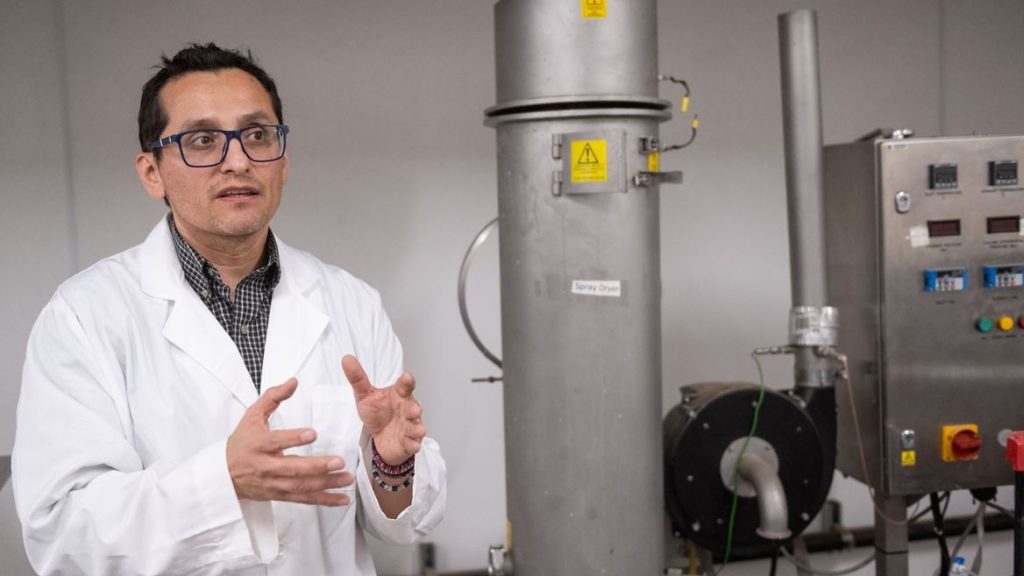
Cutline: New Mexico State University’s Sergio Martinez-Monteagudo is leading a guided ultrasound project that aims to improve energy efficiency in food processing through evaporation, one of the most energy-intensive and least visible steps in food manufacturing. (NMSU photo by Josh Bachman)
Cutline: New Mexico State University’s Sergio Martinez-Monteagudo received a $750,000 grant from the U.S. Department of Agriculture in 2025 to further his project, which involves researchers from NMSU and Arizona State University. (NMSU photo by Josh Bachman)