
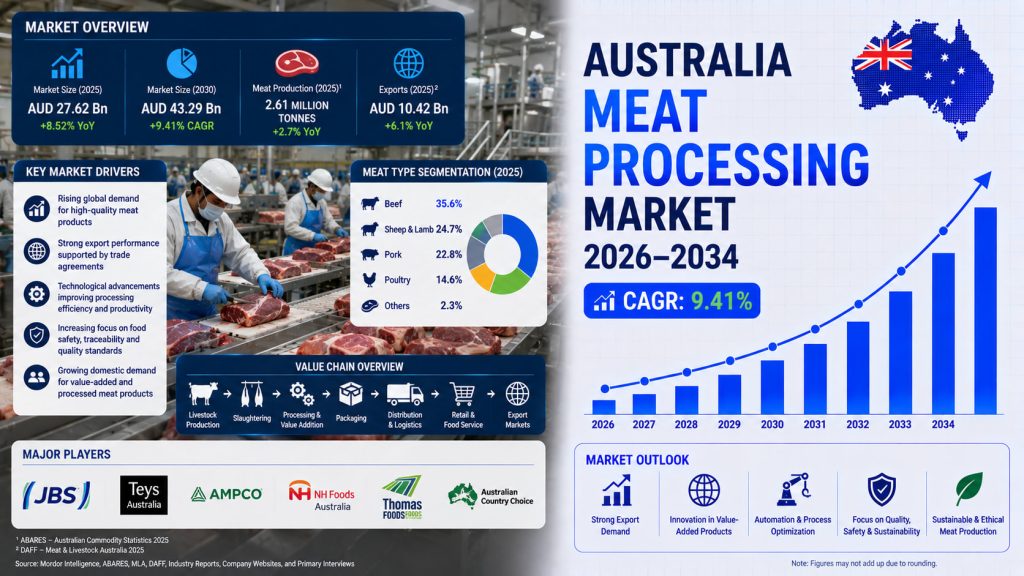
Australia Meat Processing Market Overview
The Australia meat processing market is a vital segment of the country’s food manufacturing and agribusiness industry, involving the slaughtering, processing, packaging, preservation, and distribution of meat products including beef, pork, lamb, poultry, and processed meat products.
According to IMARC Group, The Australia meat processing market size was valued at USD 500.18 Million in 2025 and is projected to reach USD 1,269.41 Million by 2034, growing at a compound annual growth rate of 9.41% from 2026-2034.
The market is experiencing steady growth driven by strong global demand for Australian meat exports, increasing adoption of automated processing technologies, rising consumption of value-added meat products, and growing focus on food safety and sustainability.
Key Market Drivers
Strong Export Demand for Australian Meat
Australia remains one of the world’s leading meat exporters, with growing international demand for premium-quality beef, lamb, and processed meat products across Asia-Pacific, North America, and the Middle East.
Rising Adoption of Automated Processing Technologies
Meat processing companies are increasingly investing in robotics, AI-powered quality control systems, and automated cutting and packaging solutions to improve efficiency and productivity.
Increasing Demand for Processed and Convenience Foods
Busy consumer lifestyles and changing dietary preferences are driving demand for ready-to-cook, packaged, and processed meat products.
Focus on Food Safety and Traceability
Stringent food safety regulations and consumer demand for transparency are encouraging companies to implement advanced traceability and quality assurance systems.
Expansion of Cold Chain and Logistics Infrastructure
Improved refrigerated transportation and storage facilities are supporting efficient meat distribution across domestic and export markets.
Request a Sample Report with the Latest 2026 Data & Forecasts
What the Opportunities Are
Growth of Premium and Organic Meat Products
Consumer preference for organic, grass-fed, hormone-free, and ethically sourced meat products is creating new market opportunities.
Expansion of Sustainable Meat Processing Practices
Companies are increasingly adopting energy-efficient processing technologies, water conservation systems, and waste reduction initiatives to improve sustainability.
Rising Demand for Halal and Export-Certified Meat
Growing international demand for halal-certified meat products is expanding export opportunities for Australian meat processors.
Integration of Smart Manufacturing Technologies
Industry 4.0 technologies including IoT sensors, predictive maintenance, and AI-driven production monitoring are improving operational performance.
Development of Alternative Protein and Hybrid Meat Products
Some meat processors are exploring plant-based and blended protein products to diversify product portfolios and address changing consumer preferences.
Recent News and Developments
May 2026: Australia’s meat processing sector accelerated automation adoption as processors expanded investment in robotic cutting, deboning, and packaging systems to address labor shortages and improve export-grade production efficiency. Automatic processing systems accounted for approximately 58.5% of industry operations in 2025.
April 2026: Australia’s red meat exporters raised concerns over the new Australia–EU trade agreement after annual beef export quotas were limited to approximately 10,200 tonnes, significantly below New Zealand’s 50,000-tonne allocation. Industry groups warned the agreement could constrain future export growth opportunities for Australian meat processors.
March 2026: The Australian government continued strengthening agricultural and food export systems through national agriculture and biosecurity programs supporting meat production, export traceability, and supply-chain resilience across the livestock industry.
December 2025: Thomas Foods International reported record annual revenue of approximately AUD 4.1 billion for FY2025, representing a 23% year-on-year increase driven by rising global demand for Australian beef. The company also expanded beef processing capacity at its Murray Bridge facility from 700 to 800 cattle per day.
December 2025: Australia’s grain-fed beef industry expanded rapidly as cattle numbers in feedlots reached a record 1.6 million head by mid-2025. Industry forecasts projected feedlot capacity could increase to around 2 million cattle by 2027 to support growing international demand for premium beef exports.
December 2025: Australian beef exports reached approximately 1.39 million tonnes during the first eleven months of 2025, surpassing total 2024 export volumes. Exports to the United States alone generated approximately AUD 1.6 billion within three months, strengthening processing activity nationwide.
November 2025: AAM Investment Group explored strategic expansion options for its Southern Cross Poultry Fund, which includes 11 poultry farms and 90 poultry sheds. Industry reports showed chicken accounted for approximately 50% of Australia’s animal protein market, with annual production valued at around AUD 4.2 billion.
October 2025: AMPC reported that independent reviews of approximately 60 meat industry research projects funded between 2020 and 2025 demonstrated an average return of around AUD 6.20 in benefits for every AUD 1 invested, supporting innovation in meat processing, energy efficiency, automation, and waste reduction technologies.
September 2025: Meat & Livestock Australia continued implementing its 2025–26 Annual Investment Plan funded jointly by industry levies and the Australian Government to support research, sustainability, export competitiveness, food safety, and advanced meat processing technologies.
December 2025: The Australian Bureau of Statistics reported that cattle slaughter increased by 1.2% to approximately 2.4 million head during the December quarter of 2025, while beef production rose 0.5% to around 727,921 tonnes. Lamb meat production also increased by 11.9% to approximately 146,968 tonnes.
Why You Should Know About the Australia Meat Processing Market?
The Australia meat processing market is a critical contributor to the country’s agricultural exports, food manufacturing sector, and rural economy.
With projected growth from USD 19.7 Billion in 2025 to USD 28.6 Billion by 2034, the market demonstrates stable expansion supported by export demand, automation technologies, and increasing consumption of processed meat products.
As the industry continues adopting advanced processing technologies and sustainable production practices, meat processing is expected to remain a key pillar of Australia’s food and agribusiness ecosystem.